Staff writers
Updated ,first published
Threats from US President Donald Trump to strike power plants in Iran prompted a sharp plunge in Australian shares on Monday before the market recovered, ending trade slightly lower after oil prices barely moved following Iran’s vow to retaliate.
Since the start of March, the S&P/ASX 200 has lost more than $300 billion. The index momentarily slipped below $3 trillion on Monday for the first time since May, edging toward a technical correction – a 10 per cent fall from its previous peak – before clawing back some gains to close down 62.5 points, or 0.74 per cent lower, at 8365.9.
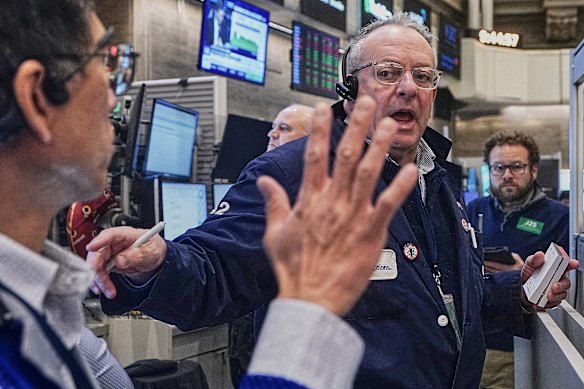
The global sell-off in stocks, gold and bonds has deepened as the US and Iran harden their rhetoric and signal a potential escalation to their conflict, which is entering its fourth week.
Trump issued a 48-hour ultimatum to Tehran on Sunday to reopen the Strait of Hormuz — crucial for the flow of oil and gas from the Middle East — failing which the US will “obliterate” Iran’s power plants. The Islamic Republic responded that any such attack would prompt it to shut the waterway indefinitely and target US and Israeli energy infrastructure across the region.
Bonds sold off as the prolonged war threatened to stoke inflation, slow growth and push central banks to consider interest-rate hikes. Futures contracts indicated losses would extend to Europe and the US. Gold slid for a ninth day to around $US4360 an ounce, underscoring the broad-based retreat across assets.
While the reaction in stocks was more pronounced, the response to the latest escalation in rhetoric was more muted in oil markets. Brent was initially volatile before edging down marginally to trade around $111.86 a barrel. Both Brent, the international standard, and US oil WTI have surged more than 70 per cent this year.
The Australian dollar traded lower, around US69.63¢, after the local market closed.
“Markets are definitely getting more nervous about what’s happening in the Middle East right now,” Martin Schulz, the head of the international equity group at Federated Hermes, said. “Our view is it is time for caution, not panic. Duration is the main issue. The longer this drags out, obviously the worse it gets.”
On the ASX, six out of 11 sectors were lower, with miners showing the biggest weakness.
Iron ore heavyweight BHP slid 0.76 per cent, Rio Tinto was down 1.71 per cent and smaller rival Fortescue fell 0.47 per cent. The selloff was worse for gold miners. Northern Star ended the day 6.97 per cent lower and Evolution Mining plunged 7.33 per cent.
Financial stocks also fell, just not quite as hard. Market behemoth the Commonwealth Bank closed down 0.79 per cent, National Australia Bank lost 1.82 per cent, Westpac fell 0.86 per cent and ANZ Bank eased by 0.9 per cent.
Energy stocks made gains supported by surging oil and gas prices. Woodside Energy rose 2.2 per cent, Santos gained 0.88 per cent, Yancoal jumped 3.85 per cent and Ampol climbed 1 per cent.
Tech stocks retreated. The sector’s only bright spot was TechnologyOne which rose 3.36 per cent, but among other stocks WiseTech slumped 5.02 per cent, Xero was down 0.45 per cent and NEXTDC shed 3.03 per cent.
“Pulling back on this war is not Trump’s sole decision,” Matt Maley, chief market strategist at Miller Tabak, said in an interview. “Uncertainty has been increasing for three weeks, and the uncertainty took a big jump now. Even if people don’t sell, they are not going to be buying – and if there’s no bids, it creates a vacuum.”
In the US, the S&P 500 fell 1.5 per cent to close its fourth straight losing week on Friday, its longest such streak in a year. The Dow Jones fell 443 points, or 1 per cent, and the Nasdaq composite tumbled 2 per cent as oil prices strengthened.
Stocks bent under the weight of leaping yields in the bond market. Treasury yields have been jumping on worries that the war with Iran will cause a long-term spike in oil and natural gas prices that drives up inflation.
Worries have got so high that traders have cancelled nearly all their bets that the Federal Reserve could cut interest rates this year, according to data from CME Group. Some even think the Fed could raise rates in 2026, a nearly unthinkable scenario before the war began.
“I think it would be market shaking,” Ann Miletti, head of equity investments at Allspring Global Investments, said about a rate hike. But she also said that if oil prices stay high for a long time, they would probably drag so much on the economy that the Fed would not raise rates.
Lower interest rates would give the economy and investment prices a boost, and they’re something Trump has angrily been calling for. Before the war, traders were betting heavily that the Fed would cut rates at least twice this year.
But lower rates risk worsening inflation. And investors now see little room for central banks worldwide to cut interest rates to help their economies. Besides the Federal Reserve, central banks in Europe, Japan and Britain also held their interest rates steady this past week.
With Bloomberg, AP
The Market Recap newsletter is a wrap of the day’s trading. Get it each weekday afternoon.
From our partners
Disclaimer : This story is auto aggregated by a computer programme and has not been created or edited by DOWNTHENEWS. Publisher: www.smh.com.au