
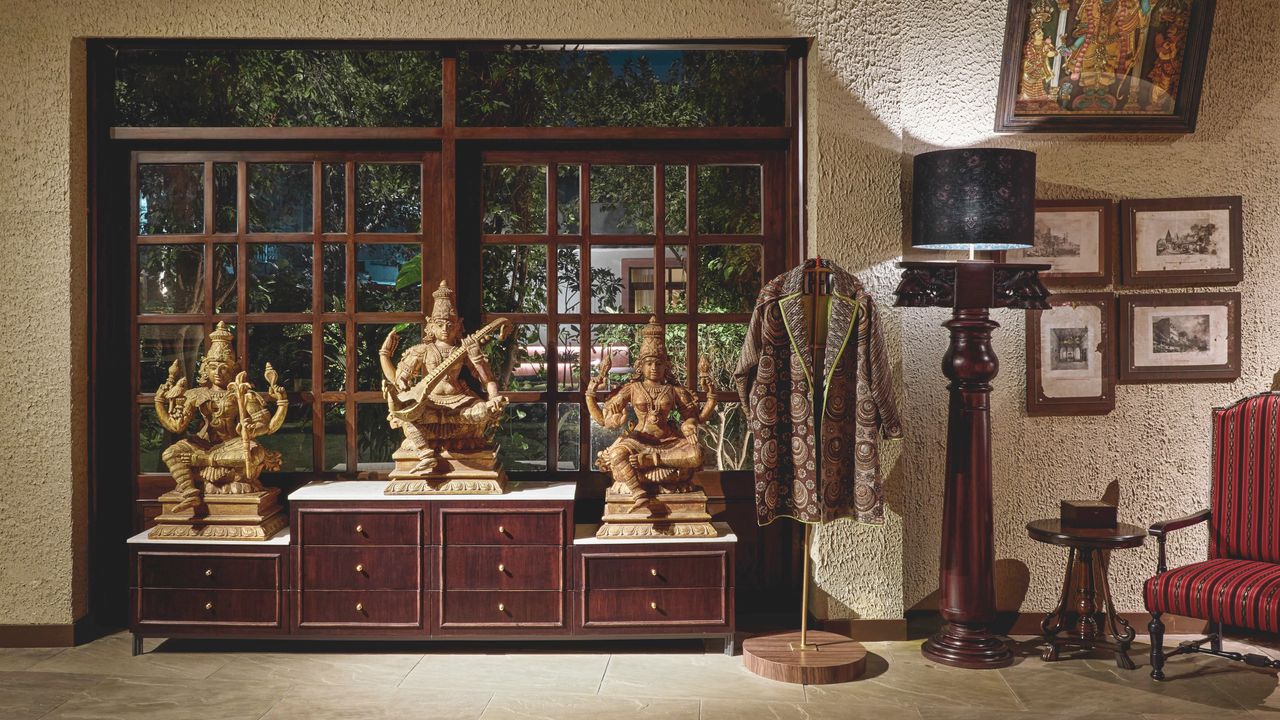
At the Sabyasachi store in Mumbai, an interesting statistic comes up in conversation with a sales associate. She mentions that on any given day, between 10 and 15 people walk in with no explicit intention of making a purchase. Many are international tourists, keen to see what’s been recommended to them as one of the most exquisite retail spaces in all of India. And for good reason. The store (and its many addresses across the country and in New York) offers an encounter with Indian maximalism where time feels suspended. Its curation of collectibles—heirloom furniture, treasured curios, antique rugs and the like—exists in a profusion that has to be seen first-hand to be truly understood. Naturally, then, visitors are sometimes confused to learn the artefacts aren’t for sale.
A few lanes away, Gaurav Gupta’s three-storey flagship is an immediate visual foil: an all-white world of minimalist futurism. Architect Vishal K Dar created a space for the brand that is undulating and otherworldly—like a white-cube gallery in which the garments are presented as wearable art. Further south, Sanjay Garg’s Raw Mango store, designed by interior architect Ashiesh Shah and designer Isla Maria ‘Loulou’ Van Damme, is meditative, measured and almost anti-spectacle in its approach to Indian craft traditions. The layout, material palette and aesthetic elements draw from the tropical modernist philosophies of architects like Geoffrey Bawa and Charles Correa, culminating in a space of true repose: an 800-square-foot courtyard. In addition to the one-kilometre radius they inhabit, the retail spaces of Sabyasachi, Gaurav Gupta and Raw Mango share a strong common denominator: they each function as compelling, tangible extensions of their brands’ sartorial identities.
Within South Mumbai’s Indo-Saracenic and neogothic streetscape, these fashion stores exist as micro-universes of craft. They’re evolving into a new version of the third space, where communities are formed, cross-collaboration is encouraged and creative programming feels entirely natural. Raw Mango’s famous baithaks come to mind, the most recent edition of which was hosted at the label’s Banjara Hills store last November.
For designers who see themselves as being creators before entrepreneurs, the store is where their vision can be realised in full. At Delhi Vintage Co, the worldbuilding takes on an almost mythological nature. Their new 10,000-square-foot store in the capital, designed by Smita Singh of NoDoor, draws from the phases of a lunar eclipse interpreted as a series of archways. Founder Manish Chhabra’s soulful private collection of Indian art is displayed throughout the store, though one of his most significant pieces was a bespoke commission: a sculpture of a devi, seemingly suspended in motion at the very edge of a table and secured in position by threads, produced by Neil Ghose Balser and Doyel Joshi of How Are You Feeling Studio. “We worked very closely on every element—from artefacts to textures to spatial flow,” says Chhabra. “Even the fragrance in the store is custom-curated, because I wanted the experience to go beyond the visual. ”
Disclaimer : This story is auto aggregated by a computer programme and has not been created or edited by DOWNTHENEWS. Publisher: vogue.in



