

Donald Trump’s Monday morning backdown – before markets opened in New York – was easy to foresee. In an all-caps message, the president announced the US and Iran had engaged in detailed and constructive talks over the weekend, and he would not proceed with his threats to attack Iranian energy facilities.
The talks, Trump said, would continue throughout the week, aimed at “a complete and total resolution of our hostilities in the Middle East”.
Investors loved it; Brent crude oil dropped 13 per cent at the open, and the Dow Jones was up more than 700 points at lunchtime.
But what was it based on? The Iranians quickly denied that any negotiations had taken place. The country’s new supreme leader, Motjaba Khamenei, is still missing – possibly dead. Who was Trump talking to, and what standing, if any, did they have?
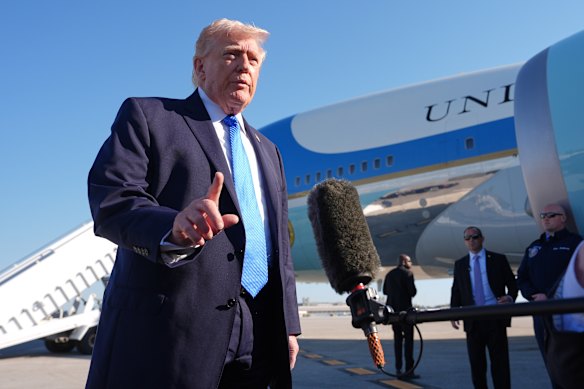
Later, addressing reporters before boarding Air Force One, the president gave a little more detail. He said the US was negotiating with “some people that I find to be very reasonable, very solid”.
People within Iran “know who they are”, Trump said. “They’re very respected. And maybe one of them will be exactly what we’re looking for.”
He went on to claim that these people had not only agreed that Iran could never have nuclear weapons, but that they would no longer seek to enrich uranium at all – not even for civilian and medical purposes. There were as many as 15 points of agreement already, Trump said.
As for reopening the Strait of Hormuz, Trump said it would happen soon, and the waterway would be “jointly controlled”. By whom? “Maybe me. Me and the ayatollah, whoever the next ayatollah [is].”
If it all seems too good to be true, it probably is.
It was reported by The Jerusalem Post, Axios and others that the “top person” the US is negotiating with is the Speaker of Iran’s parliament, Mohammad Bagher Ghalibaf. His denial was swift and emphatic.
“No negotiations with America have taken place,” Ghalibaf said on X. “Fake news is intended to manipulate financial and oil markets and to escape the quagmire in which America and Israel are trapped.
“Our people demand the complete and humiliating punishment of the aggressors. All officials stand firmly behind their Leader and people until this goal is achieved.”
Propaganda and lies from the Islamist regime in Tehran are familiar and can be dismissed with ease. After all, the “leader” whom officials apparently stand firmly behind has yet to provide proof-of-life since taking the job.
But it’s difficult to fully trust Trump’s pronouncements, either. It’s the word of a rudderless and ruined regime against an erratic US president who is highly attuned to the impact his words can have on global markets. “The price of oil will drop like a rock as soon as a deal is done,” Trump said on Monday (US time). “I guess it already has today.”
Ultimately, though, we should believe that there is some sort of dialogue under way between the Americans and the Iranians. British Prime Minister Keir Starmer has confirmed he was aware that talks were happening. And, with hindsight, Trump’s Saturday night threat to annihilate Iran’s power plants looks more like a typical Trumpian leverage tool amid talks that had already been initiated.
What does this tell us? Faced with a choice between a significant escalation (on a self-imposed deadline) or an off-ramp, Trump opted for the latter. He may yet be forced into changing tack again. But in walking back from the ledge, he has bought time to see what might be possible diplomatically and shore up support from allies.
“Trump blinked first – out of a clear understanding that striking Iran’s energy infrastructure would trigger a direct and significant retaliation,” says Danny Citrinowicz, an Iran expert at the Israeli Institute for National Security Studies, and a non-resident fellow at the Atlantic Council.
In a lengthy analysis posted on X, Citrinowicz pointed out that little of substance has actually changed, except Trump’s recognition of the limits of force.
“He issued an ultimatum and threatened action, but ultimately stepped back without securing anything from Iran. Messages may have been exchanged, but there’s little evidence of real Iranian flexibility.”
Citrinowicz added that if talks do happen, Iran will enter them from a stronger position, having increased its leverage by shuttering the Strait, and with Trump running low on palatable military options.
“We may see a familiar pattern: a framework deal that allows Trump to claim progress, while leaving Israel and Gulf states facing a more resilient Iran, economically strained but strategically emboldened, ideologically hardened, and determined to rebuild its capabilities.”
Get a note directly from our foreign correspondents on what’s making headlines around the world. Sign up for our weekly What in the World newsletter.
 Michael Koziol is the North America correspondent for The Age and Sydney Morning Herald. He is a former Sydney editor, Sun-Herald deputy editor and a federal political reporter in Canberra.Connect via X or email.
From our partners
Disclaimer : This story is auto aggregated by a computer programme and has not been created or edited by DOWNTHENEWS. Publisher: www.smh.com.au


