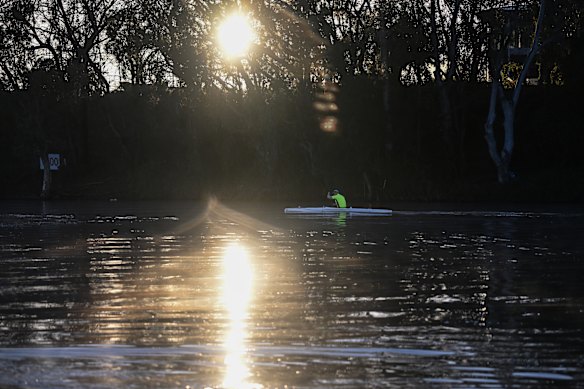

Plans to reroute and dredge Rockhampton’s Fitzroy River for the Brisbane Olympic and Paralympic would require ongoing major expense that would extend well beyond 2032 to maintain it as an elite competition venue, according to a high-level expert in river flows.
News Corp reported on Tuesday that the Games Independent Infrastructure and Co-ordination Authority’s feasibility study into the proposed course found the river would need to be widened and dredged to provide a fair course in 2032.
While achievable, the plans would require a section of the Fitzroy River to be widened, upstream from the Rockhampton CBD, to accommodate the 2120-metre-long and 110-metre-wide course.
Professor David Hamilton, the director of Griffith University’s Australian Rivers Institute, said the $400 million reported by News Corp cost seemed “a bit conservative” to him.
Any dredging would need to be as close as possible to the start of the 2032 Games to be effective, Hamilton said, and to maintain the course as a legacy elite venue for Rockhampton, it would likely need to be dredged about once a year in perpetuity.
In competition rowing, uneven riverbeds create physical inconsistencies in water displacement and resistance that can unfairly advantage one lane over another.
“The Fitzroy carries an enormous amount of sediment, and that sediment gets relocated year-on-year, particularly in floods – it gets scoured, it gets deposited, redeposited, and so on,” Hamilton said.
“There’s no guarantee that dredging operation – even if it took place very quickly and immediately before the Olympics – would look the same, in terms of the riverbed, as what might occur soon afterwards, particularly if there was a major flood.
“So what you’re faced with is an ongoing operation.”
Hamilton said straitening a stretch would be a “risky business” and have implications on the river’s flow downstream, towards central Rockhampton.
“Rivers have meanders for good reason – that’s what naturally occurs – and those meanders are part of the natural river process,” he said.
“The straightening means that the velocities in the river aren’t slowed to the same extent, even if it is relatively even due to dredging.
“I’d imagine that there’s going to be an enormous effort to control the sediment – that’s not easy in a river system when you’re dredging the bed, when you’re taking out the edges of the river.
“The consequence may be that you could end up with a lot more sediment downstream – it’s not trivial, not trivial at all.”
Comment has been sought from Deputy Premier Jarrod Bleijie, who has been at the vanguard of the Crisafulli government’s push to host rowing in Rockhampton.
Earlier on Tuesday, Transport Minister Brent Mickelberg said the government was determined to go ahead with the plan.
“We remain 100 per cent committed to ensuring that rowing is in Rockhampton in 2032,” he said.
Hamilton said he expected Commonwealth involvement, but a spokesman for Environment Minister Murray Watt said it was unlikely the plan would need federal environmental approval.
The City of Moreton Bay has proposed a permanent flatwater facility at a decommissioned Boral quarry at Lawnton, which would allow racing on still water.
Queensland rowers have backed Moreton Bay’s plans, which Mayor Peter Flannery has said would cost taxpayers $150 million.
Start the day with a summary of the day’s most important and interesting stories, analysis and insights. Sign up for our Morning Edition newsletter.
From our partners
Disclaimer : This story is auto aggregated by a computer programme and has not been created or edited by DOWNTHENEWS. Publisher: www.smh.com.au