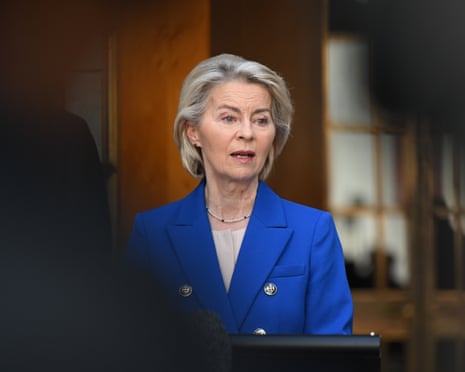
European Commission president Ursula von der Leyen has said it is time for negotiations with Iran to take place to end the war in the Middle East.
Speaking in Australia at the conclusion of a new free-trade agreement between the EU and Australia, she said:
The situation is critical for the energy supply allies worldwide.
We all feel the knock-on effects on gas and oil prices, our businesses and our societies, but it is of utmost importance that we come to a solution that is negotiated, and this puts an end to the hostilities that we see in the Middle East.
Asked what role European nations will have in the strait of Hormuz, including after it opens, von der Leyen said EU leaders had said they could engage in an operation once hostilities end.
So the leaders in the European Union have been very clear that at the when the hostilities end, they could envisage an operation, a mission. But of course, it is not for me to judge on their decision to provide the necessary capabilities in the strait of Hormuz.
This blog is closing now but our live coverage of the US-Israel war on Iran continues in a new blog here, including a recap of the latest developments. Thanks for following along.
The US-Israeli attacks on Iran continue to spook global markets and force countries into adopting new energy saving measures.
The South Korean president, Lee Jae Myung, on Tuesday called for a nationwide energy-saving campaign over risks to oil and gas supplies from the war, saying public institutions would cut back on their use of passenger cars.
The energy minister, Kim Sung-whan, told a cabinet meeting that private-sector vehicle curbs were voluntary for now, but could be reviewed if the energy alert level increased.
The government would ask the top 50 oil-consuming businesses to cut use, and encourage staggered commuting hours and other conservation steps, he said.
Kim also said Seoul would restart five nuclear reactors by May, ease restrictions on coal plants and expand renewable energy to reduce longer-term dependence on LNG.
Iran state media is reportedly saying a “new wave of missiles” has been fired at Israel.
We’ll bring you more on this soon.
In Australia, the number of petrol stations running out of fuel continues to climb as the Middle East war drags on, with at least 184 dry across the country’s three most populous states.
On Tuesday, 51 service stations in the state of New South Wales were out of fuel and 164 out of diesel, compared with 38 and 131 respectively the previous day, premier Chris Minns said.
In the state of Victoria, 101 service stations were out of petrol and 83 were without diesel, with the state’s energy minister saying demand had increased as much as 400% in some areas, Australian Associated Press reports.
In Queensland, 32 stations were out of regular unleaded and 47 stations had no diesel.
The rising shortages come as the Australian government’s fuel supply taskforce is to meet for the first time on Tuesday.
Asian stocks rallied, oil prices bounced back and the US dollar wobbled on Tuesday after Donald Trump postponed the bombing of Iran’s power grid, allaying fear of a deeper energy shock.
Reuters reports that markets went on a rollercoaster ride at the start of this week after Trump added five days to his Saturday ultimatum for Iran to reopen the strait of Hormuz within 48 hours, citing productive talks with unidentified Iranian officials, which Tehran has denied.
“It’s a negotiating tactic … I don’t think that the US administration wants to see oil at $150 because they themselves provoked it,” said Rajeev De Mello, chief investment officer at GAMA Asset Management.
Traders were quick to react to the reversal on Monday, sending crude futures tumbling and shares surging, while the dollar and government bond yields fell.
Most of the movement carried over to the Asian trading session on Tuesday, with MSCI’s broadest index of Asia-Pacific shares outside Japan rising 1.3%, while shares in Australia were up 0.7%.
Japan’s Nikkei advanced more than 2%, reversing most of Monday’s 3.5% decline.
Oil prices, meanwhile, edged higher on Tuesday after sliding 10% in the previous session. Brent crude futures were up 1% at $100.94 a barrel, while US crude rose 1.9% to $89.84.
Still, movement was highly volatile. “Markets are not out of the woods,” said Chris Weston, head of research at Pepperstone.
Price action could remain choppy into Friday’s revised deadline … The key question is whether participants see this as a genuine extension that brings a deal closer, or simply a delay that prolongs uncertainty.
Japan plans to begin releasing oil from joint stockpiles held by producing nations in the country by the end of March, prime minister Sanae Takaichi has said.
Japan started releasing 15 days’ worth of private-sector oil inventories last week, Reuters reports, and Takaichi said in post on X on Tuesday that the country would tap a month’s worth of crude from the state reserves from Thursday.
The moves come in response to the blocking of oil and natural gas shipments from the Middle East amid the war on Iran.
Japan’s contribution to a record oil stockpile release coordinated by the International Energy Agency will total nearly 80m barrels, mainly of crude oil, according to the agency.
In addition, about 13m barrels – or a total of seven days of consumption – are jointly held in Japan by Saudi Arabia, the United Arab Emirates and Kuwait, and Tokyo has priority access to that supply in case of emergencies.
Takaichi said in the post:
We began releasing privately held reserves on March 16, and will begin releasing national reserves from the 26th.
Furthermore, releases from jointly held stockpiles with oil-producing countries are also scheduled to begin later in March.
From a shop owner in India to a semi-retired teacher in the UK and a community worker in Australia, rising fuel prices are forcing people to ration oil usage.
As Jane Clinton writes in this feature, many people responded to an online callout from the Guardian on their heating oil and fuel usage since the start of the Iran war.
People shared how they were dealing with the price increase and scarcity of fuel. Some have cut back on driving, using cars for essential journeys only, cycling where possible and using public transport.
Others in cooler climes have stopped or drastically limited the use of heating oil because of “skyrocketing prices” and have been making do with heating just one room, burning wood and layering up clothing.
Some have cancelled holidays as they believe it is inappropriate to take long road trips with the heightened demand for fuel.
Many shared their anger at the conflict, while some people spoke of their relief that they had an EV and solar panels, and what they felt was a semblance of “control” over their fuel sources.
But many said they had no choice but to use their car to go to work or get around as there was either little or no public transport available. They have had to find other ways to cut back to afford fuel.
The full piece is here:
Ursula von der Leyen also said Iran’s attempts to block vessels in the strait of Hormuz and its attacks on unarmed commercial vessels in the Gulf “must be condemned”.
Standing beside Australian’s prime minster Anthony Albanese in the capital, the EC president said:
The recent attacks by Iran on unarmed commercial vessels in the Gulf, attacks on civilian infrastructure, including oil and gas installations, and the de facto closure of the strait of Hormuz by Iranian forces is unacceptable and must be condemned.
European Commission president Ursula von der Leyen has said it is time for negotiations with Iran to take place to end the war in the Middle East.
Speaking in Australia at the conclusion of a new free-trade agreement between the EU and Australia, she said:
The situation is critical for the energy supply allies worldwide.
We all feel the knock-on effects on gas and oil prices, our businesses and our societies, but it is of utmost importance that we come to a solution that is negotiated, and this puts an end to the hostilities that we see in the Middle East.
Asked what role European nations will have in the strait of Hormuz, including after it opens, von der Leyen said EU leaders had said they could engage in an operation once hostilities end.
So the leaders in the European Union have been very clear that at the when the hostilities end, they could envisage an operation, a mission. But of course, it is not for me to judge on their decision to provide the necessary capabilities in the strait of Hormuz.
An attack in western Iraq killed seven fighters from the former paramilitary coalition Hashed al-Shaabi on Tuesday, a source from the group has said, blaming the US for the strike.
The AFP news agency is quoting the source as saying seven fighters from the alliance – also known as the Popular Mobilisation Forces (PMF) and now part of the regular armed forces – were killed and 13 wounded “in a US strike” targeting their base in western Anbar province.
The bombing occurred during a commanders’ meeting and some people were “still trapped under rubble”, they said.
A security official told AFP the wounded were being treated at a hospital.
A PMF statement condemned the strike, saying it had killed a commander and a number of fighters.
Since the start of the US-Israel war on Iran, Baghdad has repeatedly denounced attacks on the Hashed al-Shaabi, which also includes brigades belonging to Iran-backed groups.
Pro-Iran armed groups have claimed responsibility for attacks on US interests in Iraq and across the region, while strikes have also targeted these groups.
There have been so many abortive rounds of diplomacy between the US and Iran that it was hardly a surprise Donald Trump’s claims of “very good” talks with Tehran initially provoked disbelief, especially after Iran denied that any negotiations were taking place at all.
Nonetheless, standing beside Air Force One, Trump did his best to sell the sudden detente with little detail as a US ultimatum to bomb Iran’s power plants loomed unless Tehran opened up the strait of Hormuz.
It was lost on few that the sudden about-face came just hours before US markets were to open for what promised to be another punishing round of trading on Monday.
Any US-Iran negotiations face an uphill battle, but the latest appear to be led by Pakistan after Washington burned through many other regional mediators.
See the full analysis here:
The Israeli military has sent rescue teams to a damaged building in northern Israel after two rounds of Iranian missile fire early on Tuesday.
After the first launch, the military said it had sent “search and rescue forces to operate at a scene in northern Israel where reports of an impact have been received”.
The Magen David Adom emergency services released video of a damaged building, with a smashed area on an upper floor and rubble spread across the ground, AFP is reporting.
The medics said they were providing treatment to a man in his 30s who suffered mild injuries after stepping on shrapnel, but there were no other casualty reports.
A loud explosion was heard in Jerusalem minutes after the second missile alert, as just mentioned. But the military said people were now cleared to leave their shelters and medics reported no casualties.
A loud explosion rang out over Jerusalem early on Tuesday after the Israeli military said it had detected another Iranian missile launch – the second of the day.
AFP reporters in the city heard the blast minutes after the military said it had detected missile launches from Iran and was working to intercept the threat.
The Israeli military claims to have captured two members of Hezbollah in southern Lebanon, while it struck Beirut’s southern suburbs on Monday in the first attack on the Iran-backed militia’s stronghold in days.
An earlier Israeli strike had hit the predominantly Christian area of Hazmieh near Beirut, with Israel saying it targeted a member of the Iranian Revolutionary Guards’ foreign operations arm, Agence France-Presse is reporting.
AFPTV’s live broadcast showed a cloud of smoke over the capital’s southern suburbs, and Lebanon’s state-run National News Agency reported at least five strikes on the area.
The Israeli military also announced it was “striking Hezbollah infrastructure in Beirut” after having called on residents to leave the southern suburbs beforehand.
The Israeli army said in a statement on Monday that “during an activity to locate weapons in southern Lebanon, [Israeli] troops identified several armed Hezbollah Radwan Force terrorists who were planning to fire an anti-tank missile”, referring to the group’s commando force.
After being identified, the terrorists surrendered. They were apprehended by the troops and transferred to Israeli territory for further questioning.
The Israeli military told AFP two Hezbollah members were captured.
Hezbollah, meanwhile, announced more than 50 attacks targeting Israeli troops and bases in northern Israel and southern Lebanon, particularly in the border coastal town of Naqura.
Airstrikes have targeted an Iraqi military base used by the Iran-aligned Popular Mobilisation Forces (PMF) in the western province of Anbar, Al Jazeera and Reuters are reporting.
According to Reuters, there have been two fighters killed and five wounded.
It comes shortly after Al Jazeera reported an attack on a military base used by the PMF in Babil province, south of Baghdad, which reportedly wounded four people.
Donald Trump’s administration is quietly weighing Iran’s parliament speaker, Mohammad Bagher Ghalibaf, as a potential partner, and even a future leader, Politico reported on Monday, citing two administration officials.
“He’s a hot option,” one administration official told Politico. “He’s one of the highest … But we got to test them, and we can’t rush into it.”
Some officials in the White House see Ghalibaf as a workable partner who could lead Iran and negotiate with the Trump administration in the war’s next phase, according to the report.
Ghalibaf denied any negotiations with the US in a post on Monday, but administration officials who spoke with Politico dismissed his comments as internal posturing.
“We’re in the testing phase of really trying to figure out who can rise, who wants to rise, who tries to rise,” the first official said. “And then as people rise, we’ll do a quick test, and if they’re radical, we’ll take them out.”
Israel should emerge from this conflict with a “new” border with Lebanon starting from the Litani River, the far-right Israeli finance minister has said, in the most explicit public call yet from a senior Israeli cabinet member for seizing Lebanese territory.
Bezalel Smotrich said in an interview on Israeli radio on Monday that Israel’s bombardment of Lebanon “needs to end with a different reality entirely”, which includes a “change of Israel’s borders”.
I say here definitively … in every room and in every discussion too: The new Israeli border must be the Litani.
The Litani River is a crucial waterway that cuts through southern Lebanon, around 15-20 miles from the current border with Israel.
Israel claims that its strikes and incursion are targeting Hezbollah, after the armed group launched rockets towards Israeli territory to avenge the assassination of Iran’s supreme leader in the initial strikes that kicked off the US-Israeli war on Iran on 28 February.
But along with its continued bombardment of Beirut’s densely populated southern suburbs, the IDF has destroyed bridges, demolished homes and attacked other civilian infrastructure in its ground assault on southern Lebanon, displacing over 1.2 million Lebanese and killing at least 1,039 – including at least 118 children.
Lebanese officials have raised concerns that Israel’s recent attacks on critical bridges appear to be part of a deliberate campaign aimed at isolating the south from Beirut and other parts of the country, and depopulating the area – as well as suggesting that the Israeli military is preparing for intensified ground operations.
Israel’s deadly attacks on residential buildings and other civilian infrastructure may amount to war crimes, the UN has said.
-
Donald Trump said the threatened US strikes on Iranian power plants had been postponed after “very good and productive” discussions with Iran about a “complete and total resolution of our hostilities” in the Middle East. After hitting a four-year high, the price of oil fell dramatically following Trump’s comments.
-
Iran, however, flatly denies that any such talks have taken place, with the country’s parliamentary speaker Mohammad Bagher Ghalibaf saying “fake news” was being used to “manipulate” the oil markets. Iran’s foreign ministry also denied that any talks with the US have taken place during the past 24 days.
-
Benjamin Netanyahu, meanwhile, said he had spoken with Trump, who saw a chance of an agreement with Iran, but added that Israel would continue its strikes against Iran and Lebanon. Trump believed there was a possibility of “leveraging the mighty achievements obtained by the IDF and the US military, in order to realize the goals of the war in a deal – a deal that will preserve our vital interests,” the Israeli PM claimed in a video statement released by his office.
-
Israel said it had launched “wide-scale” strikes on Iran on Monday morning, while Tehran continued to fire missiles at the UAE and Saudi Arabia. The IDF also claimed to have hit struck the main security headquarters of Iran’s Islamic Revolutionary Guard Corps (IRGC) as part of a “wave of strikes that was completed a short while ago in the heart of Tehran”.
-
An Israeli strike also hit Beirut’s southern suburbs on Monday, state media reported according to Agence France-Presse, hours after the Israeli army issued an order for residents of the area to evacuate. An AFPTV live broadcast showed a cloud of smoke over the densely populated southern suburbs, which are considered a Hezbollah stronghold and have not been hit since Friday night.
-
British destroyer HMS Dragon arrived in the eastern Mediterranean, three weeks after an Iranian-made drone hit the British base of RAF Akrotiri in Cyprus, the UK’s defence secretary said. The British government has faced criticism for the slowness to deploy a warship to the region, after moves by Greece and France to send extra naval support to Cyprus after the attack.
-
Slovenia became the first EU member state to introduce fuel rationing in a bid to tackle disruptions caused by the US-Israeli war on Iran and Tehran’s retaliation on their allies in the Gulf.
-
Saudi Arabia’s defence ministry said it has intercepted and destroyed at least five drones over the kingdom’s eastern region.
-
The US embassy in Muscat lifted its shelter in place guidance for the city, but the guidance remains in place for the rest of Oman, the embassy said in a post on X. It had earlier issued a security alert for the whole country because of “ongoing activity”, without elaborating further.
Disclaimer : This story is auto aggregated by a computer programme and has not been created or edited by DOWNTHENEWS. Publisher: theguardian.com