
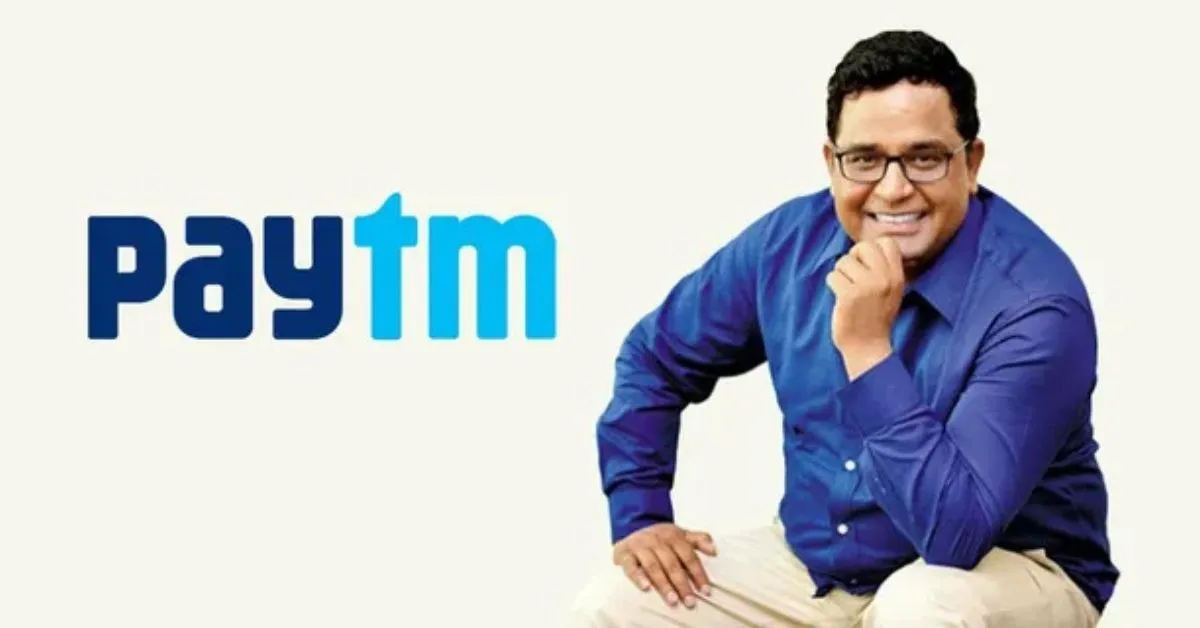
We live in a world where paying with a few taps feels second nature. From booking a cab to splitting a dinner bill, our phones have quietly taken over how we transact, making cash almost an afterthought. It’s seamless, almost effortless, and easy to take for granted.
But building something that becomes a part of everyday life like this is anything but easy.
Behind every such shift are years of trial, error, and setbacks we rarely see. Because success stories are often told through their peaks, not the valleys that made them possible. And yet, it’s in those unseen moments of doubt, failure, and starting over that the real story lies.
Few journeys capture this better than that of Vijay Shekhar Sharma, the founder of Paytm — a platform that changed how India pays.
For Sharma, failure wasn’t a detour; it was the blueprint and became the story of building, breaking and building again.
Small town, big gaps
Born in 1978 in Aligarh, Uttar Pradesh, Sharma grew up in a modest household where money was always tight. His father was a schoolteacher, his mother a homemaker, and like many middle-class families, aspirations often outpaced resources.
But the bigger hurdle wasn’t financial, it was linguistic.
Coming from a Hindi-medium school, Sharma found himself locked out of opportunities where English was the default. Instead of accepting that gap, he hacked his way through it, learning English by listening to rock music, repeating lyrics until they made sense. It was an unconventional method, but it worked for him.
At just 15, he cracked his way into Delhi College of Engineering, giving the start to a bigger story.
Out of place, but not out of fight
College was a culture shock. Surrounded by English-speaking peers, Sharma struggled to keep up in lectures, often memorising answers without fully understanding the questions.
But this phase quietly built something more powerful than academic success: self-learning.
He taught himself coding, built basic websites, and, more importantly, started thinking beyond the classroom. A chance encounter with Forbes stories about Silicon Valley startups lit a spark. If innovation could happen in garages there, why not here?
That question changed everything.
The first swing: XS corps
In 1997, at just 19, Sharma co-founded XS Corps with a bold ambition to build India’s own search engine. It was the right idea, but unfortunately at the wrong time.
With limited resources, no funding ecosystem, and infrastructure far beyond their reach, the dream slowly collapsed under its own weight. Eventually, the company pivoted to a content management solution and was sold in 1999 for $1 million.
On paper, it looked like success.
But for Sharma, it felt like unfinished business.
A second shot, and a harder fall
In 2000, he started again. This time with One97 Communications, focusing on SMS-based content, cricket scores, news, and ringtones, delivered to basic mobile phones.
The idea clicked, demand grew, and the revenues looked promising; however, one problem lingered: the money never came back.
Telecom operators delayed or defaulted on payments, leaving the company cash-starved despite strong numbers on paper. By 2003, Sharma was broke. He took up small repair jobs to survive. At one point, he sold 40% of his company for just Rs 8 lakh to keep it alive.
/filters:format(webp)/english-betterindia/media/media_files/2026/03/23/vijay-shekhar-sharma-2026-03-23-18-09-36.jpg)
This wasn’t just a business failure; it was personal.
A rejected loan application for his father during a family need hit harder than any financial loss. It exposed a deeper truth: India’s financial system wasn’t built for everyone.
That realisation stayed.
Failures tend to do one of two things — they either shut you down or sharpen your perspective.
For Sharma, it was the latter.
XS Corps taught him that ambition without infrastructure collapses. One97 taught him that revenue means nothing without cash flow. But more importantly, his struggles revealed a gap far bigger than any startup idea — financial access for everyday Indians.
The birth of Paytm
In 2010, Vijay Shekhar Sharma launched Paytm, short for “Pay Through Mobile”— with a simple starting point: mobile recharges.
No complexity, no overpromising. Just solving a real, everyday problem.
In its early years, Paytm focused on small, frequent transactions — prepaid recharges and DTH payments, quietly building trust in a country still deeply reliant on cash. By 2013, it had expanded into data cards and bill payments, slowly embedding itself into people’s daily routines.
Then came the turning point.
In 2014, Paytm introduced its wallet — a move that shifted it from a utility to a platform. Suddenly, it wasn’t just about recharges; it was about paying. Integrations with services like Uber and IRCTC brought it into mainstream usage, while new offerings from bus tickets to utility bills expanded its footprint.
By 2015, with major backing from global investors, Paytm was no longer a small experiment; it was scaling fast.
But behind that growth was everything Sharma had learnt the hard way — clean cash flows, direct transactions, and a product built for the masses, not just the metro elite.
By early 2016, Paytm had already begun evolving into a full-stack payments ecosystem, introducing QR codes for offline merchants and adding services like movie and flight bookings. The foundation was set.
So when demonetisation hit India in November 2016, Paytm didn’t need to pivot, it was already ready.
/filters:format(webp)/english-betterindia/media/media_files/2026/03/23/vijay-shekhar-sharma-2026-03-23-18-11-32.jpg)
Photograph: (Bloomberg News)
What followed was explosive. Millions of new users came onboard within months. Small vendors, kirana stores, and even street-side chai stalls began accepting payments through QR codes. The now-iconic “Paytm Karo” became less of a campaign and more of a cultural shift.
What looked like an overnight success wasn’t overnight at all.
It was 16 years in the making.
More Than a Billion-Dollar Story
Today, Sharma’s journey from a small-town boy struggling with English to building one of India’s biggest fintech platforms is often celebrated in numbers: billion-dollar valuations, global recognition and influence.
But the real story lives elsewhere.
In the failures, he doesn’t hide. In the risks that didn’t pay off. In the lessons that only come when things don’t work.
Because sometimes, what looks like a setback is actually setting the stage and sometimes, the most impossible journeys begin exactly where things fall apart.
Sources:
‘The amazing story of Paytm Founder, Vijay Shekhar Sharma’ by Atul Raja, Published on 13 January 2016.
‘Vijay Shekhar Sharma’s Success Story’ by Purnima, for The CEO Magazine
‘Vijay Shekhar Sharma’s Journey Through Failures Before Paytm’ by Manjula for Inspirepreneur, Published on 10 October 2025.
Disclaimer : This story is auto aggregated by a computer programme and has not been created or edited by DOWNTHENEWS. Publisher: thebetterindia.com









