
Updated ,first published
THEATRE
Beyond the Neck ★★★
Theatre Works, until April 4
It’s a painful and powerful time, in the wake of Bondi, to see Tom Holloway’s Beyond the Neck. His response to the 1996 Port Arthur massacre resists catharsis and isn’t an easy play to watch, even now, but it does underscore the importance of memorialising, reflecting upon, and grappling with the terror and the trauma of public violence at scale.
There are differences, of course, between the two national tragedies. At Bondi, the victims were targeted in an antisemitic terror attack, and the killings came after years of rising gun ownership in Australia (more than 4 million legal weapons owned by civilians), despite John Howard’s sane and politically courageous passage of strict gun-control laws following Port Arthur.
Theatre can’t legislate or regulate these social evils, and playwright Holloway is acutely aware of the limits of narrative art in making sense of senselessness, or in trying to imagine the unimaginable. He’s at pains to evade what has become known as “trauma porn”. So, his play takes a choric form that embodies the psychological impact of life-altering trauma; in some ways, it acts as an alienation device, a distancing effect that interrogates empathy as much as it encourages the attempt.
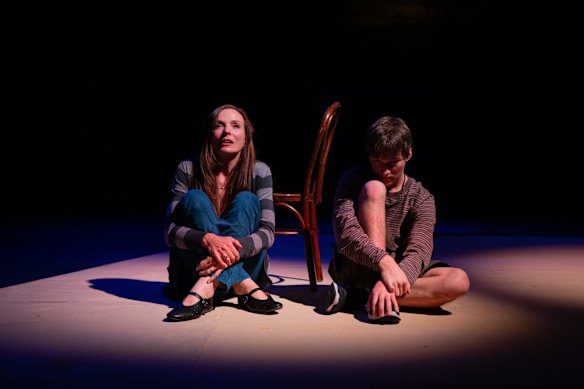
Four figures – an old man, a teenage girl, a mother and wife, and a boy – share the burden of storytelling. Each has been touched by the massacre in some way, and echoes of trauma and loss take a while to resonate; the enormity of the events of that day is treated as a hot potato, and the performances make agitated dashes between enactment and narration – and sometimes, desperate invention – to cope with it.
First staged in 2012, Suzanne Chaundy’s production is pared back, emphasising the urgent dynamism of the performers.
The action unfolds on a spartan stage, backed by a looming colonial-era painting of the convict settlement at Port Arthur, a reminder that the history of violence and cruelty in this beautiful part of the world stretches across centuries.
Each actor brings immediacy and stage presence. Francis Greenslade plays an ageing tour guide with avuncular humour that can’t quite deflect the assault of terrors relived. Cassidy Dunn’s angry teen resorts to conspiratorial thinking on the road to acknowledging her loss, while Emmaline Carroll Southwell navigates a liminal zone between reality and fantasy to stay one step ahead of the unbearable.
Perhaps the most disturbing figure is Freddy Collyer’s boy – a lonely child who, it is suggested, carries within him a primal impulse to destroy that could well be unleashed in adulthood.
Some comfort in this devastating play arrives in the old man’s recollection of events – a detail, even amid madness, in which the primal impulse to care for others is revealed to be as strong as the urge to do violence.
Bondi inspired a salient moment of heroism, too, and Beyond the Neck wrestles its way towards a sublime realisation – that the best of human nature can be found unaccountably, against all hope, in the face of the worst.
Reviewed by Cameron Woodhead
THEATRE
West Gate ★★★
Melbourne Theatre Company, Southbank Theatre, until April 18
These days, the hulking monolithic structure that connects Melbourne’s east and west is synonymous with traffic congestion and oversized trailers, but more than 50 years ago, the West Gate was the site of Australia’s deadliest industrial disaster, when the bridge’s sudden collapse led to the deaths of 35 men.
The fateful events that culminated in this tragedy and its emotional aftermath are fictionalised in Dennis McIntosh’s play, informed by a truth gleaned from meeting with families of the deceased, and years of assiduous research.
At the heart of West Gate is proud Italian migrant Vittorio (Steve Bastoni), a welder who’s a father figure of sorts to the labourers, particularly the aimless young “Scrapper” (Darcy Kent) – a blustery man who masks his vulnerability with feigned bravado and a veneer of casual racism. We meet foreman and union rep Pat (Rohan Nichol), whose commitment to fairness and rules clashes with the amiable BJ’s (Simon Maiden) own thoughts on workplace safety.
There’s a clear demarcation in West Gate between the blue-collar, migrant labourers who are building the bridge and the middle-class upper management, who debate on the sanctity of their lives at a remove that only hierarchy and privilege can provide. This callous disregard and a hubris familiar to anyone who remembers the Titanic is externalised by a trio of engineers: Stevenson (Paul English), McAlister (Peter Houghton) and Cooper (Ben Walter).
It quickly becomes evident that something is amiss with the West Gate project. Lead engineers who designed the bridge have absconded; a similarly designed box girder bridge in Wales collapsed a few weeks prior; key specifications are missing, and directions from the head English company are not forthcoming. All the while, the clock is ticking and deadlines must be met.
The devil is in the (sometimes excessive) detail, but McIntosh is less preoccupied with the minutiae of who did what, and more fixated on the abrogation of responsibility that resulted in a tragedy that could’ve been prevented in all ways.
When the inevitable occurs, it’s a cataclysmic spectacle of horrifying magnitude engulfed by the discombobulated din of frightened men – best left unspoiled for those of us yet to see this play. It’s stagecraft at its finest, a stunning recreation of the moment that left many men buried under rubble, thrown to the ground, burnt by exploding diesel fuel.
The play is spliced into two by the bridge’s collapse, underlined by Christina Smith’s shift in set design from the nuts and bolts to the personal. When the stage is once more illuminated, we’re transported to the domestic realm where Vittorio’s wife Francesca (Daniela Farinacci) grieves, confined to a kitchen squashed beneath splayed beams and concrete. Farinacci is a much-needed intervention against the all-male cast of the first act, but her acting prowess outstrips the limitations of her written character.
If the first act features hackneyed dialogue in parts, the second half suffers from a certain sense of inertia as the characters try to find their way in grief and loss. There are affecting moments of camaraderie and comradeship that build to a moving end, but the emotional fallout is borne almost single-handedly by Francesca, and Pat’s and BJ’s thin characterisations become more evident when they morph into ciphers for feelings and movements larger than what their personal narratives can convey.
Management’s response to the disaster and the ensuing royal commission are predictably and criminally negligent, but even this reveal feels at a remove; the character of Stevenson is rendered more like a cartoon villain than a man whose actions had far-ranging consequences for generations to come.
Where West Gate excels is in its exquisite staging and platforming of voices traditionally considered antithetical to the highfalutin artifice of theatre. Under Iain Sinclair’s expert direction, Kelly Ryall’s ominous sound design, coupled with Smith’s minimalistic set and Niklas Pajanti’s supremely effective light design, is the prism through which we experience this working-class story and watershed moment in Melbourne’s history.
Reviewed by Sonia Nair
JAZZ
Big Jazz Day Out
MPAC, March 21
As yet another Australian music festival (Byron Bay’s Bluesfest) bites the dust, it’s heartening to see one small but ambitious jazz event building on the success of its first outing in 2025.
Big Jazz Day Out is a one-day festival held across multiple venues at MPAC (Monash University Performing Arts Centres). Over 100 musicians took part this year, in a thoughtfully curated “takeover” of MPAC’s Ian Potter Centre for Performing Arts: a seriously impressive precinct incorporating a formal theatre, recital salon, jazz club, foyer bar and courtyard. Curator Chelsea Wilson took full advantage of the range of venues, carefully matching each act to the most appropriate space.
Often, programs designed to offer “something for everyone” can sacrifice depth – and quality – for the sake of breadth, but that was certainly not the case here. Yes, there was plenty of accessible fare that casual listeners, non-aficionados and families could enjoy in a relaxed setting. At The Count’s, patrons tapped their toes to the classic-jazz stylings of the Syncopators, swayed appreciatively as the Monash Latin Ensemble performed Cuban tunes arranged by special guest Yunior Terry and – as night fell – sank into the deliciously soulful, Hammond organ-soaked grooves of Cookin’ on 3 Burners.
Outside in the courtyard, singer Alma Zygier held the audience entranced with her wide-ranging repertoire and wonderfully expressive vibrato that can suggest trembling vulnerability, world-weariness or knowing seduction.
Strolling towards the Alexander Theatre, I was sidetracked in the foyer bar by two pianists – Adam Rudegeair and the inimitable Bob Sedergreen – trading spontaneous riffs and playful asides in a spirited twin-keyboard conversation.
Inside the theatre, a superb (and unexpectedly moving) concert by Vince Jones, Paul Grabowsky and the Monash Sinfonia was unfolding. The poignancy of Jones’ lyrics – mostly written when he was a much younger man – has deepened with the passage of time, and Grabowsky’s gorgeous arrangements for strings heightened the overarching mood of nostalgia, wistfulness and melancholy.
Later, the same venue hosted jazz from another musical planet, when Mildlife took to the stage with their heady brand of psychedelic prog-rock fusion (complete with spacey retro synths and vocoders). They’re not really a sit-down kind of band, but some of the young folk in front of me were bouncing ecstatically in their seats.
Many of the day’s most memorable shows took place in the intimate David Li Sound Gallery. Cabaret chanteuse Mama Alto offered a heartfelt tribute to Billie Holiday, and Grabowsky appeared in a mostly improvised set with guzheng virtuoso Mindy Meng Wang that was by turns delicate, dreamlike and ravishingly cinematic.
The Cloud Maker featured five musicians exploring musical tales of goddesses from their respective cultures. Led by multi-instrumentalist Aviva Endean, this mesmerising, semi-theatrical performance incorporated mystery and ritual, fiery incantation and abstract experimentation, with instruments that ranged from clarinets and nyckelharpa to an enchanted Māori flute.
In the evening, Aaron Choulai guided the Monash Art Ensemble through a riveting interpretation of his work To Kill A Magic We Got Used To. Obliquely inspired by Stravinsky and shaped around the story of an artist lured by the false promise of social media stardom, the 60-minute suite was as thought-provoking as it was musically compelling, moving nimbly between intricate notated sections and extemporised interludes where rapper Roman MC freestyled with rhythmic ingenuity and poetic acuity.
Nine hours after I arrived, I made my way home with a sense of deep gratitude and renewed appreciation for the richness of Melbourne’s fertile jazz scene. Big Jazz Day Out may still be small compared to other well-established festivals, but it’s already fulfilled its promise as a valuable addition to our city’s jazz calendar.
Reviewed by Jessica Nicholas
NOTE: No star rating has been applied to the above festival review
MUSIC
Hoang Pham ★★★★
Melbourne Recital Centre, March 21
Among the younger generations of Australian pianists, it would be hard to imagine anyone better suited to deliver an all-Chopin recital than Hoang Pham.
Here is an artist well aware of the finely blended tension of seeming opposites in the Polish composer’s music: the bittersweet tussle between nostalgia and melody, between strength and delicacy, between light and shade. Such tensions place enormous demands on the performer, particularly to balance technical control and poetic abandon.
Pham persuasively rose to this challenge in a demanding 75-minute recital that began with one of his favourite curtain raisers, the well-known Fantaisie-Impromptu, Op. 66.
Heartache for Chopin’s homeland was elegantly captured in the Three Mazurkas, Op. 63 where there was also a sensitive delineation of inner voices. Demonstrating the difference a semitone can make to the prevailing mood, the Two Nocturnes, Op. 27 were full of lyrical reverie shot through with pangs of dramatic regret.
Providing some light relief, the Two Waltzes, Op. 64, including the famous Minute Waltz, showcased Pham’s subtle rhythmic flexibility and delicate technical finesse.
At opposite ends of the program, two monumental ballades saw Pham at his expansive, expressive best. In the F minor, Op. 52, the long journey towards the climax was well-paced, Pham’s improvisatory elements and embellishments sitting well within the work’s architecture. At the summit of the program stood the G minor, Op. 23, clearly a work close to Pham’s heart. Here, a genuine, intense outpouring of passion took listeners to another realm.
With its militaristic overtones, the “Heroic” Polonaise in A-flat, Op. 53, with its famous “cavalry charge”, closed out the official program in style.
Two contrasting encores, the appealing Waltz in A-flat, Op. 69, No. 1 and the turbulent “Revolutionary” Etude, Op. 10, No. 12, delighted the audience, which was hearteningly full of young fans.
Reviewed by Tony Way
MUSIC
Anna Lapwood ★★★★
Melbourne Town Hall, March 13
A source of entertainment and education, town hall organs in the 19th and early 20th centuries enjoyed enormous popularity. Anna Lapwood’s irrepressible vivacity has won a new generation to the sonic possibilities of these extraordinary instruments, vigorously harnessing the power of social media to do so. Witness her extraordinarily diverse fan base selling out two concerts in Melbourne Town Hall.
Lapwood is unafraid to bring a childlike enthusiasm to her task, along with the passion of a motivational speaker and the chutzpah of a seasoned entertainer. A huge film buff, she skilfully blends the worlds of classical and theatre organist into a highly popular, personal amalgam, blessed with enviable dexterity of hands and feet.
Drawing an imaginative palette of colours from the Town Hall’s Grand Organ, she did not disappoint her fans, exciting them with the dramatic intrigue of The Da Vinci Code, the camp derring-do of Pirates of the Caribbean and the poignant race to find new worlds in Interstellar. Of all these Hans Zimmer scores, Interstellar is responsible for making the organ a viral phenomenon.
Ludovico Einaudi’s minimalist Experience was contrasted by Rachel Portman’s Flight. Admirable, clear technique was also on show in John Williams’ Duel of the Fates from Star Wars; space journeys further explored in Limina Luminis by Olivia Belli.
Lapwood’s substantial The Lord of the Rings organ symphony demonstrated her capacity for organistic storytelling. Maybe accompanying the entire film might be next?
Given the warm reception given to the Toccata by 19th-century French organist Eugène Gigout, it was a pity that Lapwood forfeited the educational opportunity to broaden her fans’ horizons by not adding some further recognisable classics.
Even so, in a city with a decades-long dearth of organists, here’s hoping that Lapwood will inspire some young devotees to take up the king of instruments.
Reviewed by Tony Way
MUSIC
The Devil’s Violin ★★★★
Australian Chamber Orchestra, Melbourne Recital Centre, March 14
It was immediately apparent: the unique sound of the 1743 Guarneri del Gesù violin played by Russian-born virtuoso Ilya Gringolts. Warm, intensely lyrical but also intriguingly soft-grained quality, here was a musical voice that could not be ignored.
No stranger to the Australian Chamber Orchestra and its audiences, Gringolts began with the Imitation of Bells by Johann Paul von Westhoff, which reappeared in the opening of Vivaldi’s Violin Concerto in D minor RV237. The brilliant source material led into a fervently committed account of the concerto in which the agile solo voice subtly counterpointed the burnished sound of the ACO’s impressive array of historical instruments.
In edgy contrast to the splendour of the Venetian baroque, an arrangement of Soviet composer Sofia Gubaidulina’s String Quartet No. 2 revealed an entirely different sound world.
In a testament to the versatility of the fine instruments onstage, such severe modernism seamlessly morphed into one of the most celebrated eighteenth-century works for violin, the Devil’s Trill by Tartini. The original sonata was conceived after the composer dreamt that he had sold his soul to the devil, who then played a fantastical work on his violin. No surprise that Gringolts and the ACO relished this fiendish challenge.
Mieczyslaw Weinberg’s ethereal Aria gave listeners a small taste of the glories of the ACO’s latest instrument acquisition, a 1610 Maggini viola, played by principal Stefanie Farrands.
Principal violin Satu Vänskä with her 1728/29 Stradivarius then duelled with Gringolts in Vivaldi’s Concerto for Two Violins in C major, RV507 to the genuine delight of all present. It was a rare treat to savour the differences between two superb instruments.
Newly commissioned, Paul Stanhope’s Giving Ground was a thoughtful and well-crafted reflection on the ground bass that underpins the famous La Follia theme; Geminiani’s florid version providing an exuberant finale.
Reviewed by Tony Way
The Booklist is a weekly newsletter for book lovers from Jason Steger. Get it delivered every Friday.
 Sonia Nair is a contributor to The Age and Good Food.
 Jessica Nicholas is an arts and music writer, specialising in contemporary jazz and world music.
From our partners
Disclaimer : This story is auto aggregated by a computer programme and has not been created or edited by DOWNTHENEWS. Publisher: www.smh.com.au


