
In 2025, people born outside the European Union made up about 10 percent of the EU’s 450 million population. But which countries have the largest share of foreign-born residents?
New Eurostat data revealed that on January 1st 2025, some 46.7 million people living in the EU were born in third countries (non-EU/Schengen), a 1.9 million increase over the previous year.
When it comes to citizenship, 30.6 million residents in the EU were third country nationals, 1.6 million more than in 2023, representing 6.8 per cent of the total EU population.
Eurostat, the EU statistical office, analyses data on both the country of birth and nationality given that a person’s citizenship can change over a lifetime.
In 2025 some 18 million residents were born in another EU member state and 14.1 million had the citizenship of another EU country, about 100,000 more than the previous year. EU citizens who had moved across the bloc represented about 4 per cent of the EU population.
Countries with most foreign-born residents
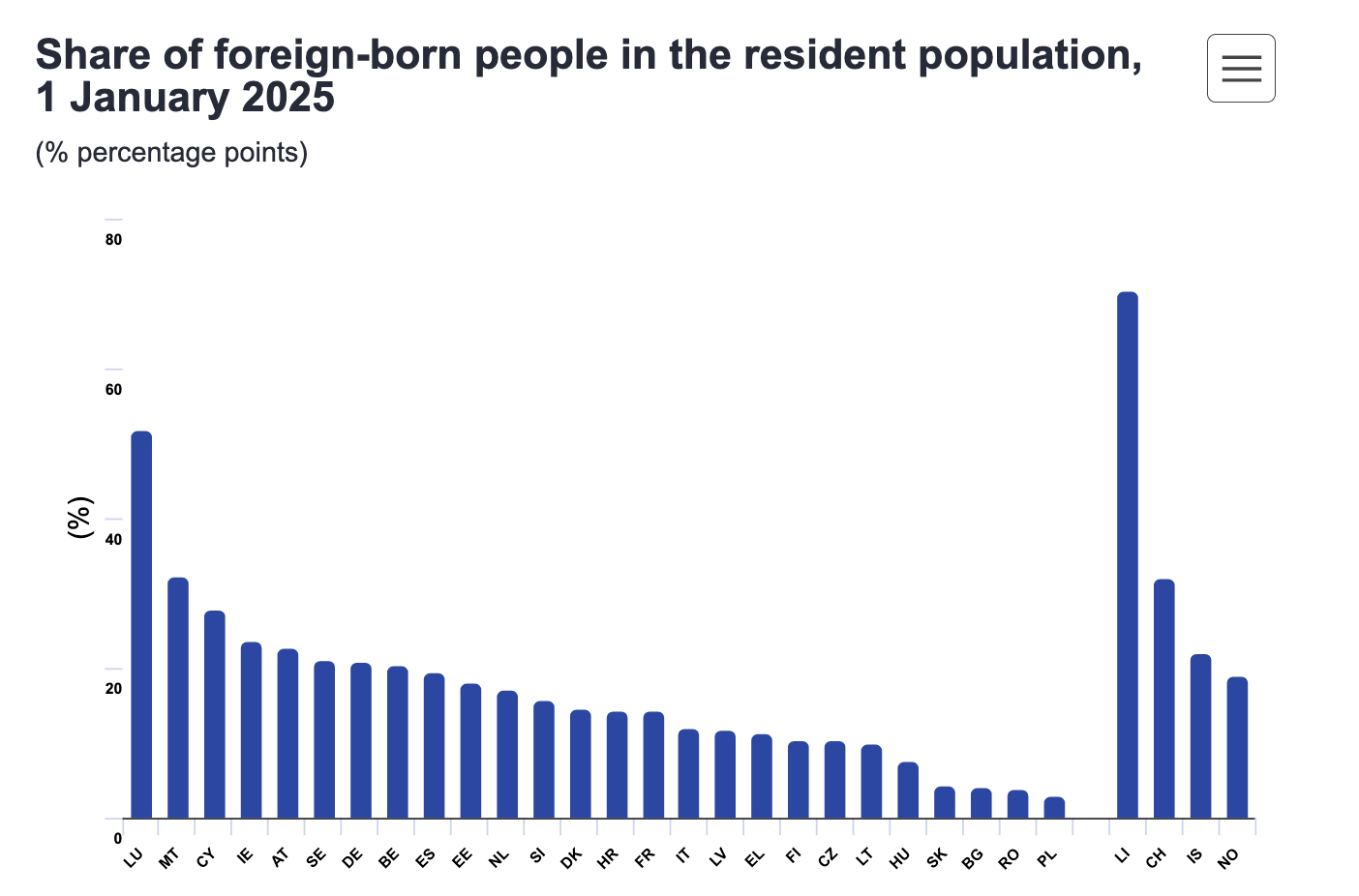
Smaller countries in Western Europe had the biggest share of foreign-born residents in 2024. In the lead was Luxembourg, where 51 percent of the total population was born abroad, in Malta some 32 percent of residents were born abroad, and in Cyprus it was almost 28 percent. In Ireland 23 percent of residents were born abroad and in Austria the figure stood at 22 percent.
Then came two of the bigger European countries – Sweden and Germany, where just over 20 percent of residents in each country were born abroad.
The figures revealed that some 19.3 percent of Spain’s population was born abroad, for Denmark it was 14.4 percent, France was slightly lower on 14 percent and Italy at 11.8 percent.
Switzerland, which is in Schengen and the European Free Trade Association, counted 31.7 percent of its population as foreign-born whilst for Norway – also a Schengen/EFTA country – the figure was 18.7 percent.
In contrast, the proportion of foreign born residents among the population was less than 5 per cent in Poland, Romania, Bulgaria and Slovakia. Similar patterns were recorded regarding citizenship.
Eurostat chart
In absolute numbers, Germany (17.2 million), France (9.6 million), Spain (9.5 million) and Italy (6.9 million) had the largest number of foreign-born residents. Taken together, these four countries counted almost 67 percent of the total of foreign-born residents in the EU.
Sweden counted 2.2 million foreign-born residents, Denmark 862,000, Austria 2.1 million whilst Switzerland was home to 2.8 million foreign-born residents and Norway around 1 million.
Eurostat noted that in the past 10 years – between January 1st 2015 and January 1st 2025 – the proportion of foreign-born residents increased in most EU countries. Only in Latvia and Greece did it decline.
“Migration is influenced by a combination of economic, environmental, political and social factors: either in a migrant’s country of origin (push factors) or in the country of destination (pull factors),” the Eurostat report says.
“Historically, the relative economic prosperity and political stability of the EU are thought to have exerted a considerable pull effect on immigrants,” the document adds.
The largest groups of third country nationals living in EU countries were from Ukraine, Turkey and Morocco, while Romanian, Italian and Polish citizens were the three largest groups living in other EU member states.
International migration
Data on international migration refers to people who have migrated to an EU country for various reasons for one year or more, according to Eurostat. In 2024, 4.2 million people moved to the EU from non-EU countries, compared to 4.4 million in 2023.
In the same year, 1.5 million people moved from one EU member state to another, and 1.6 million moved from the EU to a country outside the bloc.
All EU countries with available data, except for Latvia, reported more immigration than emigration.
Many people also move to return to their country of origin. For example in 2024, native-born people made up more than half of the number of immigrants in Romania and Latvia.
With almost 1,288,600 million arrivals, Spain reported the largest total number of immigrants in 2024, followed by Germany (1,078,500), Italy (451,600), and France (438,600).
Spain, Germany and France also reported the biggest number of emigrants in 2024, 662,300, 584,200 and 263,200 respectively, Eurostat reports.
Disclaimer : This story is auto aggregated by a computer programme and has not been created or edited by DOWNTHENEWS. Publisher: thelocal.de



