
From blazing wheels to silent water, horseback hymns and competitive egg cracking, Easter in Germany is filled with events that are equal parts improbable and endearing. Here are five interesting customs to observe or join in on.
Easter matters in Germany – and not just because of the chocolate eggs.
Shops close, families travel, church bells ring and suddenly everyone seems to have very strong opinions about coloured eggs. What may be less obvious is just how local Easter still is here: Germany is home to a remarkable variety of Easter traditions, many of them tied to specific towns or regions and many tracing their roots back long before Christianity arrived.
Pagan spring rituals, Christian symbolism and a love of well‑organised spectacle have blended over the centuries and led to the creation of customs that are uniquely German.
You’ve probably heard of the Osterhase, the Easter bunny. But have you heard of flaming wooden wheels rolling down a hill? Of men in top hats riding horses through villages at dawn? Of young women collecting magical water in total silence? Of egg‑tapping contests treated with the seriousness of an Olympic final?
These traditions are still very much alive. For newcomers, they offer a way to see Germany not as a nation of rules and paperwork, but as a patchwork of stories, rituals and gently eccentric habits.
Osterräderlauf – Lügde, North Rhine‑Westphalia
If you think German Easter traditions are all about quiet reflection, Lügde would like a word – preferably roared over the sound of crackling flames.
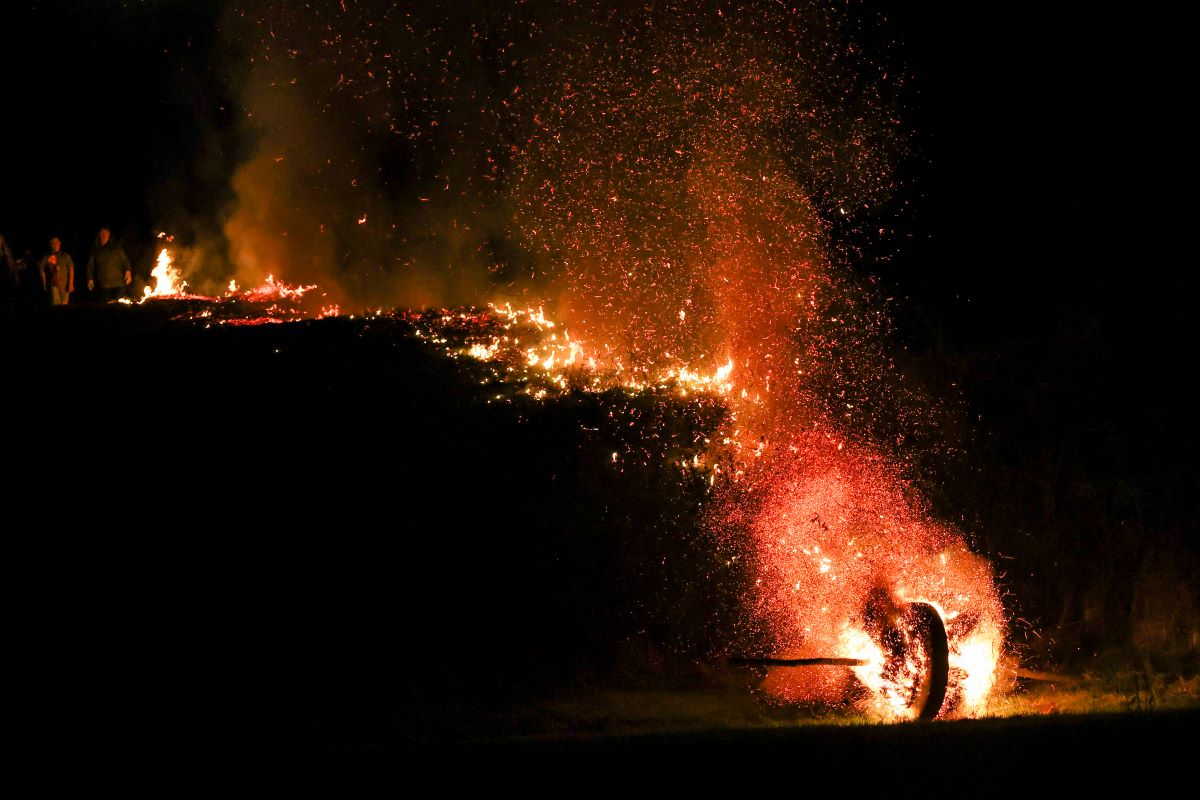
Every Easter Sunday, this small town in the Weserbergland hosts the ‘Easter Wheel Run’, or Osterräderlauf.
As darkness falls, six enormous oak wheels – each weighing around 280 kilograms and stuffed with rye straw – are set on fire and rolled down a hillside into the Emmer Valley. Sparks fly, crowds gasp and spring is symbolically declared the winner over winter.
A straw-filled wooden Easter wheel rolls down a hillside ablaze during the Easter wheel race. Photo: picture alliance/dpa | Christoph Reichwein
The tradition is thought to have its roots in ancient bonfire rituals and is today recognised as part of Germany’s intangible cultural heritage.
The event is organised by the local Osterdechenverein, an association of around 600 members who act as guardians of the tradition. Preparation begins days in advance, with music, parades, concerts and the ceremonial filling of the wheels. The main event takes place at around 9pm on Easter Sunday, followed by a fireworks display and, inevitably, a party.
Visitors are welcome. Lügde is about two hours east of Cologne, and tickets are inexpensive for adults and free for children. Just remember to stand well back.
READ ALSO: German word of the day – Osterfeuer
Osterreiten – Upper Lusatia, Saxony
On Easter Sunday morning in Upper Lusatia, the sound you hear is not church bells but hooves.
The Easter Ride, or Osterreiten, is a solemn horseback procession practised in the Catholic Sorbian communities of eastern Saxony. Hundreds of men, dressed in black frock coats and top hats, ride elaborately decorated horses from village to village, singing hymns in Sorbian and Latin to proclaim the resurrection of Christ.
The ritual is deeply rooted in Sorbian culture and may originally have had pagan origins, linked to riding around fields in spring to protect crops. Records suggest Easter rides in the area were already taking place by the end of the 15th century, making this one of Germany’s oldest documented Easter processions.
What makes the custom particularly distinctive is the rule that neighbouring processions must never meet. So riders from nearby villages must carefully choreograph routes to avoid crossing paths.
The largest and best‑known ride takes place between Wittichenau and Rabitz and attracts thousands of spectators. Visitors are welcome to watch but participation is reserved for local riders.
Osterwasser – Saxony and the Spreewald
This is perhaps the quietest Easter tradition in Germany – literally.
In parts of Saxony and the Spreewald region of Brandenburg, young women traditionally collectEaster water (Osterwasser) on the night before Easter Sunday. Drawn from streams, wells or rivers, the water is believed to bring beauty, youth and protection from illness.
There are rules: The water has to be taken from a specific place, sometimes flowing eastward, sometimes westward, depending on the village.
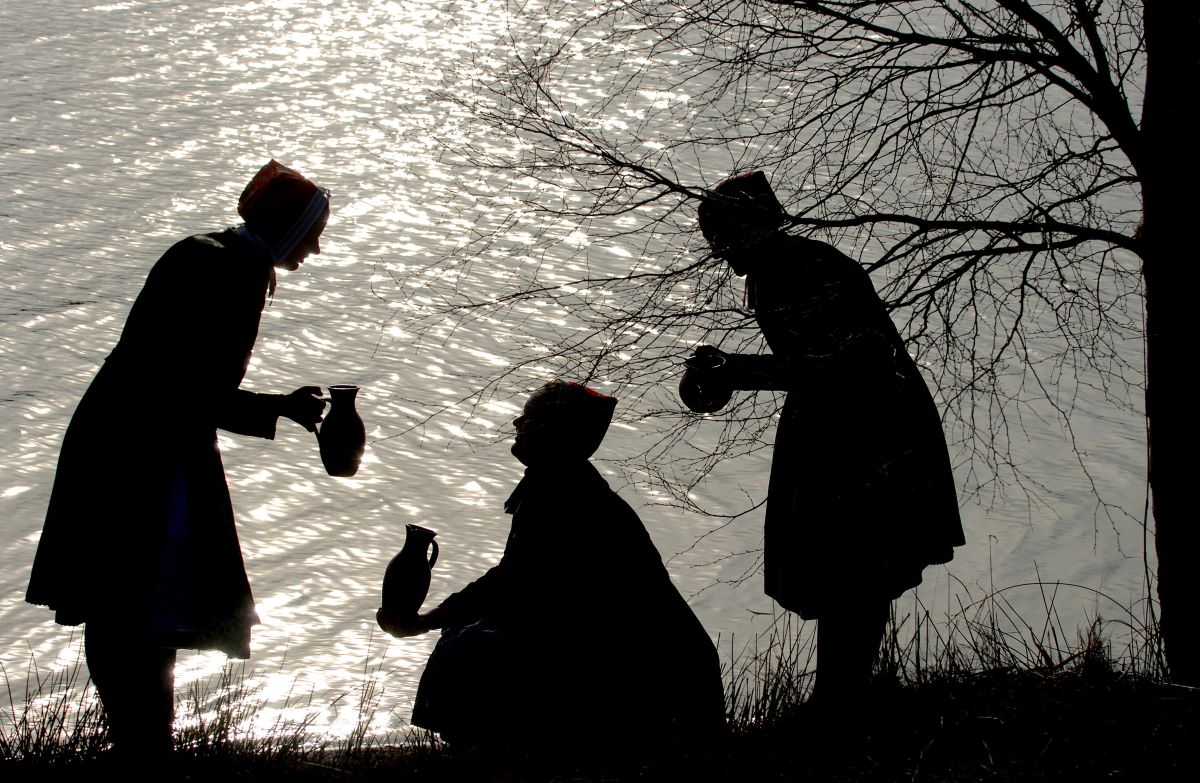
In this staged scene, three young women dressed in traditional Schleifer costumes collect Easter water from the Halbendorf spring in the small Saxon village of Halbendorf near Weißwasser. Photo: picture alliance / dpa | Patrick Pleul
In some areas it’s collected by boat at midnight. And above all, the entire process must be carried out in complete silence. Speak, laugh or drop the bucket and the water loses its power, becoming useless “chatter water”.
READ ALSO: From dancing bans to forbidden films – How strict are Germans over Easter?
Naturally, local boys have traditionally found this hilarious and gone to great lengths to make the girls laugh.
Visitors won’t usually be expected to take part, but if you happen to see a group of people silently carrying water at night on Easter weekend, now you know why none of them are talking.
Georgiritt – Traunstein, Bavaria
If you prefer your Easter traditions with bells, banners and several hundred horses, head south.
Every Easter Monday, the Bavarian town of Traunstein hosts the Georgiritt, or St. George’s Ride – one of the largest horse processions in Bavaria.
At precisely 10am, a herald signals the start, church bells ring and a long procession of decorated horses, carriages, marching bands and historical groups sets off from the town square to the Ettendorfer Kircherl.
There, riders receive a blessing, continuing a tradition that blends Christian pilgrimage with much older spring rituals.
Closely linked to the procession is the Sword Dance, first recorded in 1530, which symbolises the victory of spring over winter. Performances take place twice on Easter Monday.
The Georgiritt is organised by the St. Georgs‑Verein Traunstein with strong support from the town and parish, and was added to Germany’s Register of Intangible Cultural Heritage in 2016.
Traunstein is about an hour east of Munich and easy to reach.
READ ALSO: Easter in Germany – The very deutsch origins of the Easter Bunny
Eierpecken – Southern Germany and beyond
If travelling across the country isn’t on your Easter agenda, don’t worry. You can still take part in a very serious German Easter tradition from the comfort of your own kitchen table.
Eierpecken, or egg tapping, is widespread in southern Germany and works like this: two people each take a hard‑boiled egg (preferably painted on this occasion) and tap them against each other, point to point. The egg that survives uncracked wins. Simple. Except that it’s taken extremely seriously.
Choosing the right egg matters. Shell thickness depends on the hen’s age and diet, but in general a pointed egg is considered an advantage.
But the real trick lies in the technique, according to experimental physicist Werner Gruber. Aim the tip of your egg at the side of your opponent’s egg and strike at a steep angle to disrupt the force distribution and, in theory, secure victory.
Egg tapping is played by all ages, requires minimal equipment, and usually ends with an egg salad. It is, in many ways, the perfect introduction to German Easter traditions.
Disclaimer : This story is auto aggregated by a computer programme and has not been created or edited by DOWNTHENEWS. Publisher: thelocal.de







