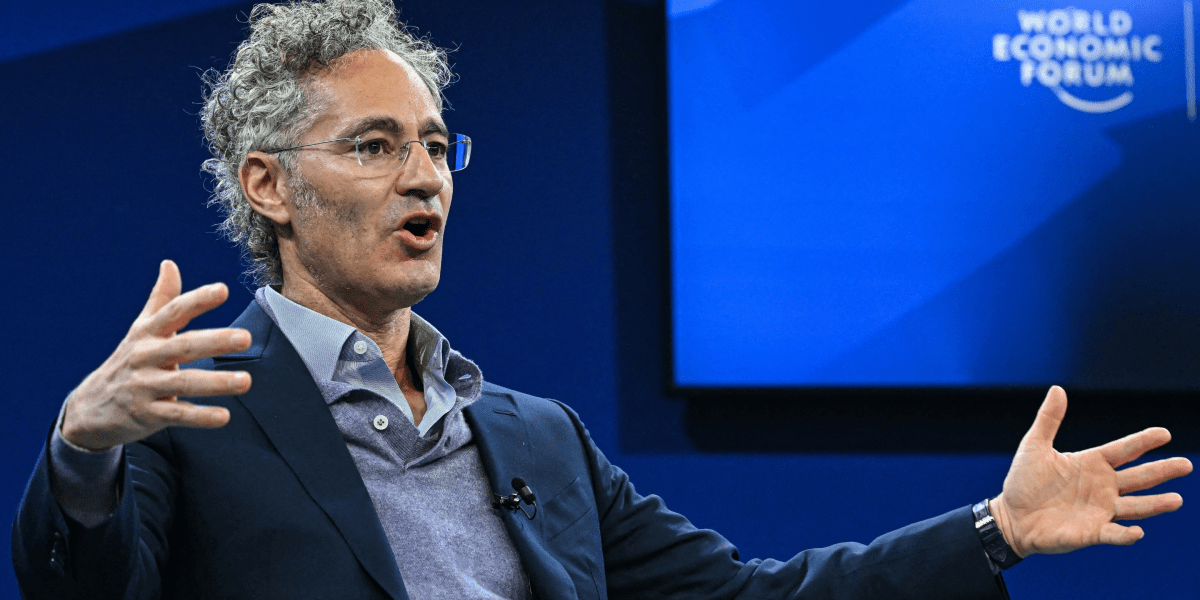
From Gen Z to baby boomers, workers across industries are on the hunt for ways to future-proof their careers as artificial intelligence threatens to upend the labor market. Palantir CEO Alex Karp is offering a starkly simple view of who will come out ahead.
“There are basically two ways to know you have a future,” the 58-year-old billionaire said on TBPN earlier this month. “One, you have some vocational training. Or two, you’re neurodivergent.”
Karp’s first category reflects a growing consensus: skilled trades professionals—from electricians to plumbers—are difficult to automate and are increasingly in demand as Big Tech companies build out massive data centers and the U.S. faces existing labor shortages.
The second category is more personal. Karp has long spoken about living with dyslexia, the learning disability that can affect reading, writing, and information processing. More broadly, neurodivergence can include conditions such as ADHD and autism.
For Karp, that cognitive difference can be an advantage in an AI-driven world—less because of the diagnosis itself and more because of the mindset it can foster. Success, he argued, will favor people who think differently and take risks, or in his words, be “more of an artist, look at things from a different direction, be able to build something unique.”
One-fifth of sales organizations within Fortune 500 companies are expected to actively recruit neurodivergent talent to improve business performance by 2027, according to a Gartner study.
As Alex Karp warns AI will wipe out jobs, Palantir is betting on neurodivergent talent and high school grads
While being neurodivergent is not a requirement to land a job at Palantir, the company has made it clear it sees such candidates as a strategic advantage.
It offers a dedicated “Neurodivergent Fellowship,” aimed at recruiting talent that may think differently from traditional hires.
“Neurodivergent individuals will play a disproportionate role in shaping the future of America and the West,” the job posting stated. “They see past performative ideologies and perceive beauty in the world that still exists—which technology and art can expose.”
The emphasis reflects Karp’s broader skepticism of traditional career pathways. Despite holding three degrees to his name—including a JD from Stanford and a PhD in philosophy from Goethe University in Germany—Karp has been blunt about the limits of higher education in an AI-driven economy.
“[AI] will destroy humanities jobs,” Karp said at the World Economic Forum’s annual meeting in Davos, Switzerland earlier this year. “You went to an elite school, and you studied philosophy—I’ll use myself as an example—hopefully, you have some other skill, that one is going to be hard to market.”
Palantir similarly launched a separate program—the Meritocracy Fellowship—designed specifically for high school graduates not enrolled in college. The program’s first cohort required Ivy League-level test scores to qualify, and attracted over 500 applicants. The 22 admitted students were a mix of those who felt attending college wasn’t compelling, or didn’t get into their dream schools, according to the Wall Street Journal.
The next round, currently recruiting for fall 2026, offers participants $5,400 a month as a stipend and pitches itself with a clear message: “Skip the debt. Reclaim years of your life. Earn the Palantir degree”—and top performers can even receive full-time offers at the company.
Entry-level roles for Gen Z are drying—but not everyone has given up on college
As traditional entry-level roles dry up for Gen Z graduates, many young people are coming to a similar conclusion as Karp: a college degree alone is no longer a guaranteed path to success.
Still, some tech leaders argue that higher education is far from obsolete—and that liberal arts in particular may become more valuable in the age of AI. Jaime Teevan, Microsoft’s chief scientist, believes the next generation will benefit from studying disciplines that emphasize how to think, not just what to do.
“Metacognitive skills will be very important—flexibility, adaptability, experimentation, thinking critically, being able to challenge things. Developing critical-thinking skills requires friction, doing things that are hard, doing deep thinking,” she told The Wall Street Journal. “For that, a traditional liberal-arts education is really important.”
In direct contrast to Karp, Daniela Amodei, cofounder of AI firm Anthropic, said studying the humanities will be “more important than ever.”
“The things that make us human will become much more important instead of much less important,” she told ABC News last month. “And what I mean by that is when we look to hire people at Anthropic today, we look for people who are great communicators, who have excellent EQ and people skills, who are kind and compassionate and curious and want to help other people.”
Disclaimer : This story is auto aggregated by a computer programme and has not been created or edited by DOWNTHENEWS. Publisher: fortune.com