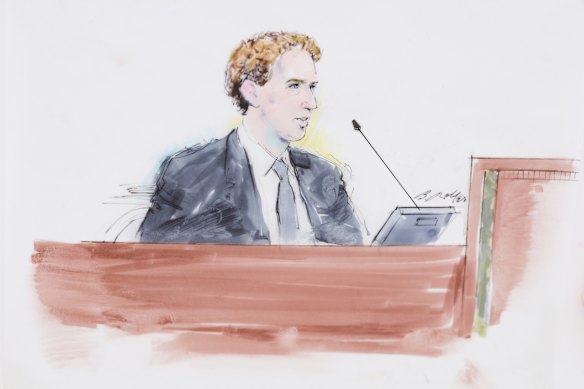

It took nine days of deliberation, 43 hours of argument among jurors, and a seven-week trial that saw the Meta chief executive dragged to the stand in Los Angeles, but the verdict that landed overnight is one Silicon Valley has been dreading for years.
A California jury found Meta and Google liable for designing addictive products that caused a young woman’s mental health problems, ordering $US6 million ($8.6 million) in combined damages.
The dollar figure is negligible for a company that pulled in nearly $US60 billion in revenue in the last quarter of 2025 alone. But the number isn’t the point.
The walls aren’t just closing in on Mark Zuckerberg. They’re already here.
For years, Washington hearings were the executive’s main accountability stage, full of hostile soundbites and viral clips. That era looks over. We’ve moved to the courtroom.
Meta suffered two jury verdicts against it in 48 hours. On Tuesday, a New Mexico jury hit the company with $US375 million in civil penalties after finding it violated state consumer protection laws, misled users about the safety of its platforms, and enabled child sexual exploitation. Prosecutors in that case had created fake accounts posing as 13-year-old girls – accounts that were immediately flooded with predatory contact. Meta’s response, or lack of it, became the centrepiece of the state’s case.
Meta lost two verdicts across two different states, and two different legal arguments – one targeting addictive design, the other targeting child-exploitation failures. Both pointed at the same company and, ultimately, at the same man.
Zuckerberg’s testimony in Los Angeles was a study in corporate deflection, and one juror has since said as much publicly. Confronted with internal documents showing Meta sought to attract younger users and lifted a ban on beauty filters that its own staff had flagged as harmful to teen girls, Zuckerberg told jurors he wanted to let users “express themselves”. The plaintiff’s attorney, Mark Lanier – a Texas trial lawyer who used a 10-metre collage of his client’s Instagram selfies to make his case – asked a blunt question: were Instagram and YouTube deliberately designed to be addictive, and did that design materially contribute to one user’s mental health collapse?
The answer – yes – now opens the door for future plaintiffs to link specific product features, from infinite scroll to algorithmic recommendations, to concrete harms.
The legal pipeline is staggering. The LA case was a bellwether, a test trial designed to set the template for about 2000 pending lawsuits from families and school districts across the United States. At the time of writing, more than 40 state attorneys general have filed separate actions against Meta. A federal trial involving multiple school districts is set to kick off in Oakland within months, while another state trial kicks off in Los Angeles in July, this time targeting Instagram, YouTube, TikTok, and Snapchat.
Meta’s defence throughout has been that teen mental health is “profoundly complex and cannot be linked to a single app”. That’s true, as far as it goes. But two juries have now concluded it doesn’t go far enough, and that complexity isn’t a shield when your own engineers are warning you about the product’s effects.
The timing of all this is exquisite. Hours before the LA verdict dropped, Meta disclosed stock grants for its senior executives that only fully pay out if the company’s market capitalisation hits $US9.4 trillion by 2031 – a more than six-fold increase from its current $US1.5 trillion valuation. Hours before that, Meta had quietly laid off hundreds of staff. So the sequence, in order: fire workers, reward executives, lose in court. Zuckerberg is following Elon Musk’s corporate playbook, but the optics could hardly be worse when juries are simultaneously concluding your company prioritised profit over children’s safety.
Zuckerberg has shrugged off controversies before. And he is not vulnerable in the traditional sense. He maintains voting control over Meta through a dual-class share structure, owning Class B shares that carry 10 votes each, compared with one vote for public Class A shares. Despite owning only about 13 to 14 per cent of the company’s total stock, this structure gives him about 60 per cent of the total voting power, making him essentially unfireable.
Appeals will follow – Meta has signalled as much – and the company has the resources to litigate for years. But the legal terrain has fundamentally changed. Juries are no longer buying the argument that free expression immunises platforms from accountability.
And, for the first time in Zuckerberg’s career, the real threat is not that people will log off. It’s that courts and politicians will decide his products need to be fundamentally redesigned – or legally constrained – in ways he can no longer control.
The tide has dramatically shifted against Zuckerberg and his ilk. The question is no longer whether Big Tech will face consequences for what it built. It’s how large those consequences will be.
The Business Briefing newsletter delivers major stories, exclusive coverage and expert opinion. Sign up to get it every weekday morning.
 David Swan is the technology editor for The Age and The Sydney Morning Herald. He was previously technology editor for The Australian newspaper.Connect via X or email.
From our partners
Disclaimer : This story is auto aggregated by a computer programme and has not been created or edited by DOWNTHENEWS. Publisher: www.smh.com.au