
From “daggy” ski socks to secret signals in the commentary box, this is the seat-of-their-pants story of the army bringing footy into your lounge room.
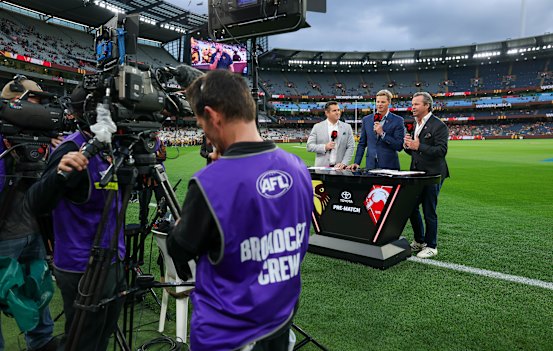
Thursday night at the MCG, and it’s the Swans versus the Hawks. But there’s a bigger team taking to the field – 75 men and women pulling together to bring 4½ hours of live television into your lounge room. And with no script and zero certainty they are going to have to rely on their faith in their preparedness to pull them through – whatever happens.
This is their behind-the-scenes, seat-of-their-pants story.
The match is more than an hour away when a production meeting in Channel Seven’s vast commentators room on level 3 of the Melbourne Cricket Ground concludes.
There are issues. Not enough TV monitors on the ground, so Rebecca Maddern will be expected to talk to viewers at home without actually seeing what she is talking about. But the host is in can-do mode. “That’s OK,” says Maddern, who under her elegant cream suit is wearing a pair of daggy ski socks because the worst thing in television is to stand on the MCG ground for four hours with freezing feet.
A giant window dominates one side of the box and beneath it is what must rank as the neatest workstation in the country – Brian Taylor’s commentary desk.
On it, Taylor, the former Richmond and Collingwood player and Coleman medallist turned Channel Seven caller, known universally as BT, has placed the tools of his trade – his charts.
There is his handwritten results chart, on which coloured squares of fluorescent ink (green for a win, pink for a loss) document the ecstasy and the agony for the competition’s 18 clubs.
Sheets of A4 paper listing player statistics – laminated, if you please – sit on the table, along with tonight’s running order. A pad is divided in half with dot points, talking points written in Taylor’s careful hand – red pen for the Swans, blue for Hawthorn. He’ll deploy them among fellow caller Hamish McLachlan and expert commentators Kane Cornes and Luke Hodge if the on field action is less than thrilling, or too one-sided. No fear. Tonight will turn out to be a cracker.
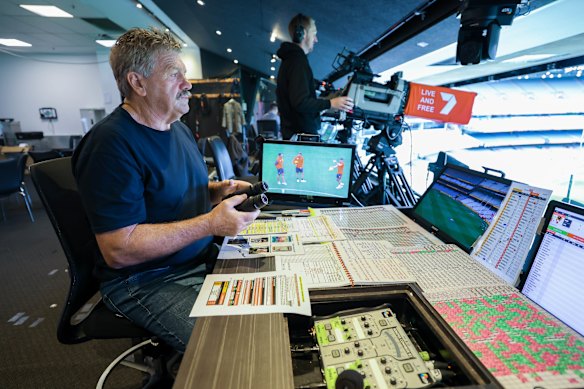
At this stage of the evening, Taylor is calm, eager to explain and grateful for the interest. Not even his wife has dropped in to see him in action, although his kids have.
For Taylor calling the game, with its vast capacity for error, is preferable to being a talking head on a panel show. “Yeah, because this is just real,” he says. “This is where all the talk stops, and this is where all of the questions are answered. So this is why it’s exciting.”
Commentating, he agrees, is an exposing job. “Very. We make one mistake tonight – and we will … let’s say if we miss the mark here, or we call some person the wrong goal kicker … then we’re getting the shit bashed out of us for the next week. It’s a very hard job to avoid criticism.”
And not just because of mistakes, he says. “Not everyone wants the same steak. Some like a medium rare. It’s the same in their football. Everyone likes something different.”
Nearby, Maddern already has two broadcasts under her belt, the 4pm and 6pm news. “It is an intense, really intense, couple of hours. When I get home, I wish I could just fall in a heap, but you don’t. You are still buzzing,” she says with a broad smile.
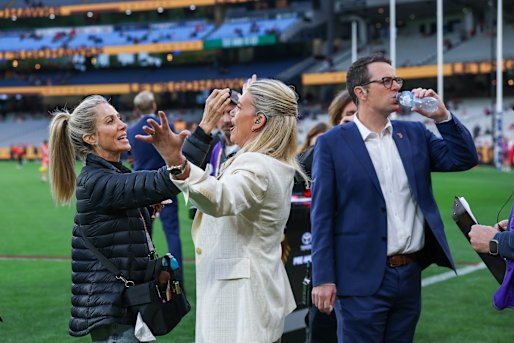
“We’ve just played the game of TV. It’s difficult to get right, but it’s the best time of the week.”
Nothing stands still. Out of the corner of my eye I notice BT, one of the AFL’s most respected figures, is slipping off his jeans and into more broadcast-appropriate trousers. It later turns out The Age’s trainee visual journalist Ruby Alexander has the whole moment captured on video, which we agree to lock in a vault marked never to be released.
Taylor, who also calls matches for Triple M, likes to be highly organised. He has every flight, taxi and hotel room booked for the first 15 rounds of the season as Seven’s Thursday night coverage takes viewers around the country.
How does he feel about this? “I love it.”
Hours earlier and on the other side of the MCG, the behind-the-scenes production members of this army assemble in a loading dock known as the outside broadcast compound. They are grouped in the shadow of a huge “double expando” trailer known as “the truck”, which houses the TV control room.
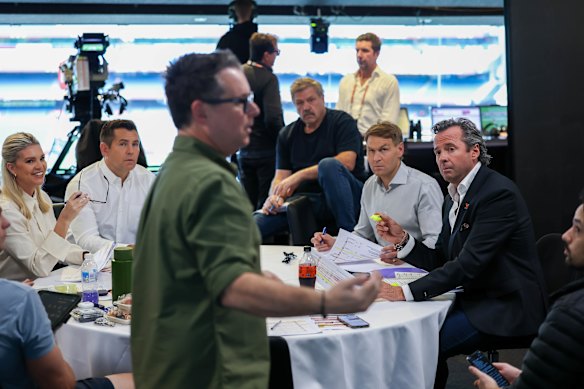
Brandishing the run sheet, senior producer Daniel Edwards, with an air of unassuming authority, is briefing the troops:
“Luke Hodge will be on camera 4.
“Mitch Cleary will do a walk off interview with a predetermined Swan.
“The Swans have agreed to give us access to the changing rooms.”
But with opportunity comes risk, particularly with live TV. When Taylor does his trademark Roaming Brian walk-around after the match, extra care will be needed.
“If BT is taking us there, we will have to poke our heads around the corner and make sure no one is naked,” Edwards explains.
The lengthy run-through over, Edwards reveals, the detailed talking points are just for that evening’s first segment, before the match even starts. “And then we will do some footy – yay!”
The side of the “double expando” trailer is emblazoned with the logo of NEP, a global production company expert in live sport. Seven produces the match in partnership with NEP and shares the production staff.
Televisually speaking, all roads in the MCG lead to the truck. There are 25 cameras on the ground, some robotic, some Steadicam, some 4K Ultra Zoom, some on drones, some hidden in the goal posts.
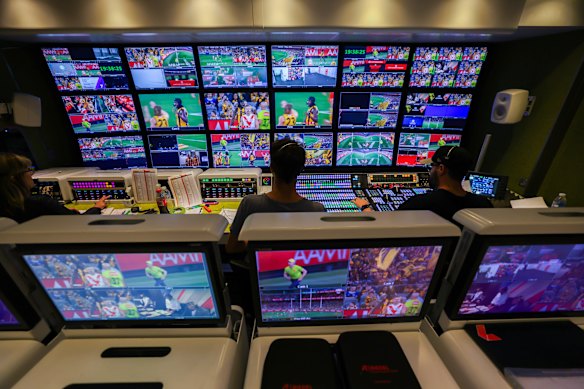
They all feed into the control room, where the production team select camera shots from a bank of TV monitors so vast it is impossible for civilians non-versed in television to process. “Like visual DJs,” Age photographer Joe Armao says.
In a small office nearby, Gary O’Keeffe, Seven’s head of AFL and sport innovation, has set up shop in his “executive shed”. He will not enter the trailer. “The last thing they need is me in there.”
O’Keeffe adds: “We’re big on families. Everyone’s welcome to our broadcast. Yeah, we get down and talk stats and all that, but we love those warm family moments.”
Thus, when Gold Coast Suns player Zeke Uwland made his debut for the club the other week, Seven already had cameras trained on his mum, Michelle, sitting in the stands to record her reaction, and interviewed her with her boys Zeke and Bodhi (another Suns player) after the match.
It is these human stories – and more sweeping drone shots, if restrictions can be overcome – that O’Keeffe sees as boosting AFL coverage into the future.
“At the end of the day, it’s live sport,” he says. “And you’re right, we are storytellers.”
Seven has leaned into Thursday nights – controversial with some fans – and stopped its traditional Saturday matches, which went behind the Fox Sports/Kayo paywall after the latest rights deal that started last year. Seven and Foxtel paid $4.5 billion for rights until 2031. For this match, Seven is the host broadcaster, Fox Sports takes Seven’s feed and adds in its own commentary.
O’Keeffe pushes back on criticism.
“Viewers have spoken,” he says. “They have spoken at home, and they have spoken with their remotes.”
And a prime-time Thursday audience is going to beat a Saturday audience.
Multiple rules changes are speeding the game up, which means less time for Seven’s TV adornments such as replays and tactics segments. The team is still adjusting to the new normal. But fast TV is good TV.
“Reality is, once that game starts, we don’t know how that’s all gonna go,” O’Keeffe says. “We’ve got no idea.”
On the boundary
We are on the move again. The darkened gloom of the car park is punctuated by animated shards of red and white heralding the Sydney Swans, courtesy of a brand-new giant video screen alongside the long race from the changing rooms towards the grounds. We ascend the race towards the bright rectangle of light at the top. This is it. We walk out onto the MCG. Pride and awe surge, emotions that are powerful and unexpected. But also: will we get in trouble for standing on the grass?
Seven’s team of presenters are already in place. Nick Riewoldt, Hamish McLachlan and Luke Hodge are grouped around a tiny desk on the boundary attended by camera operators and production staff. In the front row of the stand, excited children beg for a selfie, ignored by players ending their warm-up. But expert commentator and ex-Hawthorn captain Hodge strides over to the fence. It is minutes to airtime – they are in bliss, he is watching the clock.
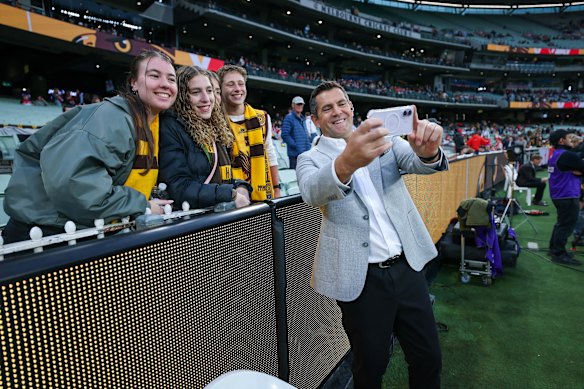
Not a ball has been kicked, but it has already been a good night for Cornes, who has had a goal-kicking tutorial from Hawthorn forward Nick Watson, a favourite player, and a no-holds-barred briefing from Sydney coach Dean Cox. For the forthright expert commentator, such access has him pinching himself.
But how does he square the need for such access on match day with the need to churn out sharp-tongued comments on the nightly panel shows, which last year resulted in North Melbourne and the Bulldogs banning him from their dressing rooms?
“But I think the clubs that handle it the best are those that probably understand it,” Cornes says.
Many are pretty good at picking up the phone for what Cornes terms “open dialogue” after his comments hit home.
“But performance dictates my commentary, really. I don’t just pluck comments from nowhere. And usually the best clubs understand that if they’re performing poorly, negative criticism is going to come with that.”
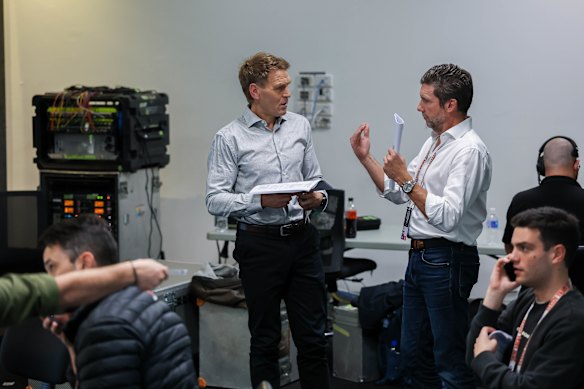
The Hawthorn club song starts up in the background as Cornes explains how he deals with a bad day in the commentary box.
“I don’t ride the waves like I did when I was a player. If I had a bad game as a player, I’d hate myself for three days, and that took a while to get over. And that was a poor character flaw of mine.”
In the truck
During the game, a quiet intensity pervades the control room.
Here, sport meets television and its accompanying commercial realities – all the ad breaks and sponsored segments are crossed off a list by Edwards, who is miked up and wearing headphones to communicate with the entire team.
Seven aims to screen six ads per quarter – and after each goal is the best place to do it. That’s no problem tonight. It’s a goal fest.
After the first goal, a Toyota ad plays, as it always does; it’s in Toyota’s contract.
The producer also logs every sponsored segments – Harvey Norman sponsors replays, Energy Australia the tactics segments.
Then there are the “squeezebacks” – when the on-field action shrinks to fit in a sponsored border that variously promotes Toyota, McDonald’s, AAMI and Bunnings, and other Seven programs.
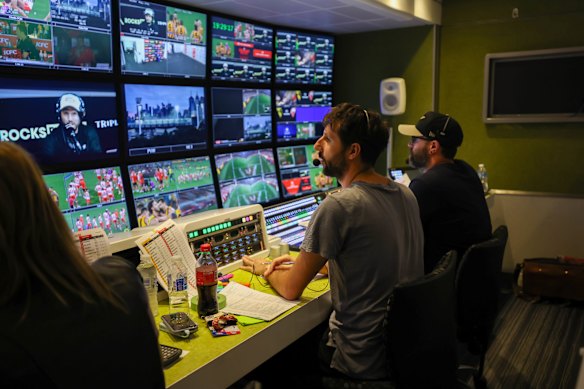
One line on the production log sheet intrigues: “After boring goal – shot of Triple M.”
In January, Seven West Media was absorbed into Triple M’s owner, Southern Cross Media, to create a merged, cross-media company.
The “boring goal” means the broadcast doesn’t need to screen a replay or tactics segment coming out of the ad break, so can cross-promote its sister radio station Triple M instead by screening a live shot of its commentary team.
Dean’s lolly jar
The team can expect to be thrown off course at any moment.
When Richmond player Hugo Ralfsmith recently chopped off his golden mullet in favour of a buzz cut, the control room was thrown into temporary consternation when he walked onto the ground – and nobody knew who he was.
“I said, ‘Who’s that?’ and I’m a Richmond supporter,” director Jarrod Rathjen reveals.
Now, someone has noticed that sitting beside Swans coach Dean Cox in his coaching box is a large lolly jar. Everyone is keen to get it on air, but Edwards requests they wait until he can word up Taylor in the commentary room.
When the time comes, the moment is seamless.
“Anyone else puts their hand in there and you will have it chopped off,” says Taylor.
Soon Emma Francis, Channel Seven head of communications – sport, who is shepherding us around the ground, has already received a text from the delighted Swans comms team.
Sweets manufacturer Allen has created the personalised “Dean’s Lolly Jar” label and added its own logo, hoping for some publicity, and it has already paid off. There was nothing accidental about this product placement.
It turns out Taylor had queried the jar with Jan Cameron, the match-day integration liaison responsible for ensuring that Seven’s sponsorship and marketing commitments appear on screen and no commercial conflicts occur that might annoy sponsors. “McDonald’s don’t sell lollies,” she explains.
The commentary team are a study in contrasts. The match callers sit to the left. Rather, Taylor sits. McLachlan stands, shirt untucked, blazer slung over his chair, his pink adidas sneakers now swapped for sensible white shoes for the cameras. McLachlan’s notes cascade over his desk. He has no laminates.
The two men are within touching distance, and silently tap each other on the shoulder or the waist, to signal it’s time to take over commentating. A silent passing of the baton.
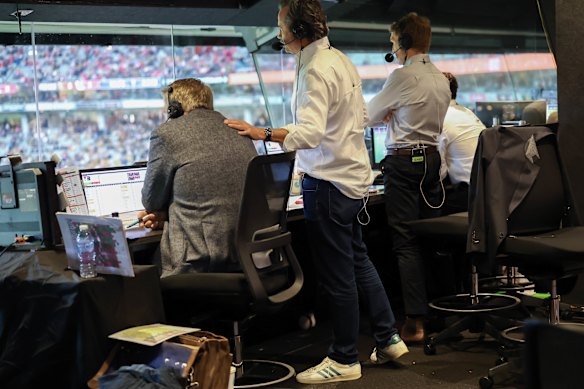
To McLachlan’s right, expert commentator Cornes has no papers on his desk. But he does have a laptop and an iPad, while Hodge makes do with a single notepad.
The banter is not confined to the commentary.
“I’m just a boy from Colac,” Hodge tells the effortlessly patrician McLachlan at one stage in a calculated burn that McLachlan receives with an air of studied nonchalance.
Most commentators expect a Sydney win, but the match tosses and turns and the Hawks run over the Swans 99 to 82.
But the content wagon rolls on for days afterwards.
Dean’s Lolly Jar ends up on the AFL’s official Instagram account, while Triple M posts on Instagram of Seven boundary reporter Mitch Cleary’s “five minute” photo op with our photographers, trying to work out what all the fuss is about.
But there was one detail the team missed. A soft drink bottle thrown by a Swans supporter at Hawthorn players after the siren was missed by all the cameras. And none of the Hawthorn players mentioned it in post-match interviews.
But when it was mentioned on FM breakfast radio the following Monday, the story blew up and ran for days, leading to a five-year ban for the fan.
No doubt it was a topic of discussion at the broadcaster’s Tuesday debrief, where the team would have assessed how closely they stuck to O’Keeffe’s mantra of sports broadcasting: “Tell the moment, tell the story, and then stay out.”
McLachlan puts it more directly: “Mum’s at home in Birregurra. She wants to be entertained, but not overloaded.”
Disclaimer : This story is auto aggregated by a computer programme and has not been created or edited by DOWNTHENEWS. Publisher: www.smh.com.au


