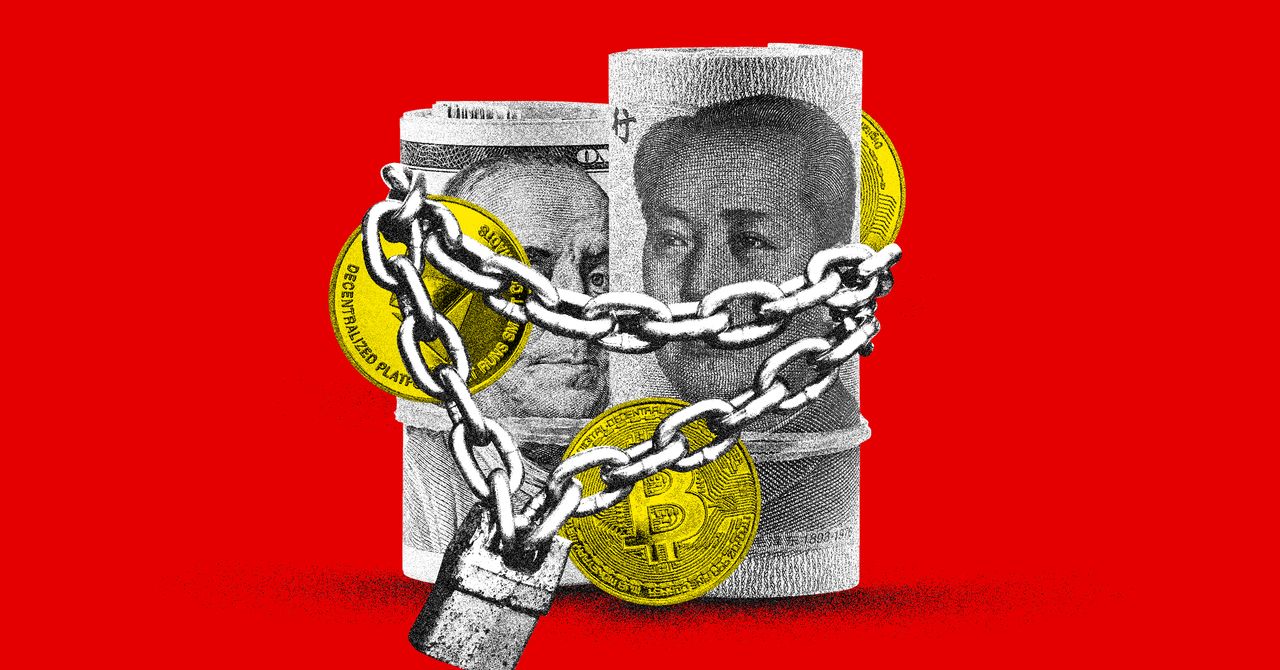
Chinese-language online black markets have become one of the biggest drivers of cybercrime in history, processing tens of billions of dollars of illicit finance every year. Helping the trade in stolen data, money-laundering services, and even at times electrified shackles, these underground marketplaces have fueled scam operations and human trafficking around the world. Now, officials in the United Kingdom have dealt one $20 billion cryptocurrency marketplace a potentially punishing blow.
On Thursday, the UK’s Foreign, Commonwealth and Development Office, also known as the Foreign Office, revealed financial sanctions against the Xinbi Guarantee online marketplace, which will likely limit its operations. The online bazaar, which has operated using channels and accounts on the messaging platform Telegram, has previously been linked to billions in cryptocurrency transactions and proved hard to disrupt.
The sanctions against Xinbi were issued as British officials also penalized multiple individuals allegedly linked to the operation of industrial-sized scam compounds in Cambodia, including the 20,000 person #8 Park compound. The British government also seized properties in London, including a £9 million penthouse, linked to the sanctioned individuals. Foreign Office minister Stephen Doughty said in a statement that the sanctions “send a clear message” that those running scam compounds will face consequences. The action follows a sweeping wave of penalties from the US and UK against Cambodian-linked scamming operations in October.
Over the last decade, hundreds of thousands of victims of human-trafficking have been forced to work out of compounds across Cambodia and Southeast Asia, running online cryptocurrency investment and romance scams day and night. This multibillion-dollar scam industry, which often has links to Chinese organized crime groups, has flourished and been propped up by secondary services and cryptocurrency marketplaces that sell the tools and technical infrastructure needed to operate the scams. These include Xinbi, which has become one of the largest marketplaces, since the Huione Group was sanctioned last year.
“Xinbi is or has been involved in profiting financially or otherwise obtaining a benefit from human rights abuses,” the UK’s sanctions register alleges, referring to brutal treatment and torture that has happened in some scam compounds in the region. “Xinbi has enabled and profited from the operation of scam centers in Southeast Asia.”
“Sanctions will make it more challenging for Xinbi, its merchants and users, to spend or exchange cryptocurrency that has passed through the marketplace,” Tom Robinson, the chief scientist and cofounder of crypto-tracing firm Elliptic, tells WIRED. Last year, analysis from Elliptic revealed that the Xinbi Guarantee platform has facilitated at least $8.4 billion in transactions since 2022. The “vast majority” of that money, Robinson said at the time, was likely to be money stolen from online scam victims. However, the platform’s other activity also involved selling the technology, personal data, and money-laundering services needed to run online scams.
Following WIRED’s reporting last May, Telegram removed channels and accounts linked to both the Huione marketplace and Xinbi. Since then, though, Xinbi has rebuilt its presence on Telegram and also moved to diversify its infrastructure to be more resilient to takedown actions.
“Xinbi was able to recover very effectively from Telegram’s action against it. It simply created new Telegram channels and continued its activity,” Robinson tells WIRED. “In fact it has grown substantially, increasing its market share following the shutdown of Huione Guarantee and other similar marketplaces.” Robinson now estimates that across the entirety of Xinbi, including the merchants that operate on it and its own infrastructure, it has processed at $19.7 billion.
The Xinbi website included in the latest round of UK sanctions lists multiple Telegram channels that contain thousands of members, with one including around 175,000 subscribers. Telegram did not immediately respond to WIRED’s request for comment about the sanctions against Xinbi and channels linked on its website. Telegram accounts linked to the Xinbi website did not immediately respond to WIRED.
Analysis from crypto-tracing firm Chainalysis says Xinbi has “taken additional steps” to protect its operations and estimates that between 2021 and 2025, it processed $19.9 billion. In recent months, it has duplicated some of its crypto payments infrastructure on an alternative messaging app and launched its own payment app XinbiPay, Chainalysis researchers write. “All of Xinbi’s services are connected on chain, signaling an effort to build out proprietary financial infrastructure and insulate itself from disruptions against other illicit service providers.”
Governments around the world have taken increasingly aggressive enforcement actions against different facets of the scam ecosystem—sanctioning crypto marketplaces, working to disrupt crypto-based money laundering, and raiding scam centers. Following the US-UK sanctions last year, including the ultimate arrest of alleged criminal mastermind Chen Zhi by Chinese officials, Cambodia has been attempting to shut down hundreds of scam compounds in the region.
However, the huge sums of money flowing through these criminal operations, plus close political links, often allows them to build new technology, purchase infrastructure, and become more resistant to takedown efforts. As a result of this kind of resilience, even massive international collaborations have struggled to make a significant dent in the scale and effectiveness of global scamming.
Gregory Heeb, the FBI’s deputy assistant director of the criminal division, said in a United States Senate Joint Economic Committee hearing on Wednesday that scamming is still thought to be vastly underreported in the US, but reported dollar losses have still increased roughly 350 percent since 2019. The FBI’s Internet Crime Complaint Center received roughly 456,000 digital scam complaints in 2025, according to preliminary data, and reported losses exceeded $17.7 billion.
“The network of the money launderers is, for the most part, separate from the network of the [scam] compounds itself,” said Karen Seifert, director of the Scam Center Strike Force within the United States Attorney’s Office for the District of Columbia in the Senate hearing on Wednesday. “Even if I can crack the code on who’s leading the compound at sort of the regional level, that person is totally divorced from the money-laundering network, and that’s a whole separate case. So we’re spending a lot of resources on both sides of the problem.”
The scale of scamming, money laundering, and closely linked online casinos operating out of Asia is “not like anything we have ever seen before,” says John Wojcik, a threat researcher at security company Infoblox and a former official at the United Nations Office on Drugs and Crime focussing on scamming operations.
“The critical vulnerability here is not at the point of the multibillion-dollar cybercrime and scam operations themselves, but in the underground banking and money-laundering infrastructure that has supercharged it,” Wojcik says. “Asian money-laundering organizations are clear global market leaders in this space, and we’ve only just begun to grasp how deeply they’ve infiltrated our financial systems and economies.”
Disclaimer : This story is auto aggregated by a computer programme and has not been created or edited by DOWNTHENEWS. Publisher: wired.com