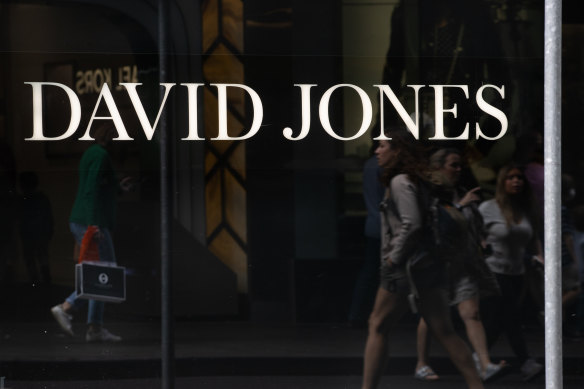

David Jones is moving to permanently pay suppliers up to eight weeks after their goods have sold in a sign of major financial pressure on the 188-year-old department store chain, which blamed a previous attempt to extend its deadlines in January on a one-off IT upgrade.
The company and its private equity owners, Anchorage Capital, dismissed concerns about the group’s ability to pay its bills as “misinformed” on Wednesday and argued it was in a good position to withstand a turbulent economy.
Department stores globally have been under major pressure from online shopping, smaller and more nimble physical rivals, and diminishing foot traffic as more people work from home, forcing the closure of Canada’s flagship chain Hudson’s Bay last year and the bankruptcy of Saks in the US this year.
A spokeswoman for David Jones, which Anchorage bought in 2022 after the chain lost about $2 billion in value under its previous owners, declared that: “All concession partner payments are up-to-date and there are no delays.”
Concession partners are the retailers that operate their own branded spaces within David Jones stores but that statement does not cover the suppliers who provide the goods that the chain sells directly to customers.
Industry sources said David Jones was late paying some suppliers and was pushing them towards 60-day payment terms, which the company did not dispute.
That means David Jones essentially has two months to pay suppliers for the goods sold in its stores after a customer takes them home, which could be a sign of financial stress or a hard-headed business move to turn the screws on suppliers.
In January, David Jones wrote to suppliers saying it needed to extend payment terms for that month because it was introducing a new computer system.
“This time will allow us to complete testing, validate accuracy, and align processes as we retire legacy systems and run parallel programs,” David Jones chief commercial officer, Erica Berchtold, wrote in the email seen by this masthead. “We therefore propose paying these amounts in the first week of March 2026, at which time you will receive payment for all of January 2026 and the first week of February 2026.”
The company, industry sources said, did not proceed with that move after suppliers disagreed. But it has since moved to the even longer payment terms, which a spokeswoman said would be good for transparency.
“Many of our major partners have already agreed to the new, streamlined payments approach, with further discussions under way, and we appreciate the openness and constructive engagement all partners have demonstrated throughout this process,” the David Jones spokeswoman said. “No payment changes have been made without the agreement of suppliers.”
Anchorage defended the business changes and rejected concerns about DJ’s financial health.
“We note that recent media commentary is best characterised as misinformed – like many businesses, David Jones is adjusting some operational processes to best position the business for sustainable, long-term growth,” a spokesperson for Anchorage said.
Anchorage said David Jones was trading well in the first half of the financial year and its sales were growing.
“We intend to continue investing in the business, supported by our financial partners, and look forward to enabling continued growth and innovation for David Jones,” its spokeswoman said.
Anchorage pointed to the $250 million it said David Jones had spent revamping its stores, loyalty program, digital presence and customer relationship systems to boost sales and compete head-on with online retailers and luxury brands going direct to consumers.
The Australian Financial Review reported in 2023 that Anchorage had paid just $92.5 million for David Jones earlier that year, buying it for a fraction of the $2.1 billion South African retail conglomerate Woolworths (unrelated to the Australian supermarket chain of the same name) had spent purchasing the department store chain in 2014.
Anchorage specialises in turning around undervalued businesses. Under its ownership, several David Jones stores, such as those in Chatswood Chase and Burwood in Sydney and Southland in Melbourne, have undergone major refurbishments. But the revamped stores are often a full floor smaller than they previously were.
This year’s payment changes are not the first time David Jones has been accused of squeezing suppliers to avoid cashflow problems. Reports last year said the group delayed supplier payments in 2024 as its store revamps commenced.
Industry concerns about the group escalated this year with suppliers confirming that they have been denied trade credit insurance which would cover them if David Jones cannot pay its bills.
Cosmetics group Mac announced earlier this year it was defecting to Myer from mid-2026.
It is a significant loss for David Jones, with health and beauty products making up 22 per cent of its $2.2 billion worth of sales in 2024, according to investment bank UBS. It already trails Myer’s market share in this crucial segment.
“Beauty has been a key focus for department stores, with its historical access to limited distribution brands often achieved via concessions with brand focused selling, with range of premium beauty products a key advantage,” UBS says.
David Jones reported a $74 million loss for the 2024 financial year – its first full year under Anchorage’s ownership – and is soon expected to report a loss for the 2025 financial year when its accounts are filed with the corporate regulator.
Morningstar retail analyst Johannes Faul, told clients that he was sceptical about whether local department stores could turn around their story of decline.
“The Australian department store sector has been in structural decline for decades, and this trend is unlikely to let up,” Faul wrote in a research note on Wednesday. “We expect Amazon to provide similarly disruptive to incumbents in Australia as in the US, compounded by a continued decline in the sector’s relevance to consumers as they shift their spending to entertainment, leisure, and specialty shops.”
Gordon Brothers, a Boston-headquartered investor that specialises in distressed lending which has a $190 million debt facility with David Jones, declined to comment.
The Business Briefing newsletter delivers major stories, exclusive coverage and expert opinion. Sign up to get it every weekday morning.
 Colin Kruger is a senior business reporter for the Sydney Morning Herald and The Age.Connect via email.
From our partners
Disclaimer : This story is auto aggregated by a computer programme and has not been created or edited by DOWNTHENEWS. Publisher: www.smh.com.au