
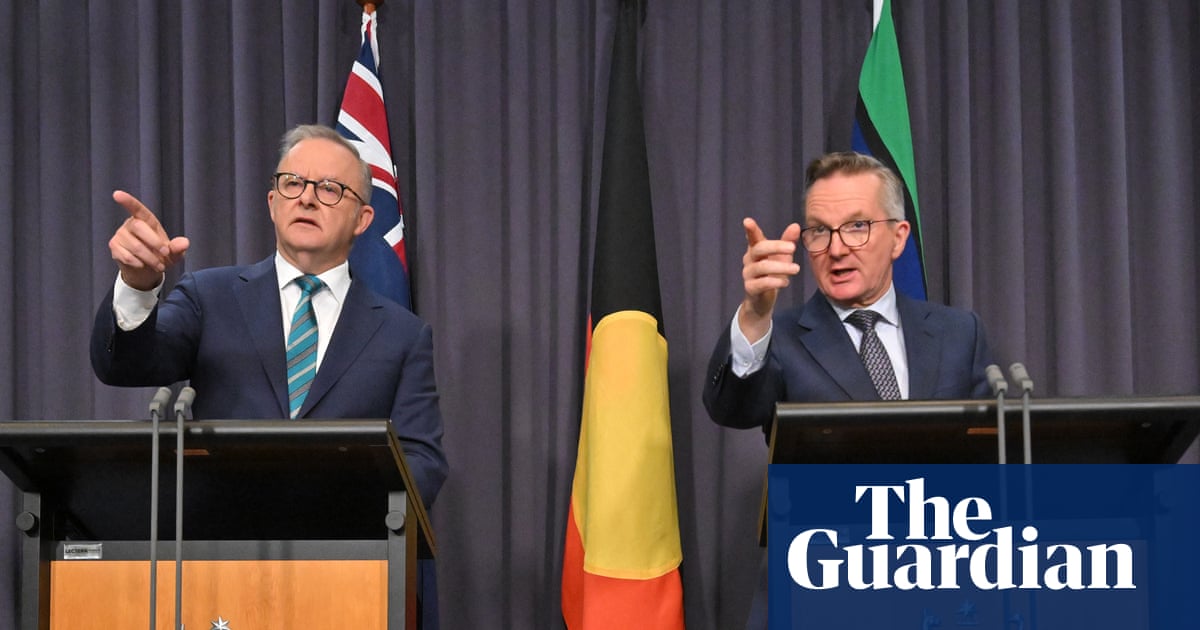
The prime minister and energy minister moved to reassure the public about normal or even higher levels of fuel supply in the coming weeks, as the Coalition escalated calls for a cut to the fuel excise and the government downplayed the prospect of any major restrictions on petrol sales.
It comes as the latest figures from the consumer watchdog showed diesel prices across Australia’s five largest cities have risen by an average of 10% over the last week, while unleaded petrol was up 8%.
The opposition leader, Angus Taylor, on Friday called for a halving of the fuel excise to help cut ballooning petrol prices, an idea the Labor government had rejected this week.
The latest figures from New South Wales showed one in seven service stations in the state had run out of at least one type of fuel, amid a surge in demand.
Anthony Albanese shared sympathy for families and businesses struggling with rising fuel bills, but said the government was working to bring more supply to areas facing shortages.
“We understand that people are under real pressure and the impact of this war is real,” the prime minister told a press conference in Canberra.
“It’s happening across the other side of the world. But in today’s interconnected world, it’s why we have to engage and we acknowledge that. I feel for people who are under pressure with some of the shortages which have been there.”
Albanese said again that shortages were a “distributional” issue in regional areas especially, adding: “there hasn’t been a reduction in supply of fuel into Australia or indeed production.
Government sources expressed concern about economic downturn if people stopped travelling and stayed home, with responses such as encouraging people to work from home or limit driving – canvassed in 2020 government documents about fuel crises – currently considered unlikely.
Albanese said Monday’s specially convened national cabinet meeting of state and territory leaders would work on a “national response” to the fuel crisis, contrasting that to how various states had different responses to the Covid pandemic.
“One of the lessons of the Covid pandemic is that we made a number of decisions as a nation that could have been made better if there was proper consideration. We also had different systems operating across the eight states and territories,” Albanese said.
Albanese said six tankers of jet fuel from China would arrive in Australia between 28 March and 8 April. Chris Bowen said jet fuel supplies from China were assured until late April or early May.
“Australia’s supply of petrol and diesel and oil will be the same, if not higher, than it normally would be,” he said.
In NSW, the energy department said that 347 of the 2,414 service stations registered in the FuelCheck compliance platform – or just over one in seven – are temporarily out of stock of one fuel type.
Fifty-nine stations are out of any type of fuel, and 207 stations are out of diesel, premium diesel, or both, an increase on Thursday’s figures.
Taylor on Friday urged the Albanese government to immediately halve the federal fuel excise for three months. That sales tax is set at 52.6 cents a litre of fuel bought, with a halving to potentially save motorists 26 cents a litre.
Such a move would be expensive. Former opposition leader Peter Dutton proposed at the 2025 election to halve the fuel excise for 12 months, which was then set at 50.8 cents a litre, and estimated to cost $6bn.
State premiers and federal independent politicians have called for the excise to be cut, but treasurer Jim Chalmers said on Tuesday “it’s not something that we have been considering.”
Analysis showed the richest households would benefit the most from such an idea; economists have warned it could worsen petrol shortages and add to inflation.
“Fuel prices are rising, stations are running dry, and families already stretched by the cost of living are falling further behind. This is now a national fuel crisis,” Taylor said.
The Nationals leader, Matt Canavan, was critical of the government for overseeing fuel shortages.
“The government says there is enough fuel in the system, but if that is true, then this is a failure to get fuel where it is needed,” he said.
Albanese did not endorse the idea when asked about cutting fuel excise, but did not rule it out either, saying “my government has always been strong on cost of living measures. We’ll continue to do so. We do so in a responsible way in the context of our budget considerations.”
The Australian Competition and Consumer Commission said on Friday that across the five largest cities, average diesel prices reached 303.5 cents a litre, up 10% from the previous week, while regular unleaded petrol was 252.2 cents a litre, up 8%.
Additional reporting by Penry Buckley
Disclaimer : This story is auto aggregated by a computer programme and has not been created or edited by DOWNTHENEWS. Publisher: theguardian.com







