In the second free practice session for the Japanese Grand Prix, McLaren driver Oscar Piastri set the pace with a 1m30.133s, finishing around a tenth clear of the two Mercedes drivers, Kimi Antonelli and George Russell.
However, anyone hoping for a close fight at the front or a McLaren breakthrough should be cautious. In the decisive long runs at the end of the session – completed on heavy fuel – Mercedes once again proved to be the dominant force, and by a clear margin.
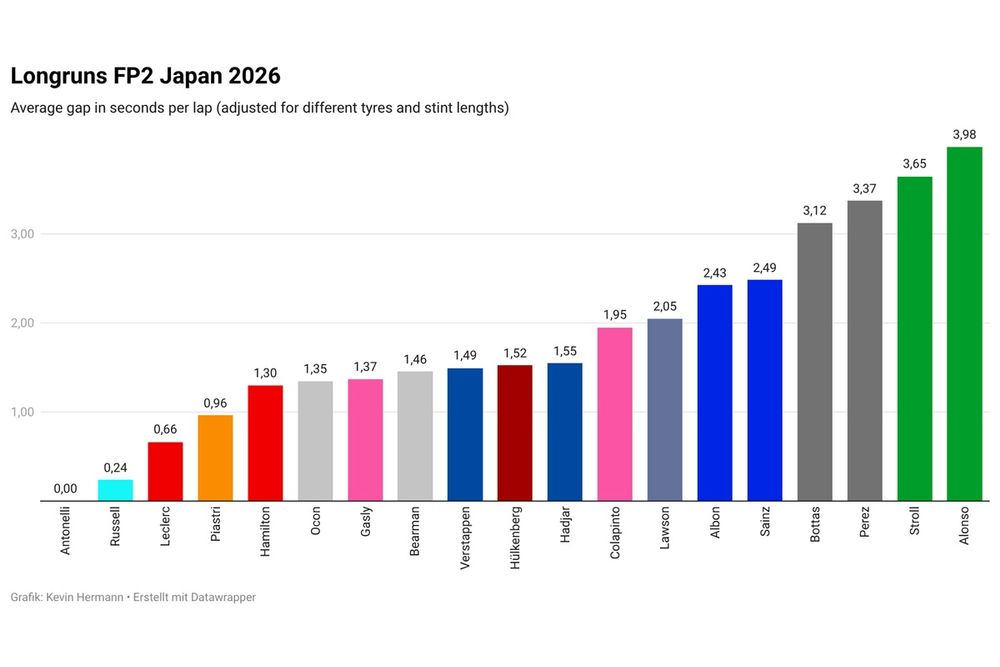
When adjusting the long-run data for different tyre compounds and stint lengths, Antonelli emerged as the fastest driver by some distance. On average, the Italian was around two and a half tenths of a second per lap quicker than Russell. McLaren, meanwhile, didn’t feature near the front in that comparison.
Ferrari once again the second force
Behind Mercedes – at a noticeable gap – sits Ferrari, just as in previous race weekends. Charles Leclerc was roughly 0.66 seconds per lap slower than Mercedes in long-run pace.
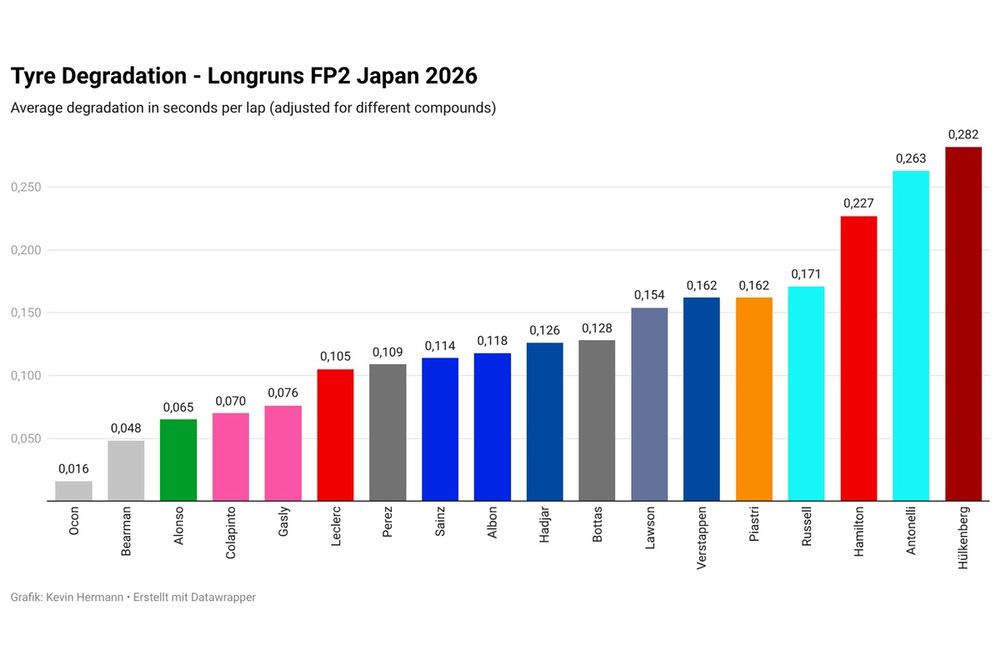
It was a difficult session for his team-mate Lewis Hamilton, who never found a rhythm. The seven-time world champion lost an average of 1.3s per lap and also struggled with high tyre degradation.
McLaren slotted in between: Piastri was, on average, 0.96s per lap slower than Mercedes on the long runs. His team-mate Lando Norris did not complete a long run at all due to technical issues, having spent a prolonged period in the pits.
Where Mercedes is quicker
One thing is clear: in terms of qualifying pace, Mercedes has likely not shown its full potential and therefore heads into the remainder of the weekend as the clear favourite. But where exactly is the Silver Arrows finding its lap time?
A look at the average sector times from the long runs shows that Mercedes gains most of its advantage over Ferrari in sectors one and three. In sector two, Leclerc was almost as quick. The key difference lies on the long straights in sectors one and three.
Mercedes achieves significantly higher top speeds – particularly on the run to Turn 1 and towards the final chicane. The advantage towards Turn 1 can reach up to 15km/h, and around 10km/h in the final sector. In the fast Esses of sector one, Ferrari is nearly level – the bulk of the time loss clearly occurs on the straights.
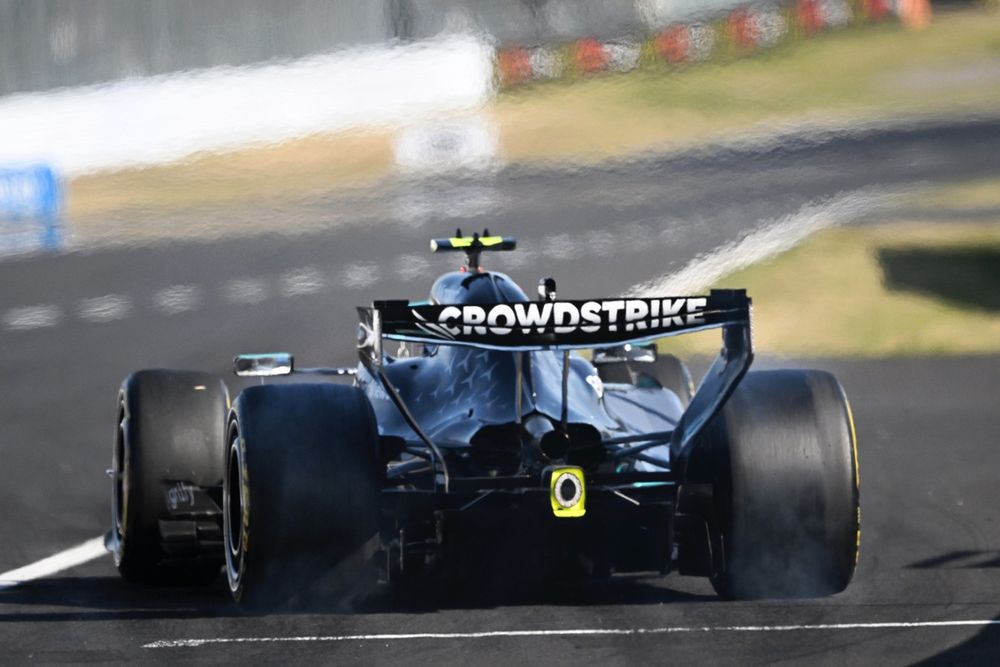
Andrea Kimi Antonelli, Mercedes
Photo by: Mark Sutton / Formula 1 via Getty Images
A similar pattern can be seen with McLaren: here too, most of the time is lost on the straights, despite the Woking team using the same engine. In addition, weaker performance in the corners compounds the deficit, leaving McLaren behind Ferrari.
Red Bull in no man’s land – but PU isn’t the main issue
For Red Bull, the outlook is once again bleak. With an average long-run deficit of 1.49s per lap, Max Verstappen is not only far off the pace compared to the frontrunners, but even behind Haas (+1.35s) and Alpine (+1.37s).
After three race weekends, the impression is increasingly that Red Bull is currently just a midfield team – and this does not appear to be primarily due to engine performance. In fact, sector three, with its long straight, is the only part of the lap where Red Bull can somewhat keep up.
As already seen in China, the RB22 loses the majority of its time in the corners. Telemetry data even shows that Red Bull performs better on the straights than Ferrari and McLaren. However, especially in the fast Esses of sector one, there is a clear lack of performance.
It is also notable that sister team Racing Bulls loses significantly more time on the straights despite running the same engine. It is possible that Red Bull has opted for an overly aggressive low-downforce set-up, or that the car is fundamentally too focused on efficiency, lacking the necessary overall downforce.
Midfield: Haas and Alpine set the pace, Audi in the mix
In the midfield, a similar picture to China emerges. Haas (+1.35s) and Alpine (+1.37s) have the strongest long-run pace, with Audi (+1.52s) close behind.
Nico Hulkenberg’s long run started promisingly, but the strong initial phase came at the cost of high tyre degradation. Overall, Audi ended up on par with Red Bull – raising the question of whether this reflects Audi’s progress or simply highlights Red Bull’s struggles.
Racing Bulls (+2.05s) has already lost significant ground to the front of the midfield, while Williams (+2.43s) once again disappointed. The backmarkers remain Cadillac (+3.12s) and Aston Martin (+3.65s). A sobering note: Aston Martin’s qualifying pace was roughly equivalent to Mercedes’ long-run pace with a full fuel load.
We want your opinion!
What would you like to see on Motorsport.com?
– The Motorsport.com Team
Disclaimer : This story is auto aggregated by a computer programme and has not been created or edited by DOWNTHENEWS. Publisher: motorsport.com