
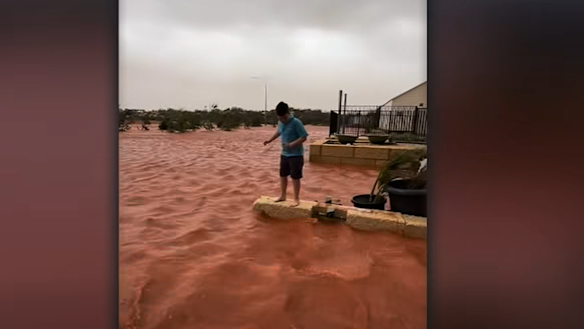

Residents in Exmouth are assessing the trail of destruction left by Tropical Cyclone Narelle as the system weakened on Saturday morning to a low and continued to track south.
The cyclone crossed the WA coast at Coral Bay on Friday afternoon as a category 3 system, bringing with it winds of up to 250km/h which tore off roofs, uprooted trees, flooded homes and cut power.
A day on, Exmouth Shire president Matthew Niikkula said the town had suffered “extensive damage”, with many of the town’s residents without running water.
“The airport has suffered catastrophic damage to the terminal, so we won’t be able to receive or send out regular passenger planes for a while. The runway itself has sustained major damage, which RAF are working on trying to clear that and repair that as fast as possible in order to be able to get some support planes in,” he said.
“Everyone’s on emergency power right now, and we’re still cut off by road and by air except for helicopter at the moment.”
Niikkula said there were no injuries reported as a result of the storm, but that damage to properties was “very extensive”.
“Roofs off, sheds down, fences down,” he said.
Both of the town’s supermarkets had also received damage to their buildings and he said, as well as the fuel stations.
Niikkula will be taking part in emergency talks on Saturday about how best to get the town back on its feet and the community will be updated after.
Resident Violeta Brosig said it was the worst cyclone she had experienced since moving to the town 17 years ago.
“It was the most scary,” she said.
“To be honest I’m not worried about the property at all. Property is just whatever. I just want to know how everyone is.”
Almost 350mm of rain fell as the cyclone passed through – a year’s worth of rain in 12 hours. The town was on red alert for more than 24 hours.
Residents reported the town was bathed in red dirt as the wind stirred up the Pilbara dust, creating an eerie post-apocalyptic scene.
“The wind started from about 8pm [Thursday night] and then it just continued to get worse and worse,” Yarni McLachlan told 9 News Perth.
“Pretty scary gusts.”
Bureau of Meteorologist spokeswoman Christie Johnson said the system was continuing to make its way south and inland on Saturday.
“Yesterday Severe Tropical Cyclone Narelle crossed at the coast around Coral Bay during the afternoon as a category three, but was downgraded to a category two system during the evening as it moved onshore and to the south,” she said.
“Through this morning, it moved through the northern Gascoyne. Last night we saw 133km/h wind gusts at Carnarvon Airport and 122km/h at Gascoyne Junction.
“We have seen the wind beginning to increase this morning over the southern Gascoyne with Golden Grove Airport recording 90km/h and 89km/h recorded at Mount Magnet.”
Johnson said the low would bring destructive winds to inland communities, with some areas expected to cop between 30 and 50 millimetres of rain within six hours, which could cause flash flooding.
Overnight, Dalgety Downs recorded the most rain, with 112mm in the gauge in the past 24 hours.
Talisker Station resident Judy Rogers said her property, about 150 kilometres east of Shark Bay, was damaged by the cyclone.
“We had very strong winds all day yesterday that picked up lots of red dirt,” she said.
“The winds intensified around about 6 o’clock. The rain was coming in horizontal.”
She said they measured around 104mm of rain and sustained damage to some of the roof on the house and the roof of one shed was gone completely.
“Some of our power solar panels are on the ground,” she said.
“We’ve lost one wall on the shearing shed. Given the strength of the winds we endured we have faired better than we expected. We put this down to the very good warnings that were put out giving us time to prepare.”
Narelle was reclassified as a tropical low on Saturday morning.
Now known as ex-tropical cyclone Narelle, the weather system is still expected to bring severe weather to large parts of WA on Saturday, Bureau of Meteorology’s Angus Hines said.
“We will continue to see some weather impacts, particularly rainfall but also some strong wind as this weather system keeps on moving southward,” he said.
Narelle is currently moving through the Wheatbelt area of WA and heading towards the Great Southern before heading towards the Esperance coastline this afternoon and this evening.
By tonight the system will be back out to sea after having made landfall twice already – first in Queensland and then in the Northern Territory – before reforming.
“This will be the final time we say farewell to Narelle,” Hines said.
Start the day with a summary of the day’s most important and interesting stories, analysis and insights. Sign up for our Morning Edition newsletter.
From our partners
Disclaimer : This story is auto aggregated by a computer programme and has not been created or edited by DOWNTHENEWS. Publisher: www.smh.com.au






