
Imagine someone upstream in your company just deployed an AI agent. Their throughput doubles overnight. Work starts flying to you at twice the speed. But you’re still in Excel. You still don’t have access to the company’s data lake. Overnight, you’ve become the bottleneck — the weak link in a chain that’s suddenly moving faster than ever.
“This will expose the weakest link in an organization,” said Eric Bradlow, chair of the marketing department and vice chair of AI and analytics at the Wharton School of the University of Pennsylvania, who uses that exact scenario to describe what he fears is coming. “If efficiency gains are happening here but not here,” he said, gesticulating with his hands, “it will be exacerbated and you will see it quickly.”
That bottleneck problem is materializing across corporate America — and the root cause isn’t technology. It’s that companies aren’t doing the hard, unglamorous work of preparing the people who are supposed to be working alongside it.
The 7% problem
The numbers are stark. Across the corporate sector, consultants and analysts see similar, troubling patterns. According to Deloitte’s most recent Tech Trends report (covered by Fortune when it was released), IT accounts for roughly 93% of AI adoption budgets. Only 7% of companies are making meaningful progress designing how humans and AI actually work together.
The deliberate, structural work of figuring out what happens to the people whose jobs are being transformed is an afterthought, said Lara Abrash, chair of Deloitte U.S.. “Ninety-three to seven is not the right level of effort in both places,” she said. “Companies should be spending as much time on the workforce right now as they are on the technology. And we’re seeing most companies focus much more on the technology.”

courtesy of Deloitte
The same imbalance shows up in Wharton’s AI adoption research. Bradlow said Wharton and GBK Collective found in a prior research report what he calls a “donut hole” at the center of most large organizations: the C-suite is investing heavily in AI, younger workers have grown up using it natively, but the middle managers who actually have to orchestrate workflow change are the ones resisting — or being left behind. It was unclear from the data whether this took the form of passive or active resistance.
“You have the C-suite making massive investments in AI,” he said, and “obviously the young people, they’re trained using AI and it typically is the middle, the middle managers where the, if you like, the reluctancy is.”
Why companies keep getting this wrong
The reasons for the imbalance are not mysterious. Technology investments are legible: you can point to a use case, benchmark a result, or show a board a number. Workforce transformation is messier, slower, and harder to quantify.
“It’s a little bit easier to get your hands around what you would need to do with technology,” Abrash said. “It’s a lot harder to deal with the workforce.” This isn’t just an “AI-specific thing,” she added, noting, for example, how companies have grown fond of reorganizations, seemingly for their own sake, and managers looking at various mechanisms to cut headcount instead of doing the hard work of optimizing their workforce. “This behavior is not because of AI. It’s just the way it generally is.”
Linda Hill, a professor at Harvard Business School and head faculty chair of its Leadership Initiative, put it in a broader leadership context in a recent conversation with Fortune. In her new book Genius at Scale, co-authored with Jason Wild and Emily Tedards, she argued that the entire model of what makes a great leader is shifting — and many executives are still operating on the old playbook.
“Traditional leadership has been: be decisive, stick out the chest, show confidence. This is the destination. Get in the car and follow me, it’ll be okay,” said Wild, a 25-year innovation veteran who led teams at Microsoft, IBM, and Salesforce. The problem with that approach now, he added, is that “the world is literally shifting underneath our feet by three or four feet every week.”

courtesy of Jason Wild
Hill and Wild call the new required skill “wayfinding” — a deliberate contrast to the old chest-sticking-out method of “pathfinding.” Pathfinders set a destination and drive toward it. Wayfinders navigate fog. It’s suddenly an era, Hill added, when org chart whispers include “I don’t even know what team I’m going to need in a year, let alone three,” arguing that the wayfinder way of leadership will matter enormously. Hill explained it this way: pathfinding isn’t an inherently old-fashioned way of leading, but it is one orientated around a clear destination in sight; we aren’t in that kind of circumstance now. The destination is ahead of us, but it’s unclear.
“When we finally realized what we were studying was wayfinding and not pathfinding,” Hill said, “we also realized how emotionally and intellectually challenging innovating and being agile really are.”
What happens when you skip the human work
The consequences of neglecting the workforce side of AI aren’t hypothetical. Abrash described them in vivid terms.
“Workforces are like antigens in your body,” she said. “They can fight things they want to fight pretty hard … If they don’t see how it makes their jobs better and how they can show up and bring what makes them special, they’re going to be that antigen and they’re going to fight it.”
That resistance leads directly to failed adoption — companies spend heavily on AI tools that employees quietly route around, ignore, or undermine. But there’s a subtler and potentially more dangerous risk: when a human is removed from the loop without a deliberate design for what they’re supposed to be doing instead, the AI operates unchecked.
“You could end up having hallucinations and bad outcomes because you don’t have a human in the loop,” Abrash warned. “It’s a brand and reputation issue. It has to be done at the same time.”
Bradlow added a precision dimension that is often overlooked in popular coverage. In high-stakes industries — aerospace, life sciences, financial regulation — “90% accuracy is not okay. 95% is not okay. Maybe even 99% accuracy is not okay. You might need to be 99.999% accurate.” Training AI agents to reach those thresholds requires active human supervision, correction, and feedback loops that most companies haven’t built.
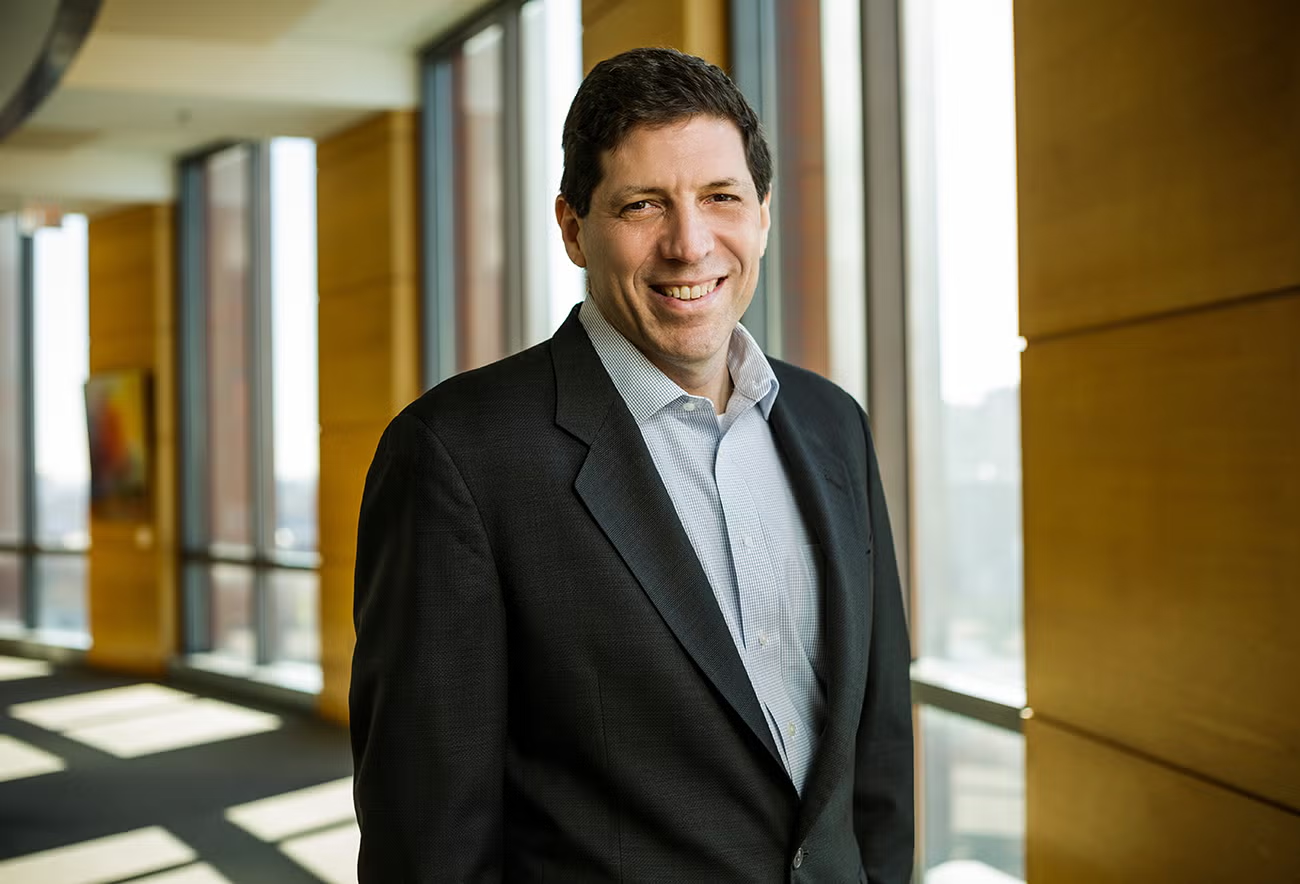
courtesy of the Wharton School
Nearly the same point was made by Wild, who noted that enterprise systems are deterministic — “you do a search on the internet, you want the same freaking answer every time,” but now we’re in different territory. “AI is a probabilistic system, right? You ask the same question, word it the same way, in ChatGPT five times, you get five different answers.” Time for a whole new style of leadership, in other words.
The real skills that will matter
What does the human bring that the machine can’t? Abrash cited Deloitte’s survey of high-performing teams produced a consistent answer of six consistently critical human capabilities, with three key ones to note. The first is curiosity — the drive to generate novel questions, not just process existing ones. “A machine is not tuned to create curiosity,” she said. “And when teams come together, designed to create new ideas and solutions, that’ll drive innovation and it’ll optimize what the machines do.”
The second is emotional and social intelligence. Machines can simulate empathy, but can’t feel the actual stakes of a team under pressure, a client in distress, or a workforce absorbing a major change. “We need EQ in the workforce,” Abrash said flatly.
The third is divergent thinking — the uniquely human capacity to generate multiple solutions rather than converge on one. “The technology is going to be intelligent and drive you down to one solution. That’s how it’s built. A human is not tuned that way.”

courtesy of Harvard
Hill echoed that idea in the context of leadership. She studied Kathy Fish at Procter & Gamble, the former Chief R&D and Innovation Officer who told her team bluntly: “We’re going to have to innovate on how we innovate.” Facing an activist investor and a product-centric legacy, Fish redesigned not just what P&G made but who was responsible for making it — expanding the definition of “innovator” to include virtually everyone in the organization. The lesson, Hill said, is that human creativity can’t be siloed. “You need everybody to be able to innovate.”
Bradlow talked about his college-age son, who is sorting through what to do with his career. “Every one of his friends are thinking, ‘So what is that job that’s going to be out there for me in two years? What actually are firms going to be hiring for it?’” He acknowledged that Wharton, the top business school in the world, has followed a certain model where finance and consulting majors go into certain tracks, but “I’m not sure those tracks and career paths exist anymore.”
Looking at the problem from an enterprise level, he said, “there’s a big human resources — I’ll just call it a mental health challenge that we’re going to face, which is people having to think about like, ‘Do I have a job future? What is it?’” Bradlow said he would be proud if his son chose to be an electrician, but he thinks it’s shortsighted to rush into supposedly AI-proof careers. Maybe consulting firms, banks and private equity won’t need as many highly educated workers due to AI adoption, but more “antiquated” members of the Fortune 500 surely will.
By the way, Bradlow added, this same concern applies to his job at the University of Pennsylvania itself. “We’re going to find out very quickly whether something that was founded by Benjamin Franklin can pivot quickly enough to really educate people on the skills that are needed today.” At the end of the day, the Accentures of the world are going to evaluate who has AI skills and doesn’t, regardless of their training, and “if we’re not adding value and if we don’t totally redo our curriculum around the kind of skills that are needed, we’re going to have a problem as an institution.” For instance, Wharton has now offers an entire AI major at both the undergrad and MBA level, in addition to its Business Analytics major, which is a decade old. Bradlow’s Wharton AI and Analytics department also offers experiential projects and short courses on AI.
Leadership roles no one is hiring for
Hill and Wild’s research identifies a specific kind of leader who is increasingly critical and increasingly rare: what they call the “bridger.” These are the people who translate across organizational boundaries — between IT and operations, between startups and legacy systems, between technology teams and business units.
Wild said she hears a constant refrain from executives: “We don’t have people who know how to bridge.” Leaders admit they can’t do all the work by themselves and need partners within their business, she added, but it’s a rare skillset.
At Delta, for example, a leader trying to build a biometric boarding-pass system with startup Clear had to navigate the airline’s own IT department, federal regulators at TSA, and the startup’s risk tolerance — simultaneously. That work is invisible, rarely credited, and too often structurally undervalued. Metrics and siloed organizational structures can get in the way of breakthroughs like a whole new system for boarding a plane.
“There are no bridger titles,” he said. “But Chief of Staff, RevOps, Forward Deployed Engineer — those are all bridger roles.” Wild said he can almost draw a line between companies investing in bridger roles and “laying off those people,” he argued, “they’re going to regret it later.”
Bradlow, meanwhile, said he’s watching something similar play out in talent markets. The AI skills gap is real, but the solution isn’t to flood into trades that seem “robot-proof” — a temptation he sees in students and workers everywhere.
“I’m concerned there’ll be a wide-level redeployment of people towards things they think are protected from artificial intelligence,” he said. “Maybe there’s a short-run version of that. But I’m not convinced there’s a long-run version.”
His preferred metric for talent in the AI era: “You don’t invest in someone who’s got a high intercept. You invest in someone who’s got a high slope. I don’t care what you know now. I care how quickly you can learn.”
The upside no one is pricing in
For all the doomsday narratives, there’s a revenue story hiding behind the efficiency story — and it may be the bigger one.
Accenture’s James Crowley, Bradlow’s research partner, said the dominant productivity framing of AI misses the point. “We’re trying to pivot from just the productivity conversation to the revenue and upside conversation.” In modeling a hypothetical $60 billion company for their most recent in-depth report, “the age of co-intelligence,” the researchers estimated approximately $6 billion in potential annual revenue growth from well deployed-AI, meaning that higher productivity among redeployed workers will lead to greater revenue, rather than a shrinking workforce. Among executives surveyed, 78% said they see more benefit on the revenue growth side than the cost-cutting side.
“The gains on the revenue side are going to eventually dwarf the gains on the efficiency and productivity side,” Bradlow said. “It’s corporations doing things they just could not do before.”
Abrash offered a concrete illustration. Knee replacement surgery used to require a surgeon to manually saw bone — an inherently imprecise process. Today, a robotic system handles the cutting with precision born of thousands of prior procedures, while the human surgeon focuses entirely on judgment, risk assessment, and the decisions that require a human mind. “There’s a set of work that someone no longer needs to do,” she said. “And it positions them to do something that’s higher value.”
The companies most likely to struggle aren’t the ones that failed to buy the right AI tools. They’re the ones who treated the workforce as an afterthought — spending 94% of their budget on technology and 6% on the people who have to use it.
“You have better tools than the explorers did,” Hill said. “You actually do have data. You do have all these emerging technologies to help us figure things out faster. But the emotional task, because we’re human, of working through that — given the amount of anxiety that exists in the world today — those are incredibly complicated challenges for leaders.”
Disclaimer : This story is auto aggregated by a computer programme and has not been created or edited by DOWNTHENEWS. Publisher: fortune.com





