
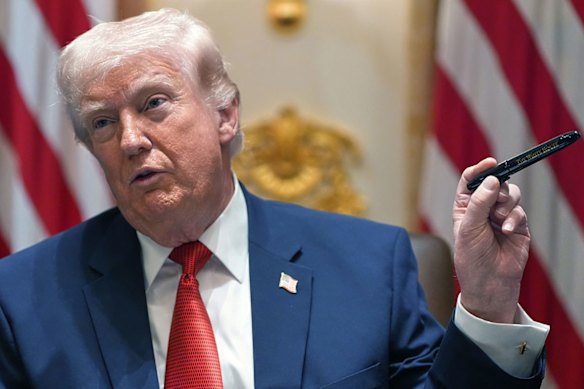
Financial markets are bouncing back as both Donald Trump and the Iranians are signalling the prospect of an imminent end to the war.
The US sharemarket jumped almost 3 per cent on Tuesday, with the ratio of stocks rising to those falling hitting record levels. Bond yields, which have leapt since the start of the conflict, eased and oil prices fell to their lowest levels in almost a week.
Investors were responding to a series of comments by Trump, a report in the Wall Street Journal that he had told aides that he is willing to end the war even if the Strait of Hormuz remains closed and an Iran state news agency report that its president, Masoud Pezeskhian, had told the European Union Council’s president, Antonio Costa, that Iran was willing to end the war as long as there were guarantees to prevent its recurrence.
Trump told the New York Post that the US was “not going to be there (Iran) too much longer” and the White House press pool that the US was “finishing the job” and he thought the US action would end within two to three weeks.
He also told his European and other (former?) allies to “go get your own oil,” which is another signal that the US isn’t going to attempt to re-open the Strait of Hormuz, instead leaving it to the rest of the world to deal with the mess it has created, one with significant and unpleasant implications for the global economy, with its assault on Iran.
While America is self-sufficient in oil, which Trump and his officials seem to believe insulates them against the fallout from the closure and enables them to walk away from the conflict without repercussions, its oil prices – and politically-sensitive fuel and diesel prices – are directly linked to global oil prices.
It isn’t immune to the effects of a continued closure of the strait, through which about 20 per cent of the world’s oil and oil derivates flow. The average US petrol price, which was $US2.92 just ahead of the assault on Iran, rose above $US4 a gallon on Tuesday. The price of diesel has risen from $US3.60 a gallon to $US5.45.
That will impact US inflation, economic growth and Trump’s approval ratings – which have been nose-diving throughout the conflict – in the lead up to this year’s midterm elections.
The US started the war without any plan to secure the Strait of Hormuz and without developing an exit strategy if, as has occurred, the Iranians were able to close it to shipping.
Trump’s increasingly aggressive threats – to bomb Iran’s power and desalination plants and seize or “obliterate” its key Kharg Island oil processing and shipping facilities –haven’t caused the Iranian regime to blink. They have allowed more ships passage through the strait, with tolls of $US2 million ($2.9 million) per tanker, but only those from countries with which it has good relations.
That’s one reason why the markets’ enthusiasm may be premature.
Until the strait is fully reopened, without tolls, and without Iran’s pre-condition that trade through the strait should be settled in China’s yuan, oil prices will remain elevated relative to their levels of around or below $US70 a barrel before the conflict. The oil price, which was above $US116 a barrel on Monday, traded around $US103 a barrel on Tuesday.
There’s another reason for investors to remain cautious.
Trump has teased the market with his commentaries and social media posts on the war previously. He’s generally, whether wittingly or not, misled investors.
Iran’s parliamentary speaker, Mohammad-Bagher Ghalibaf described it well last Sunday in a post that trolled the administration.
“Pre-market so-called ‘news’ or ‘Truth’ is often just a setup for profit-taking,” he said.
“Basically, it’s a reverse indicator. Do the opposite: if they pump it, short it. If they dump it, go long. See something tomorrow? You know the drill.”
Even cursory comparisons of Trump’s Truth Social posts, or public statements of developments within thee war with the markets’ reactions suggests Ghalibaf’s analysis is spot on.
Anything he [Trump] says about the progress of the war and its potential end has to be taken with more than one grain of salt.
While its conceivable that Trump-driven spikes in the markets in response to Trump comments, often just before they open, point to some level of insider trading – there’s been some very suspicious trading ahead of them – they could also just reflect Trump being Trump. He is prone to making overly-optimistic and, frequently, misleading statements.
Late last month, on a Saturday, he gave Iran 48 hours to re-open the strait or, he threatened, he’d obliterate its infrastructure – only days after saying the US was close to ticking off its objectives. Global sharemarkets tumbled and the oil price spiked.
Just before trading opened on the Monday, he extended that deadline to five days (and subsequently to10) while claiming there had been “in depth, detailed and constructive conversations” with Iran over the weekend about a “complete and total resolution” of the war.
The sharemarket rebounded, bond yields fell and someone – or several someones – made hundreds of millions of dollars, if not billions, from positions in derivatives and predictions markets taken out mere minutes before he posted those comments.
Last week, when he again threatened to destroy Iran’s infrastructure in another attempt to coerce Iran into re-opening the strait, the US sharemarket fell. He hasn’t, of course, made good on the threat, which could trigger devastating Iranian attacks on the regions’ energy and water infrastructure.
Now, he’s hinting at a US withdrawal from the war, and markets are once again responding positively to his statements.
Since the start of the war, there have been numerous similar instances where Trump comments have caused the market to move materially before he has contradicted himself in subsequent comments or posts, with those movements unwound.
That’s why anything he says about the progress of the war and its potential end has to be taken with more than one grain of salt.
Nevertheless, and despite a continuing build-up of US troops in the Middle East, which could presage an assault on either or both of Kharg Island or Iran’s nuclear materials stockpile, it is apparent that the US has no stomach for the price it could pay for trying to re-open the strait.
Having devastated Iran’s military and its infrastructure, there’s not much more it can achieve by prolonging a war during which Iran has retaliated with missile strikes on Israel, US military bases in the region and the oil infrastructure of America’s Middle Eastern allies unless it is prepared to risk its troops in a ground conflict or its naval ships, and probably ground troops, in forcing passage through the strait.
If the US does end the war, apart from confirming the market’s adage that Trump Always Chickens Out, it will probably lead to the re-opening of the strait. It’s not in Iran’s interests to keep it closed, other than as leverage.
It might re-open as a tollway, with Iran charging $US2 million a ship, but it will be a slow return to normal for the oil trade and the world’s economies, given the impact of the disruption to the flows, the need to refill depleted inventories and the damage to the region’s energy infrastructure and political stability in a region that produces about a third of the world’s energy.
Investors – and this is probably the sensible response to anything to do with Trump and anything that he says – shouldn’t get too far ahead of themselves.
The Market Recap newsletter is a wrap of the day’s trading. Get it each weekday afternoon.
 Stephen Bartholomeusz is one of Australia’s most respected business journalists. He was most recently co-founder and associate editor of the Business Spectator website and an associate editor and senior columnist at The Australian.Connect via email.
From our partners
Disclaimer : This story is auto aggregated by a computer programme and has not been created or edited by DOWNTHENEWS. Publisher: www.smh.com.au




