Updated ,first published
The nation’s major TV broadcasters will demand the Albanese government abandon Australia’s broadcasting tax and fast-track efforts to force tech giants to pay for news to plug a $90 million hole created by a planned crackdown on gambling advertising.
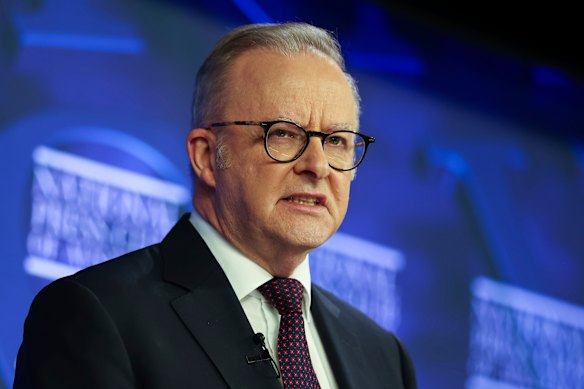
In an address to the National Press Club on Thursday, Albanese revealed restrictions on betting ads spanning stadiums, uniforms, TV, radio and the internet, but stopped short of the complete ban on online gambling advertising recommended by the late Labor MP Peta Murphy more than 1000 days ago in her last political act.
Gambling critics argued the planned changes, which the government hopes will take effect next year, did not go far enough to address Australians’ $30 billion in annual gambling losses, but media companies already battling social media rivals warned they would need compensation for the changes.
“We are getting the balance right. Letting adults have a punt if they want to, but making sure our children don’t see betting ads everywhere they look. Because we don’t want kids growing up thinking that footy and gambling are inextricably linked,” Albanese told the Press Club.
He said the government would cap the number of TV ads from betting agencies to a maximum of three per hour between 6am and 8.30pm, and would ban all gambling ads on radio during school drop-off and pick-up times.
The new restrictions – which this masthead revealed were coming on Wednesday – will also include a ban on cross-promotion that mixes sporting commentary with betting odds, an end to advertising on jerseys and in stadiums, a ban on online advertising to people under 18, and blocking illegal gaming sites. The use of celebrities and sports players in gambling ads will also be banned, as will online Keno type “pocket pokies” under Labor’s proposal, which is yet to be introduced to parliament.
Australian media companies could be hit hard by the reforms. Nine Entertainment, owner of this masthead, along with Southern Cross Austereo, owner of the Seven Network, and Network Ten, rely on gambling advertising revenue to cover major sports rights such as the AFL and NRL.
In response to Albanese’s announcement, Free TV, the lobby group representing these free-to-air broadcasters, called on the government to consider mitigation measures to offset the risks to revenue posed by the gambling advertising restrictions.
These include the removal of the commercial broadcasting tax, which media companies pay to the tune of about $50 million a year for using spectrum, and fast-tracking the introduction of the News Bargaining Incentive, a charge-and-offset scheme aimed at forcing big tech firms Meta, Google and TikTok to pay publishers for news.
“We are concerned about the revenue impact these restrictions will have on services that are required to be advertiser funded,” Free TV chief executive Bridget Fair said in a statement on Thursday. “The government has consistently acknowledged that mitigation is part of this equation, and we urge it to act on that commitment without delay.”
Equity Economics, a consultancy, found last year that Australians lose more than $30 billion a year across all forms of gambling, including poker machines, in a report commissioned by anti-gambling activists.
Reverend Tim Costello, chief advocate of the Alliance for Gambling Reform, said Albanese’s plans were a historic admission that Australia was not protecting children from gambling.
“Some good, practical measures,” Costello said. “But on the whole, it’s a very timid package. The Murphy report rightly said to ban all ads … We shouldn’t have kids seeing these ads at all.”
Southern Cross chairman Heith Mackay-Cruise said the company is looking forward to working with the government on compensation for its TV business, the Seven Network, which will lose out on revenue.
“We broadly support the government’s announcement and we look forward to working with it on financial compensation for the resultant loss of revenue and the implementation costs,” he said in a statement.
Foxtel, the pay TV operator owned by the British streaming company DAZN, said it needed to see more detail to assess the financial implications of the government’s gambling ad restrictions.
“We are the biggest non-government funder of sports, investing around $1 billion a year in sports rights and production, and while we support the government in seeking to reduce gambling-related harm, we need further detail to better understand the financial impact of the proposed reforms,” a Foxtel spokeswoman said.
Opposition communications spokeswoman Sarah Henderson said the government’s reforms were a long-overdue backflip. “This is a prime minister who voted against meaningful reform, then spent three years delaying, denying, and deflecting,” she said. “Australians will rightly ask why action on an issue causing real harm in communities has taken so long.”
Independent MP Kate Chaney, who sat on the committee that recommended an ad ban, labelled the gambling reforms “feeble half-measures”. “The changes proposed continue to put the onus on the individual, rather than treating this as a public health issue, as recommended by the report,” Chaney said.
The research firm Guideline, formerly Standard Media Index, estimated in data reported by The Australian Financial Review in late 2024 that the total gambling ad category was worth as much as $300 million in 2022.
But the release of the Murphy report in 2023 triggered a major pullback among betting firms, which media industry sources estimate has fallen about 60 per cent in the years since. On Thursday, industry sources estimated that Labor’s plans could create a shortfall valued at roughly $30 million for each of the three major broadcasters.
In a statement on Thursday, the Irish-owned SportsBet branded Labor’s headline reforms “severe and far-reaching”.
“The further restrictions announced by the government are severe and far‑reaching. Sportsbet recognises changing community sentiment on gambling advertising and has already taken proactive steps, including significantly reducing advertising volumes and removing odds‑style advertising from live sport,” the spokesman said.
“We are concerned that overly blunt restrictions risk serious unintended consequences – particularly driving more Australians towards illegal offshore operators that offer no consumer protections, pay no tax and contribute nothing to Australian sport or racing.”
Labor’s new gambling ad restrictions will also have knock-on effects for sporting administrators, including the AFL and NRL.
The largest source of revenue for most sporting codes is the cash they rake in selling broadcast rights to media operators, which have for years depended on gambling advertising to claw back the money they pay to air major sports. The AFL struck a deal with Seven and Foxtel worth $4.5 billion in 2022.
The NRL, meanwhile, is currently in talks with broadcasters over a new rights deal that Australian Rugby League Commission chairman Peter V’landys hopes will beat the high watermark set by rugby league’s rival code.
 John Buckley is a CBD columnist for The Sydney Morning Herald and The Age.Connect via email.
 Kishor Napier-Raman is a senior business writer for The Sydney Morning Herald and The Age. Previously he worked as a CBD columnist and reporter in the federal parliamentary press gallery.Connect via X or email.
From our partners
Disclaimer : This story is auto aggregated by a computer programme and has not been created or edited by DOWNTHENEWS. Publisher: www.smh.com.au