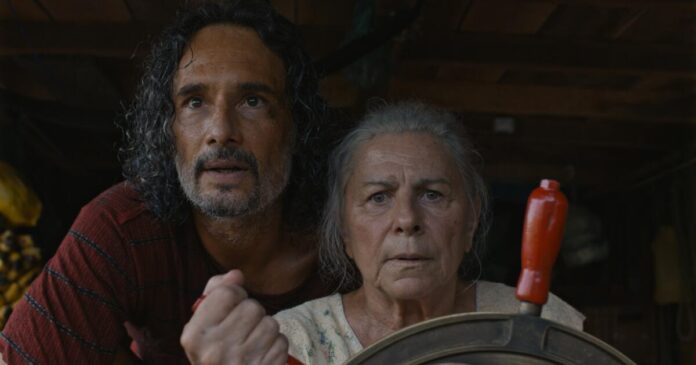
“The Blue Trail” is lyrical science fiction that takes place just around the next bend. An old woman, Tereza (Denise Weinberg), comes home from her factory job annoyed to find a government official hammering giant metal laurels on the door of her shack. It’s a tribute to the elderly, the anonymous worker bee explains. Tereza is grouchy. “Since when was getting older an honor?” she huffs.
Her concerns are correct. In this near-future version of rural Brazil, those shiny laurels perform the same function to the country’s old and poor as did Hitler’s gold stars for Jews. They mark that Tereza is no longer an individual. She’s been reduced to a number — 77 years old — and must now be bused to a retirement camp from where no one ever returns. How Tereza’s exile helps her countrymen isn’t quite clear, but I suspect it starts with giving someone younger her house and her job.
One thing aging and fascism have in common is that it’s hard to conceive of them until you’re personally affected. While brusque and self-sufficient, Tereza starts the film as the head-down, dutiful sort. She has never objected to other old folks getting carried away in trucks with kennel-type cages. “Wrinkle wagons,” she sneers. We can see an earlier version of Tereza in her daughter Joana (Clarissa Pinheiro), a harried single mother who is so exhausted trying to scrape by that she doesn’t have the energy to question authority. But Tereza is upset that the law has finally come for her, insisting that she put on a diaper. “You don’t need to use them — you just need to wear them,” a civil servant says, capturing the government’s one-size-fits-all indifference.
Filmmaker Gabriel Mascaro is just over 42, young enough to think like this bathroom-fixated bureaucrat who doesn’t seem to think getting old will happen to them either. (If most of us really believed it, we’d do more squats.) Yet, Mascaro and his equally youthful co-screenwriter Tibério Azul are wise beyond their years. This is a rebellious, empathetic adventure story about a grandmother who catches on that her society needs to learn how to think freely. (Full disclosure: Last year, I was on the Berlin Film Festival jury that awarded “The Blue Trail” our second top prize, the Silver Bear. On a second watch, it remains terrific.)
And so the plot tracks Tereza’s episodic adventures on the run, escaping to sail down the river in search of a working airplane. Along the way, she encounters a brokenhearted ferryman (Rodrigo Santoro of “Westworld”), a Bible salesman (Miriam Socorrás) and a degenerate mechanic (Adanilo, who like fellow Brazilians Pelé and Ronaldo prefers to go by one name). She also trips over a dozen other travel agents and casino operators who can’t be trusted not to rat her out to the state. Her look evolves from a worn-out cog to a biker-like granny who’d seem natural riding on the back of Dennis Hopper’s hog. Memo Guerra’s honking jazz score adds an another playful layer of life — it’s the noise of a bizarro nightclub where the air shivers with eerie musical saws.
Right now, when a Brazilian movie comes to town, the smart bet is to see it. If the globe threw a party, Brazil and the U.S. would be in the same corner venting about our home life. (Gauging by the popular response to the recent economic thrillers of Park Chan-wook and Bong Joon Ho, South Korea would come over and hang out too.) Having thrown off dictatorship in the ’80s and bucked aspiring despot Jair Bolsonaro out of the presidency and into prison, the country has so much to share with us that the Brazilian films “I’m Still Here” and “The Secret Agent” were nominated for best picture at the Academy Awards two years in a row.
Anyone with a high-concept idea and a low production budget should study how “The Blue Trail” creates the sense of massive, fascistic machinery with a few pennies’ worth of props: a dozen uniform vests, some spray paint and a loudspeaker promising that everything the nation is doing is out of love. From up in the sky, a kindly female voice claims that Brazil wants “to ensure the protection of those who represent the history of our people.” That line must really clang hollow over the razed villages of Amazonian tribes.
Mascaro launched his career with entertaining documentaries that cross-examined class and privilege from a posh penthouse in Rio (2009’s “High-Rise”) to a reality-TV obsessive in a Recife favela (“Av. Brasília Formosa”). In his 2012 breakout “Housemaids,” Mascaro gave cameras to seven teenagers and asked them to record how they treated their help. He has the confidence to only dress up his new dystopia a tad, letting the scale of the oppression creep up on you when, say, an açaí bowl salesman casually asks Tereza for her papers. The simplicity of his execution underlines that a nightmare future doesn’t need to much to come to fruition, just a couple of clipboards and mass apathy.
Cinematographer Guillermo Garza shoots neglected settings like fine art, embracing the grime. Whenever possible, “The Blue Trail” steps back and films a mesmerizing place just as it is: waterfront homes connected by skinny sidewalks of wooden planks, overgrown sculpture gardens with mossy animals lurking in the brush and an alligator-skinning plant where Tereza works. (Mild gore alert: It appears to be real, but don’t worry too much. We mostly see her stretch her weary joints in the steam.)
There are images in here so stark and beautiful that they come home with you like a stack of postcards in your pocket. One of the most staggering is simply pollution: a jungle riverbank heaped with trashed tires. The ferryman jokes that the rubber has returned to its origins. He’s laughing through his outrage. Soon after, he distracts himself by getting blitzed on the hallucinogenic goo from the make-believe Blue Drool snail. The blue trail of the title is how people describe getting snail-stoned to find the path to enlightenment. But Mascaro’s style is too realistic to take us on a goofy psychotropic bender. We just watch the boat captain go somewhere deep inside himself that we don’t get to see, emerging drenched in sweat.
Likewise, the camera observes Weinberg’s Tereza with a sensual tactility that I haven’t seen lavished on any actor over 70 who hasn’t spent her golden years at the plastic surgeon. “The Blue Trail” doesn’t shoot her exploitatively, just affectionately. Given Hollywood’s own discomfort making movies with geriatric heroines, I was struck by how bold it felt to see her sing karaoke in a towel, rub ice on her neck and dance nose-to-nose with a new friend. The story stays small, sticking only with her, a stubborn woman who doesn’t want much from the world and doesn’t feel responsible for its rescue. But it’s wonderful to watch her chart her own destiny.
‘The Blue Trail’
In Portuguese with subtitles
Not rated
Running time: 1 hour, 26 minutes
Playing: Opens Friday, April 3 at Landmark’s Nuart Theatre
More to Read
Disclaimer : This story is auto aggregated by a computer programme and has not been created or edited by DOWNTHENEWS. Publisher: latimes.com