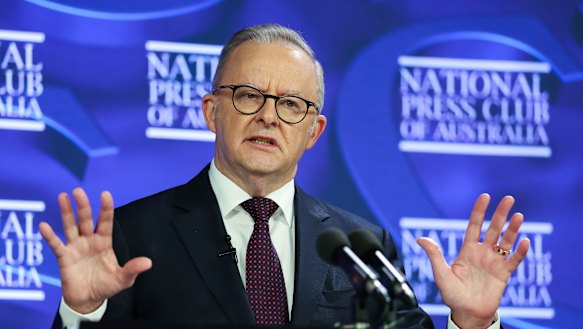
Speaking to the National Press Club on Thursday following his televised national address the previous evening, Prime Minister Anthony Albanese portrayed himself as a voice of calm in a maelstrom of misinformation.
“I took the opportunity to talk directly to the nation,” he told assembled journalists. “That is more important than ever because the nature of noise that is out there, the conspiracy theories that are out there, which propagate, which we can’t do anything about.”
Three minutes of soothing rhetoric alone are unlikely to counteract the news ordinary Australians are “getting … on their device”, as Albanese put it. But clearly the federal government sees the speech as part of a suite of measures to assuage mounting public anxiety over the effects of the US-Israeli war on Iran.
Headlining the package is the decision to give motorists back 32¢ on every litre of petrol bought through a cut to excise and redirection of GST revenues. Like the prime minister’s speech, this is meant to reassure but raises fresh fears, not least over the effect on inflation and then interest rates.
At the same time as making petrol cheaper, and so dampening the price signals markets are sending about impending scarcity, Albanese has urged people not to use too much or hoard fuel. He cut the heavy road vehicle user charge to zero to help truckies and announced $1 billion in interest-free loans for manufacturing and fuel businesses dealing with the costs of the conflict.
“No government can promise to eliminate the pressures that this war is causing,” the prime minister said in his televised address, glossing over the fact his government expressed support for that war at its outset. Having placed himself centre stage of the economic response, the risk is clear: that every setback from here will be measured against Wednesday’s words.
Such setbacks are not difficult to envision. With the United States continuing to build up its forces in the Middle East, an end to the conflict within this month seems unlikely; by late April, the Asian refineries upon which we rely for most of our fuel will be exhausting their inventories, sparking intense competition for remaining supplies of oil and gas. Should fuel prices continue to spiral upwards, the excise cut will soon be consumed.
The West Australian government has already invoked emergency powers to force fuel suppliers to disclose information about shipments, and the red meat industry is warning that without priority access to fuel, shortages are likely in supermarkets.
Given the immediate measures taken, perhaps Albanese would be better served by talking about the longer term. But this is something the politician in him resists. “They are being deliberately vague to not create panic and that is totally understandable,” was how former NAB and Australia Post boss Ahmed Fahour explained it to The Age. But is it sufficient?
Former Australian Competition and Consumer Commission chairman Allan Fels, writing for this masthead, argued that when it comes to fuel rationing, it would be better to go sooner rather than later. But he also acknowledges that “the choice of essential users will be controversial, much more than the COVID selections of essential industries and workers”.
We have found ourselves exposed through years of delay in addressing our dependence on diesel, the decisions of successive governments to shut down our refining capacity (with only two ageing refineries still standing, in Brisbane and Geelong) and our failure to maintain a fuel stockpile that we are committed to by treaty.
In his response to the prime minister’s address, Opposition Leader Angus Taylor had a simple and Trumpist solution to these challenges: “We must dig and we must drill. We need more Australian oil for Australians.”
Labor has long seemed caught between such calls and a greater commitment to decarbonising our economy. There will be those who hope that this crisis spurs the party to chart a bolder course, but will it be in the Taylor direction or towards new sources of energy?
All these are questions that could have been answered by the prime minister in a national address or even in parliament over recent days. Instead, reassurance seems to be the order of the day, extending even to our relationship with the conflict that has generated this crisis.
“I think Australians understand that this is all happening because of a war we’re not a party to,” was how Health Minister Mark Butler put it. But our decision to send air support to the United Arab Emirates and our initial welcome for the US-Israeli action have muddied those waters too. Australians who remember our experiences in Afghanistan and Iraq would be right to expect a more honest account of where our alliances have left us.
The alternative is a nation left guessing about where our energy is coming from and our geopolitical destination, with a growing suspicion that the people we elect to lead us aren’t willing to tell us hard truths.
Get a weekly wrap of views that will challenge, champion and inform your own. Sign up for our Opinion newsletter.
 The Age’s View – Since The Age was first published in 1854, the editorial team has believed it important to express a considered view on the issues of the day for readers, always putting the public interest first.
From our partners
Disclaimer : This story is auto aggregated by a computer programme and has not been created or edited by DOWNTHENEWS. Publisher: www.smh.com.au