On day six of its mission, Artemis II is closing in on the far side of the moon. Meanwhile, the historic journey has not been without fascinating and curious stories, from the images and videos that its four crew members have shared with the world to the inevitable unforeseen events—including a tricky toilet situation.
A few hours before the crew begins its lunar flyby, here’s how things are going on Artemis II.
When Will They Reach the Far Side of the Moon?
While Artemis II won’t actually land on the moon (that won’t happen until Artemis IV), that does not make this mission any less compelling. Once the Artemis II astronauts finish flying over the dark side of the moon, they will have the historic distinction of being the humans who have traveled the farthest from Earth.
They will also test all the systems needed for future lunar missions, validating life support, navigation, spacesuits, communications, and other human operations in deep space.
But when are they supposed to reach this far-off point? First, the Orion capsule reached what is known as the moon’s “sphere of influence” on Sunday night. This is the point where the moon’s gravitational force is stronger than the force of the Earth.
At present, Orion is circling the moon. Once the capsule is on the dark side of the moon, approximately 7,000 kilometers from the surface, communications with Earth will be interrupted. For six hours, they will be able to view the far side of the moon, something no human being has ever seen with their own eyes—not even the astronauts of the Apollo program, as this region of the moon was always too dark or difficult for them to reach.
That six-hour flyby of the dark side of the moon is expected to begin Monday, April 6, at 2:45 pm EDT and 7:45 pm London time.
After that, the capsule will use the moon’s gravity to propel itself back to Earth. Splashdown, when the astronauts reach Earth, is scheduled for April 10 in the Pacific Ocean, not far from the coast of California, the tenth day of the mission.
Remember that you can follow the live broadcast of the Artemis II mission from NASA’s official channels.
What Has Happened so Far?
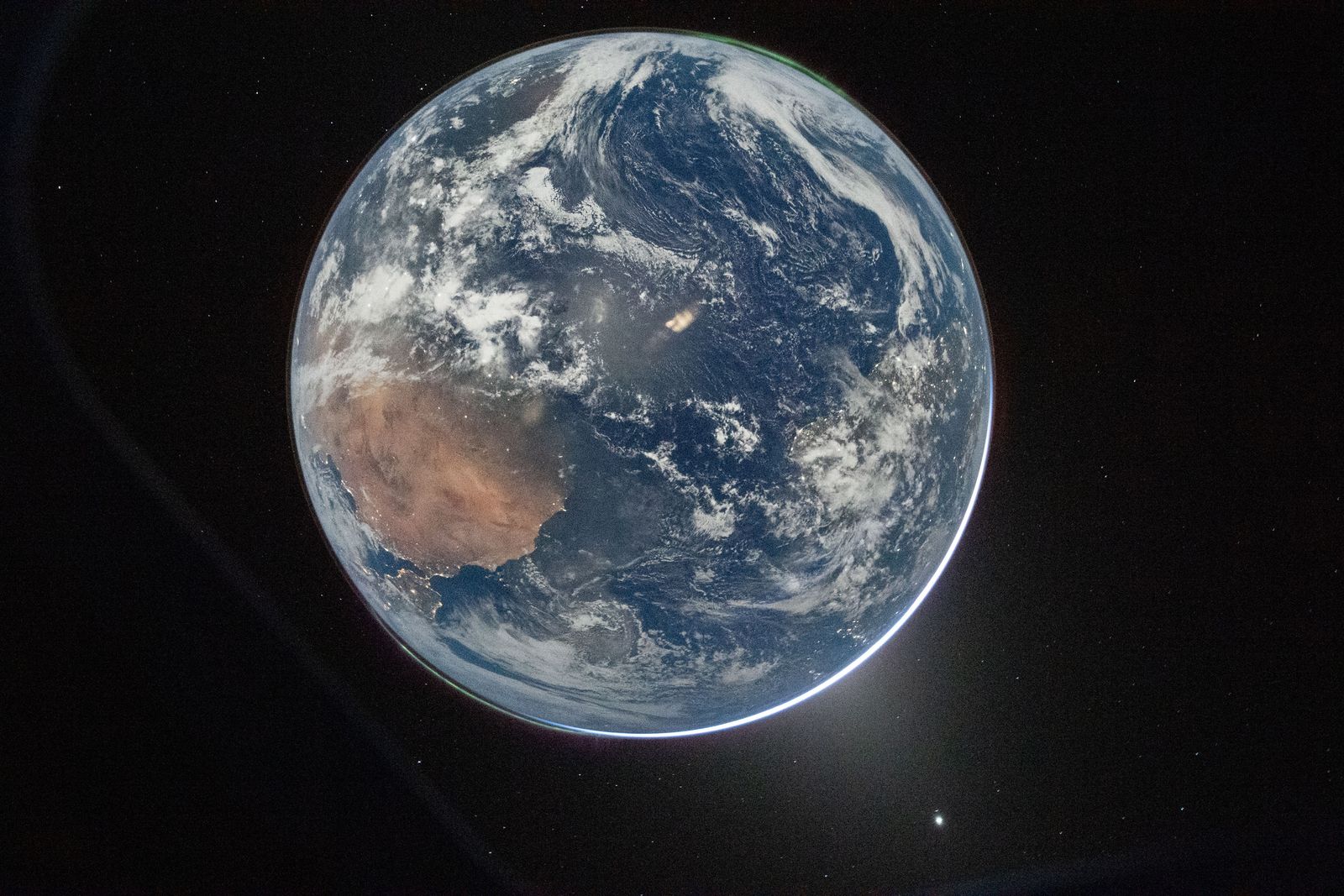
Since its successful launch on April 1 from Kennedy Space Center, the Artemis II crew has shared several spectacular photos, such as the featured image in this post, which shows mission specialist Christina Koch looking down at Earth through one of Orion’s main cabin windows.
This incredible photo of a Earth, taken on April 2, went viral on social media, referencing the famous “Blue Marble” image captured by the Apollo 17 astronauts in 1972.
And of course, the Artemis II crew has also captured images of their destination, such as this one, taken on April 3. The photo below includes the Orientale basin on the far left, an unheard of view for humans. “It’s very unique and no human eye had ever seen this crater until today, when we had the privilege of seeing it,” Koch said during a conference organized by the Canadian Space Agency. Until now, only robotic cameras had been able to observe this region of the moon.

In addition to photos, the mission is still on course. So far the trajectory has remained precise, with the spacecraft moving forward without having to make major adjustments. The astronauts have been in constant communication with the control center in Houston, and have shared everything from scientific and technical observations to more sentimental or philosophical reflections.
“The mood on board is very positive,” said commander Reid Wiseman after speaking with his daughters from space. “We’re up here, so far away, and for an instant, I was reunited with my little family,” he said during a live broadcast. “It was, quite simply, the best moment of my life.”
But What About the Toilet?
Have you ever been stuck on a long trip with the only toilet out of order? That’s the uncomfortable image evoked by the situation aboard the Orion capsule, after it was revealed that the spacecraft’s only toilet malfunctioned. It turns out that shortly after beginning the lunar phase, the crew detected a burning smell coming from the waste management system. As a precaution, Houston asked the astronauts to limit their use of the toilet while the cause was investigated.
These types of systems work with suction and ventilation to handle liquids and solids in microgravity, so any anomaly can affect both the comfort and safety of the internal environment. In the case of Orion, this system has presented at least two failures. The crew was able to resolve the first one, but soon after, the toilet developed another problem. NASA engineers suspect that the most recent failure may be due to ice blocking one of the pipes.
After an initial assessment, it was concluded that these failures do not pose a critical risk to the mission. Astronauts have been trained to react to any unforeseen event, and this is a minor inconvenience (despite the outsized attention it has received on social networks). “Space toilets and bathrooms are something that everyone can understand … they always pose a challenge,” said Debbie Korth, deputy director of NASA’s Orion program. Bathrooms on the International Space Station also tend to present problems.
So how do astronauts relieve themselves? The same way they have since the Apollo era: by means of bags with adhesive seals for solids and funnel-like devices connected to small bags for liquids, both of which include absorbent materials and filters to control odors and bacteria. These kits are used individually and then stored in closed compartments inside the spacecraft until controlled disposal. It’s not convenient or elegant, but it’s the way it is.
This story originally appeared on WIRED en Español and has been translated from Spanish.
Disclaimer : This story is auto aggregated by a computer programme and has not been created or edited by DOWNTHENEWS. Publisher: wired.com