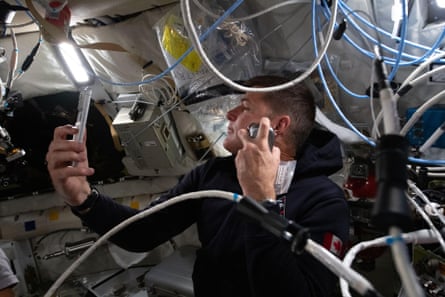
Artemis II astronauts broke Apollo 13’s distance record at 1.57pm eastern time on Monday, hugging each other in the cramped capsule as they made history for becoming the first four humans to travel the farthest from Earth.
About five hours later, at 7.02pm ET, the crew reached the furthest point in its mission, before swinging back around, at 252,756 miles from Earth – 4,111 miles farther than the ill-fated Apollo 13 mission in 1970.
“It is blowing my mind what you can see with the naked eye from the moon right now,” Canadian astronaut Jeremy Hansen radioed ahead of the flyby. “It is just unbelievable.”
He challenged “this generation and the next to make sure this record is not long-lived”.
The astronauts – Reid Wiseman, Victor Glover and Christina Koch of the US space agency Nasa; and Hansen of the Canadian Space Agency – are Earth’s farthest travelled, having journeyed 5,000 miles (8,000km) beyond the moon, exceeding the distance record set by Apollo 13 in 1970.
Astronauts on the emergency flyby in 1970 – commander Jim Lovell, Fred Haise and Jack Swigert – reached a maximum 248,655 miles from Earth before making their turn..
Hours after the Artemis quartet surpassed that distance record, the capsule passed on the far side of the moon, starting a communications blackout that lasted about 40 minutes.
“We will see you on the other side,” said astronaut Victor Glover, minutes before the connection was lost. Nasa reconnected with the spacecraft at 7.24pm ET.
As Orion emerged from behind the moon, Koch reflected on the emotions as the crew witnessed Earthrise. “We will always choose Earth, we will always choose each other,” she said as communications were restored.
Earlier Monday, Nasa sent the crew a list of 30 lunar surface targets to observe during the approximately seven-hour window when it was close enough to carefully view the surface of the moon. Those targets included the Orientale basin, a 3.8-bn-year-old, 600-mile-wide crater stretching across the moon’s near and far sides, and the 400-mile-wide Hertzsprung basin on the far side of the moon.
Later, Hansen said the astronauts had proposed naming a crater they had already observed in honor of Wiseman’s late wife, who died of cancer in 2020 at the age of 46.
“It’s a bright spot on the moon, and we would like to call it Carroll,” Hansen said, in an emotional moment for the four astronauts, Agence France-Presse reports.
The report added that the astronauts also decided to name another crater “Integrity”, after their spacecraft.
According to a Nasa spokesperson speaking to Agence France-Presse, the proposed crater names will be submitted to the International Astronomical Union, which is responsible for naming celestial bodies.
Meanwhile, Koch described her experience of capturing the moon’s surface, saying: “I just had an overwhelming sense of being moved by looking at the moon … It lasted just a second or two, and I actually couldn’t even make it happen again. But something just drew me in suddenly to the lunar landscape, and it became real.”
“The truth is, the moon really is its own body in the universe – it’s not just a poster in the sky … It is a real place. And when we have that perspective and we compare it to our home of Earth, it just reminds us how much we have in common. Everything we need, Earth provides. And that is somewhat of a miracle, and one that you can’t truly know until you’ve had the perspective of the other,” she added.
On what is the sixth day of a lunar mission that has reinvigorated Nasa’s space exploration program, the Orion capsule’s roughly six-hour flyby on Monday promised views of the moon’s far side that were too dark or too difficult to see by the Apollo program astronauts who preceded them more than half a century ago.
Koch recently said she and her Artemis II crewmates do not live on superlatives, but it was an important milestone “that people can understand and wrap their heads around”, merging the past with the present – and even the future when new records are set.
Later on Monday, Donald Trump called to congratulate the astronauts circling the moon for making “history,” telling them they’ve “made all America really proud, incredibly proud.”
“You really are modern-day pioneers – all of you,” Trump said. “You’ve got a lot of courage doing what you’re doing.”
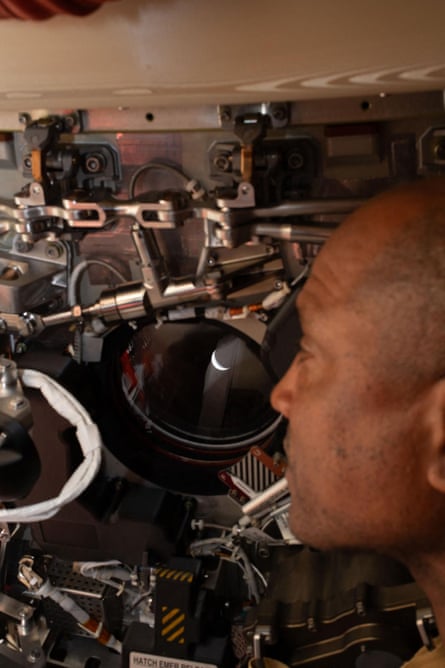
As the crew rounded the moon and aimed for home, a total solar eclipse graced the sky. The hour-long eclipse allowed the astronauts to complete a final part of their mission: observing the sun’s corona as the rest of the star is hidden.
“After all of the things we saw earlier, we just went sci-fi,” Glover said. “It just looks unreal … the Earthshine.”
By 9.35pm ET, Orion had completed its observations and was on its trip back home to planet Earth.
Disclaimer : This story is auto aggregated by a computer programme and has not been created or edited by DOWNTHENEWS. Publisher: theguardian.com