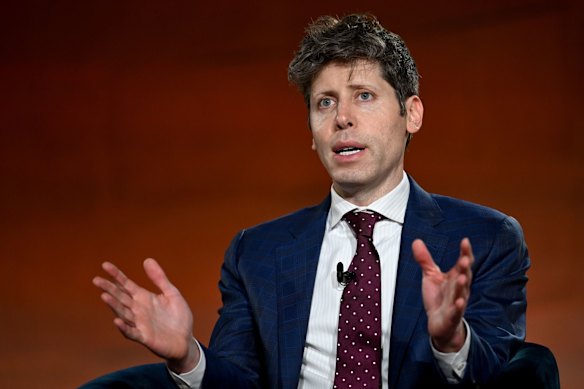
The godfather of artificial intelligence, OpenAI chief executive Sam Altman, has begun the mother of all public relations offensives. He has created a blueprint for governments to mitigate the societal fallout from artificial intelligence – one that acknowledges widespread labour redundancies and the potential for rogue AI systems capable of replicating themselves.
In owning his influence on this generation’s most socially disruptive and potentially cataclysmic technology, Altman is seeking authorship of how to deal with the fallout, in what amounts to an attempt to get ahead of the curve.
And on the cusp of a potential $US1 trillion ($1.45 trillion) public listing of OpenAI (the owner of ChatGPT), his public service-based thoughts on mitigating the downside of this technology must be viewed within this framework.
Make no mistake, AI is an incredible opportunity for business to supercharge profit and productivity and has already shown its potential for medical breakthroughs. But the side effects on society, its workers and the potential for cyberattacks are terrifying to the point of sci-fi horror.
The blueprint Altman released this week contains ideas to socialise the monetary gains from AI by giving people “a stake in AI driven economic growth”. A taste of these measures include the introduction of a robot tax to redistribute the wealth to those AI-created jobless, and the creation of a sovereign wealth fund from AI financial gains.
He tackles the problem of workforce shrinkage with a plan to introduce a four-day but fully paid work week.
Addressing the negative AI consequences forms part of his AI public relations effort.
AI pioneers want to ensure the legacy of the world’s adoption of this super intelligence won’t be the creation of a gulf between AI winners and losers. And it is better to frame the regulation, rather than be hit by it.
Altman recognises that the artificial intelligence revolution is coming so fast and its impacts on society will be so profound that the traditional operation of capitalism will be too slow to manage the consequences.
Redistribution of the profits from AI is Altman’s solution, but is a move so extreme that it provides evidence of how disruptive this technology could become once it is more universally embraced.
Altman’s blueprint is his first pass at prescriptive remedies that governments could adopt to deal with the negative consequences of AI.
For example, the blueprint looks at triggers which are tied to economic data. For instance, when a certain level of workers are displaced by AI it could prompt temporary increases in public support like unemployment benefits and cash assistance, according to a report by US media outlet Axios of an interview with Altman in which he discusses his blueprint.
In a future where payroll taxes are not the government revenue drivers they are now, the Altman plan is to have this replaced with tax derived capital gain and corporate profit.
OpenAI’s chief of global affairs, Chris Lehane, has already met with two dozen members of the US Senate, according to an interview with Bloomberg.
The US government has to date adopted a generally regulation-lite approach to AI, and OpenAI’s more radical discussion points appear to be well beyond what the Trump administration would be considering.
The Australian government has been considering the copyright implications on the AI large language models, but has generally taken a wait-and-see approach to how the technology evolves.
Altman told Axios: “I think almost everybody involved in our industry feels the gravity of what we’re doing. … We all take that responsibility very seriously. We feel that way every day.”
Good luck pitching these ideas to Donald Trump.
The Business Briefing newsletter delivers major stories, exclusive coverage and expert opinion. Sign up to get it every weekday morning.
From our partners
Disclaimer : This story is auto aggregated by a computer programme and has not been created or edited by DOWNTHENEWS. Publisher: www.smh.com.au