
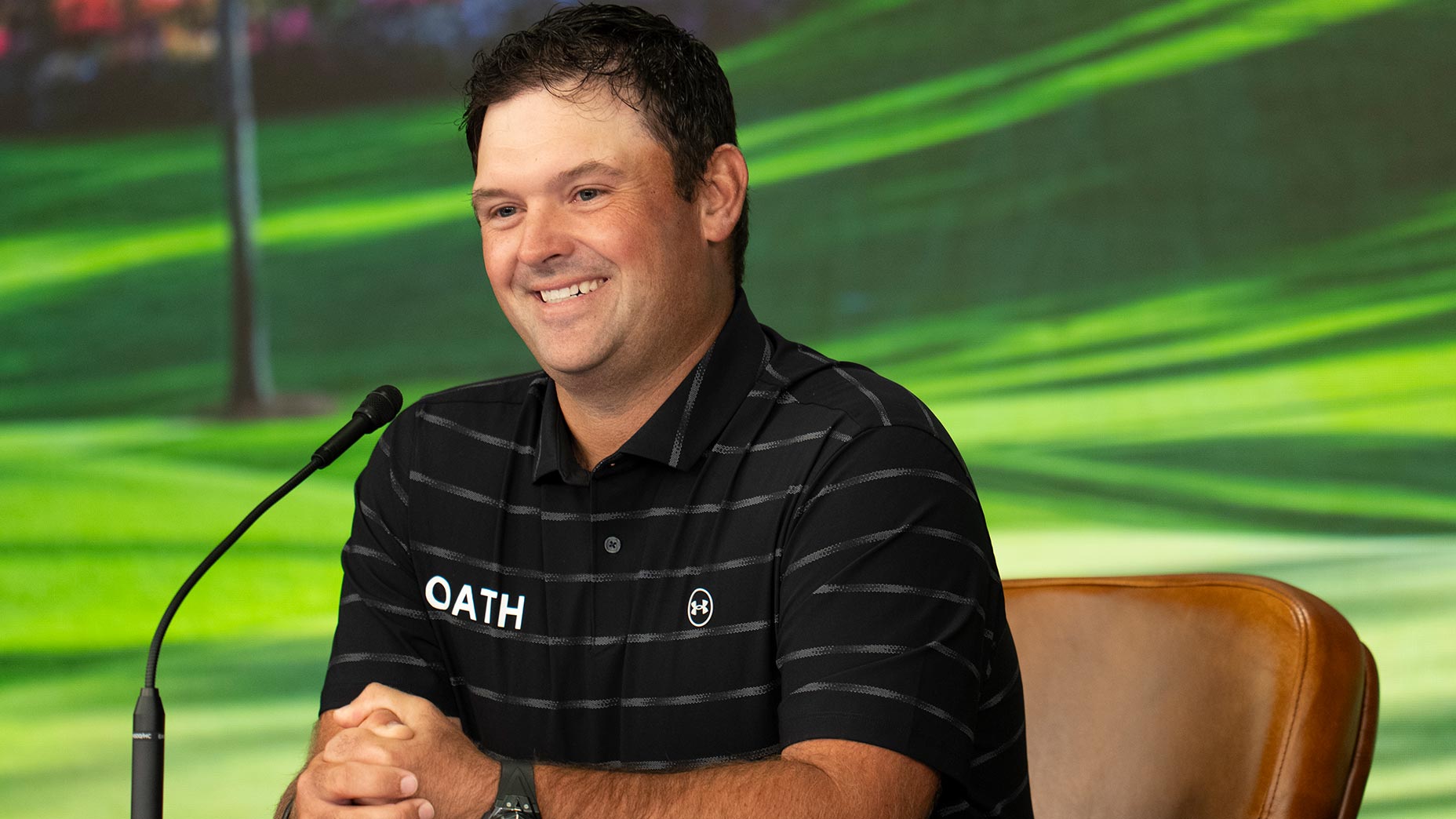
AUGUSTA, Ga. — This week, a fresh start: Pat Reed, 2.0. Done with his four-year LIV Golf experiment, Reed will return to the PGA Tour in late August, when he pops out of Brian Rolapp’s penalty box. But nothing can keep him out of the Masters field, not as a former winner (2018) in the prime of life (he’s 35) and condition (rosy cheeks, country strong). You’re tempted to say that nothing can keep P-Reed from top-10ing this week, either. Three months into this golf year, he’s playing about as well as anybody in the world. Year after year, he plays Augusta National out of Nick Faldo’s clinician playbook. (Reed finished third last year, two shots out of the Justin Rose-Rory McIlroy playoff.) Then there’s his emotional state, if his Monday afternoon here told us anything about his interior life. It’s buoyant.
My fam is first, my golf is second, there is no third — and it’s ALL goooood and so am I.
In the press building, Reed was on message, on point — and on brand. (That is, semi-cocky.)
On the range, Reed was purposeful and engaged. His old caddie (still his brother-in-law, Kessler Karain) and new coach (Dave Pelz’s son, Eddie) really had nothing to do, except watch one perfect, soaring, thick-armed draw shot after another.
On the course, playing a methodical four-hole loop as a singleton, Reed was loose with spectators as he walked fairways, and a clinician on the greens, putting expertly and repeatedly to hole positions he knows intimately on the 1st green, the 2nd, the 8th and the 9th. The other holes aren’t going anywhere.
If you have followed Reed over the course of his 15-year career, you know how he has sabotaged his own standing in the game with rules debacles and pointless lawsuits against members of the Golf Establishment. When he won the Masters, he was estranged from his parents, Augusta residents who were not on hand for his quiet victory. That Sunday night wasn’t the normal Augusta joyfest, though his play was through the roof.
But, in the name of Bobby Jones and all that holy water running in Rae’s Creek, you’d like to think that this week, and this year, could be a turning point in Reed’s standing. This 2026 Masters is like the ultimate spring-training game for him. This restart button is like another crack at a rookie season. He has here, uncommonly, second chances to make a first impression, without going into the transfer portal. If you can’t have a fresh start in mid-April at Augusta National, where can you have one? This 90th Masters is the 47th Grand Slam event of Reed’s career, and the first major of the rest of his life.
On Tuesday night, Reed will attend the Champions Dinner, where a fellow Texan, Ben Crenshaw, the two-time Masters champion, will preside as the master of ceremonies. (Rory McIlroy, Reed’s former Ryder Cup foil, is picking up the tab.) Nobody is expecting Reed to become, as Crenshaw is, a poet of the game, writing sonnets to its loveliness. Nobody is expecting Reed to suddenly start offering deep, semi-accidental what-does-it-all mean life observations, in the manner that another Texan with two Masters wins, Scottie Scheffler.
Still, Patrick Reed at the 2026 Masters is not the Patrick Reed who finished two shots out of the Rose-McIlroy playoff. Last year, Reed was all about LIV Golf and his LIV team, the Four Aces, and to hell with the Old Order. To innumerable and traditional American golf fans — and the Augusta National rope lines are lined with such people — Reed was Captain America, the Ryder Cup star who went AWOL.
That was then — maybe that was then. This new version of Patrick Reed, with two wins on the DP World Tour this year, could be on the Presidents Cup team this year, making the U.S. team on points or as a captain’s pick. Next year’s Ryder Cup team, the same. He could contend (or win) this week or in any of the other majors this year. He’s ranked 23rd in the world now and that ranking likely understates where he really stands in the game.
Talking to reporters Monday afternoon in the press building, Reed said there used to be “five or six, maybe seven guys” who could win at Augusta. That was earlier in his career. “I definitely feel like this year you have 10 to 12 guys who have a really legitimate opportunity to win the green jacket,” he said. Even 12 is a surprisingly low and ungenerous number. There’s something cold about it, and something cool (neat, boss) about it, too.
Based on his other comments about the state his game and his comfort on the course, Reed surely feels he is among the dozen players on the I-can-win short list. That means he only has to beat 11 other guys — Rory, Bryson, Scottie, Rahm, Brooks and a half-dozen others — to earn his place in the two-timers club. Koepka, in a withering analysis, once said something in a similar vein, and those comments haven’t died yet. Koepka, 2019: “There’s 156 in the field, so you figure at least 80 of them I’m just going to beat. You figure about half of them won’t play well from there, so you’re down to about maybe 35. And then from 35, some of them, pressure is going to get to them. It only leaves you with a few more and you’ve just got to beat those guys.” Jack Nicklaus, in his long heyday, likely thought the same thing. He was just too Midwestern, too well-mannered, to say it. Reed, on Monday in the Augusta National press building was leaning into Koepka, though his language was less fiery.
He went from the press building to the range. It’s always been a pleasure to watch Reed swing a golf club, with those gravedigger arms that look so heavy, thick with heavy muscle, that they can never go racing, all out of whack and ahead of his body. In the regard, he brings to mind Tom Watson, Mark McCumber, Hal Sutton, Ian Woosnam and other players with short, strong forearms held close to the body. On one driver swing after another, Reed, dressed in black from toe to head, could keep a white golf glove trapped between his upper right arm and body.
“There’s so much connection,” Eddie Pelz said. “It’s really an old-school type of swing you don’t see much of anymore. Patrick’s not chasing distance.” On the par-5 2nd hole, in his mini practice round, Reed hit a 3-wood just short of the yawning bunker on the right off the tee, then a 7-wood in the middle of the green. A no-stress, two-putt birdie is a wonderful way to go to the third tee one under.
On the par-5 8th hole, after a drive in the middle of the fairway, a fan implored Reed to hit driver off the deck in an effort to get home in two. “I’m gonna need you to come out here and show me how to do it,” Reed said playfully. He was loose. He joked with fans, quick to dis (jokingly) Karain, his caddie, about the “hour” it took him to rake a large deep trap beside the second green after Reed played a bunch of bunker shots from it. Reed stiffed his second shot at nine. It was all easy. Reed’s life in golf often hasn’t been.
In the last four years, Reed has played more than two dozen countries. He has had the chance to expose himself to different languages, customs and foods. He has seen and maybe considered the world. Is he a different person because of it? Time will tell.
“I think the biggest thing [about playing the world] is just appreciating the sport, appreciating the different cultures and different places,” Reed said. “I’m the type that, when I travel, I like checking out all the local places and really experiencing the culture, to really dive in. Experience different cuisines, different areas, different places. It’s something that is true to me.”
Has it changed him? We can’t tell yet and maybe Reed doesn’t know himself. By Sunday night, we’ll know more and he’ll know more and even that will only be a start. Thirty-five with a swing and a body that will not quit. The man in black is back, and not going anywhere.
Michael Bamberger welcomes your comments at Michael.Bamberger@Golf.com.
Disclaimer : This story is auto aggregated by a computer programme and has not been created or edited by DOWNTHENEWS. Publisher: golf.com





