
AUGUSTA, Ga. — Phil Mickelson may not be here at the Masters but one of his simple tips lives on without him … on the scorecards of Jon Rahm.
Rahm is among the Masters favorites and deservingly so, having finished in the top five of all five LIV events this year. He won the Masters in 2023, and even recently confessed to GOLF.com that he feels as sharp now as he did then. He’s also armed with a mental trick that helps the game’s best players hang around without tumbling down the leaderboard on Masters Thursday or Friday. He simply doesn’t get bothered by making par.
It’s of course a bit more analytical than that, and it needs to be for Rahm. He’s one of the modern game’s most-studied participants. He’s watched any number of old Masters final round broadcasts on YouTube. But the core of this mindset is in the Masters media guide.
“The single best helpful hint — it was both [Jose Maria Olazabal] and Phil [Mickelson] who said it,” Rahm told GOLF.com last month. “Statistically, 99.9% of the time, for the whole tournament, the only holes that play under par are the par 5s. Every other hole at Augusta National plays over par.”
Rahm has received plenty of advice from Olazabal and Mickelson over the years, and not just at Augusta National. But that stat bears out constantly. Players who keep it in mind can keep from grinding when they miss a short birdie putt, knowing that even disappointing pars help them gain on the field average.
“That includes 3,” Rahm said of the short par-4. “That includes nine, even when people are hitting it way down there, that includes every single hole people might consider easy. All of them play over par, which means if you’re making a par, you’re not losing strokes to anybody.”
The numbers track, too. Every non-par-5 has played over par, cumulatively on average, from the early 1940s through 2025. And every par-5 has played fractionally below par. Of course, there are years when the conditions are scorable, leading to blips where some par-4s sneak under par, but over decades and decades, there are no bad pars to be had at Augusta National. Only four slightly disappointing ones.
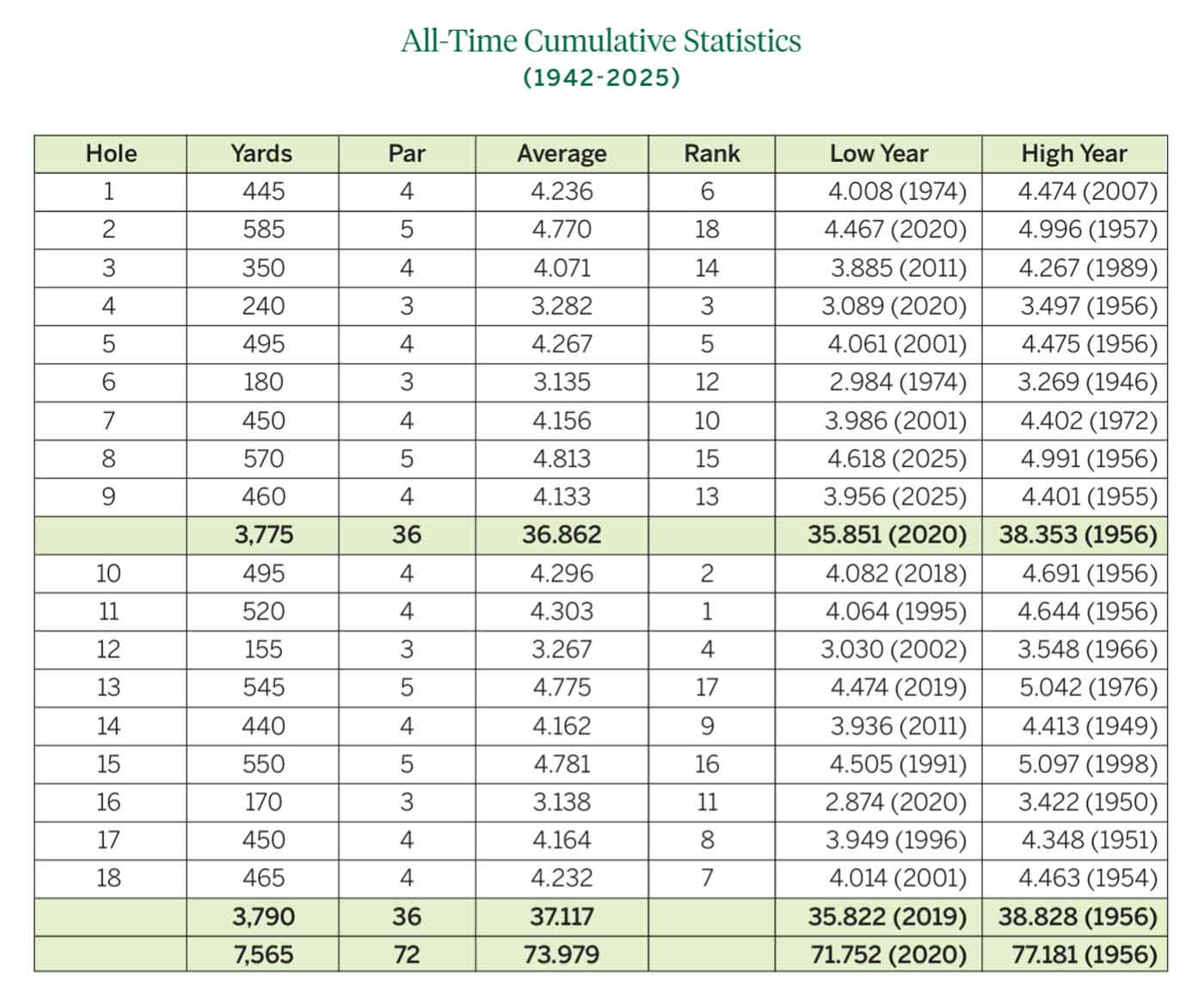
“And even if you make a par on a par-5,” Rahm continued, “it’s only 0.1 or 0.2 [being lost], depending on the year. It’s not much. You’re not really losing strokes. So when you think, Oh, made a par on this hole, you’re not really losing that much.”
Now this is where Rahm’s mindset via Mickelson starts to fall apart. While the stats in the box above make it seem like the par-5s only lead to a quarter of a stroke lost here and there with a par, that may be a more-dated observation. Consider the 2025 Masters, where Rory McIlroy and Justin Rose entered a playoff at 11 under. It was by no means a shootout 12 months ago. But the par-5s on the front both averaged 4.61 strokes, meaning a par was going to lose nearly half of a stroke to the field average, far more than Rahm is bargaining for.
Those pesky par-5s on the back, however, track nicely with what Rahm said. The gettable 13th played to a score of 4.82 last year and the 15th to an even higher average: 4.926. Perhaps unsurprisingly, those are the par-5s that have been adjusted most recently, with new tee boxes added to each in the last five years.
Where does that leave us with Rahm’s mindset tip? In need of an adjustment. Either he restates the truth, in that there are 16 holes where par is mostly fine at Augusta National. Or we get to making those front-nine par-5s just a bit more difficult.
Disclaimer : This story is auto aggregated by a computer programme and has not been created or edited by DOWNTHENEWS. Publisher: golf.com






