At the outset, Solicitor General Tushar Mehta, appearing for the Centre, asked how the court decides what a superstitious practice is.
“Even assuming that there is a superstitious practice,” he said, “It is not for the court to determine that it is superstition. Under Article 25(2)(b) of the Constitution, it is for the legislature to step in and enact a reform law.”
“The legislature can say that a particular practice is superstition and requires reform. There are several such statutes and laws, for the prevention of black magic and other such practices,” Mehta told the bench, which also comprised Justices B V Nagarathna, M M Sundresh, Ahsanuddin Amanullah, Aravind Kumar, Augustine George Masih, Prasanna B Varale, R Mahadevan and Joymalya Bagchi.
Responding to Mehta’s submission, Justice Amanullah said the statement is too simplistic, as the court has the right and the jurisdiction to hold whether something is superstitious.
“What will follow is for the legislature to deal with. But, in court, you cannot say that whatever the legislature decides is the last word. That cannot be,” he said.
Mehta said a secular court cannot decide that a religious practice is mere superstition, because the court may not possess such scholarly competence.
“Your Lordships are experts in the field of law, not religion,” he said.
The solicitor general argued, “Something religious for Nagaland may be a superstition for me. We are in a greatly diverse society. Maharashtra has Black Act. They may say this is the practice prevalent in our area and that’s why we protect it under Article 25(2)(b),” Mehta said.
Justice Bagchi asked if witchcraft was part of religious practice, would it not be considered superstition?
“Your argument is that it is for the legislature to take up and prohibit any practice that promotes it (witchcraft). Let us say the court is approached under Article 32 of the Constitution, saying that a religious practice of witchcraft exists, and the legislature is silent. Can the court not use the ‘doctrine of unoccupied field’ to give directions to prohibit such a practice, keeping in mind … health, morality and public order?” Justice Bagchi asked Mehta.
The solicitor general replied that judicial review can be done because it falls under ‘health, morality and public order’, and not because it is superstition.
Justice Nagarathna opined that in determining what an essential religious practice is, the court should view it through the lens of the philosophy of that particular religion.
“You cannot apply (the views of) some other religion and say this is not essential religious practice. The approach of the court is to apply the philosophy of that religion, subject to health, morality and public order,” Justice Nagarathna said.
The hearing is underway.
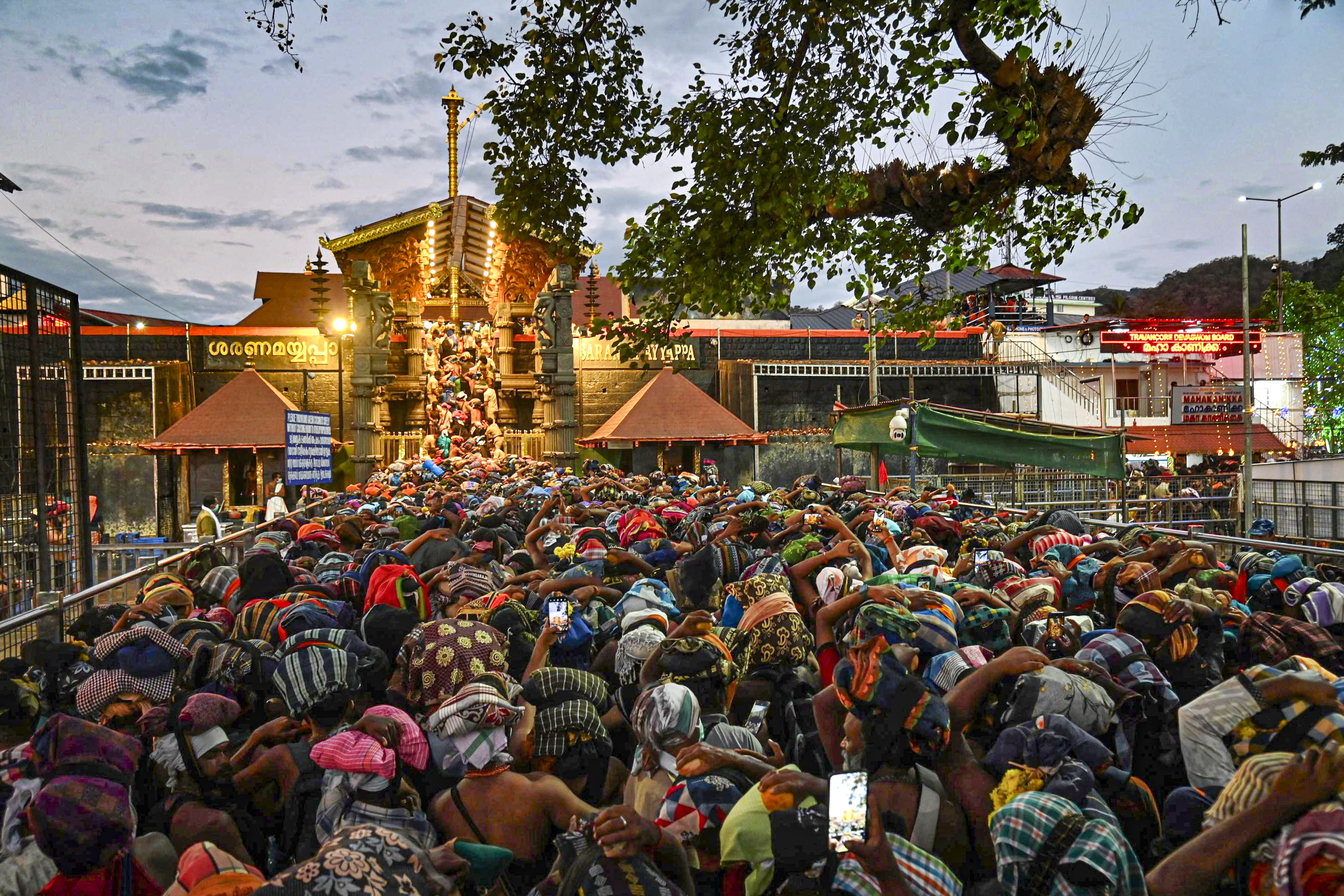
In September 2018, a five-judge Constitution bench, by a 4:1 majority verdict, had lifted the ban that prevented women between the ages of 10 and 50 from entering the Sabarimala Ayyappa temple in Kerala, and held that the centuries-old Hindu religious practice was illegal and unconstitutional.
Later, on November 14, 2019, another five-judge bench headed by the then CJI Ranjan Gogoi, by a majority of 3:2, referred the issue of discrimination against women at various places of worship to a larger bench.
The bench had then framed broad issues on freedom across religions, saying they cannot be decided without any facts of the particular case.