AF Corse unveiled its privateer Ferrari hypercar to the world on Tuesday, offering a first look at the Italian marque’s updated aero package for the 2026 World Endurance Championship.
At an event organised at the headquarters of its new partner ESA NanoTech, the Italian team showcased the #83 Ferrari 499P to be driven once again by 2025 Le Mans 24 Hours winners Robert Kubica, Yifei Ye and Phil Hanson.
As is well known, the WEC, ACO and IMSA have agreed on a new re-homologation of all LMH and LMDh prototypes competing in Hypercar and GTP classes. Consequently, the manufacturers have been working over the winter to recalibrate their aerodynamics.
Already during the official presentation of the 499P, technical chief Ferdinando Cannizzo had specifically outlined what the Maranello-based had focused on, also at the request of the federation itself, which, with the new parameters, aims to obtain even more accurate and detailed data to better define the Balance of Performance.

Ferrari 499P, 2026 detail
Photo by: AF Corse
“The new homologation essentially involves three aspects. The change of wind tunnel from Sauber to Windshear, thus from Switzerland to the United States; a new data collection and analysis process, including new measurement points in the wind tunnel; and finally, a repositioning, a redefinition of the performance window,” said Cannizzo, head of endurance cars in Maranello.
“This therefore meant we had to review our car’s positioning at the new operating point. We did this deliberately without using any Evo Joker points – which we wanted to keep in reserve for the future – and thus by making adjustments to small details.”
But what exactly did changing the bodywork – and, with it, the aerodynamics – entail? It must be said that some changes aren’t visible to the naked eye because they affect the airflow beneath the car, while others have slightly altered shape and dimensions without drastically altering the original design.


What immediately stands out starting from the front is the new design of the aerodynamic appendages mounted above the splitter at both ends, just below the headlights.
These two flaps, also known as “flick” in technical jargon, are now shorter and more contoured, and lack the small support that had been present since their introduction in the summer of 2024, when the first (and only, so far) Evo Joker was released by the Emilia-based manufacturer.
“Still focusing on the front end, we worked on the lower flaps and flow deflectors to try to adjust the car’s balance,” adds Cannizzo.


Moving up to the upper section, the way airflow is managed around the wheel arch has changed; in fact, the two appendages that were attached to the black carbon section in front of the fender opening have been removed (at the Federation’s request), and this area now takes on the of a true aerodynamic surface, as illustrated by Ferrari’s chief engineer.
The two similar black strips located between the end of the wheel arch and the cockpit have also changed shape.


Continuing along the lines of the 499P and moving to the central section, the radiator vents on the sides have been slightly revised, but what the Ferrari engineers have highlighted as most important is the new design of the engine cover, particularly its rear end.
This section, situated between the diffuser and the beam wing, now has a more concave shape and no longer features the two long appendages (similar to those that were attached to the front wheel arches), effectively creating more downforce on the rear axle, where there are also other new features.


Looking at the ends of the rear wing, with larger-shaped flaps, the supports now have much larger appendages next to the lights installed at the top.
Moving down to the lower section, the side panels behind the rear wheels have been redesigned with a more arched shape to readjust and optimize the aerodynamic flow.

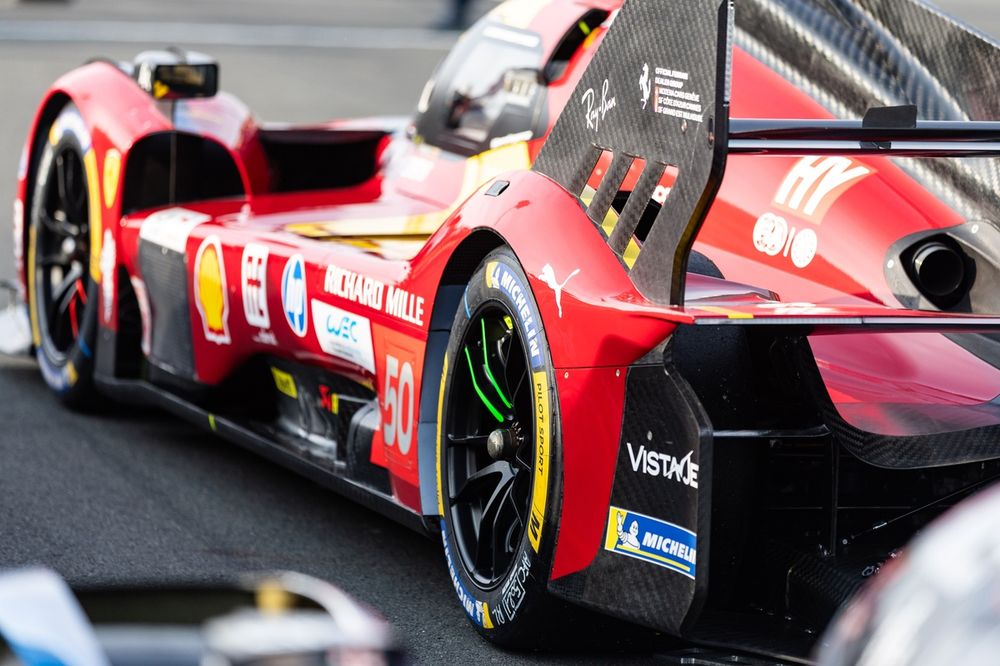
“These are the minimal yet effective changes we were able to make without altering the car’s main surfaces. This allowed us to get back within the expected performance window,” concluded Cannizzo.
The updates were tested during last week’s session at Imola, and further valuable data will be collected as early as the Prologue on 14 April – a preview of the season’s first race weekend, which will also take place on the banks of the Santerno River.
We want your opinion!
What would you like to see on Motorsport.com?
– The Motorsport.com Team
Disclaimer : This story is auto aggregated by a computer programme and has not been created or edited by DOWNTHENEWS. Publisher: motorsport.com