Updated ,first published
A major fire has damaged the Geelong oil refinery that is one of only two in Australia, adding pressure to the country’s fuel stocks, which are already under strain due to the war in the Middle East.
Fire Rescue Victoria said an equipment failure caused the blaze at the Viva Energy refinery in Corio that broke out just after 11pm on Wednesday, triggering explosions and sending a cloud of smoke towards Geelong.
The fire continued to burn out of control on Thursday morning, severely damaging the facility that supplies 50 per cent of Victoria’s fuel and 10 per cent of Australia’s fuel.
Viva Energy chief executive Scott Wyatt said the fire damaged two of the refinery’s gasoline production units.
The company ramped up production recently after Donald Trump’s war against Iran led to the Islamic Republic closing the Strait of Hormuz, sparking global fears of fuel shortages.
But the Geelong refinery has now temporarily cut its output of petrol, diesel and jet fuel down to “minimum rates” following the major fire damage.
FRV’s deputy commissioner Michelle Cowling told ABC Radio she believed investigators knew the fire’s cause.
“It was an equipment failure in the refinery. And Viva is looking into that,” she said.
Earlier, FRV assistant chief fire officer Mick McGuinness described the blaze as “quite ferocious” and said it started in the plant’s Mogas section.
“There’s been a significant leak of liquid hydrocarbons and gases that have fuelled the fire,” McGuinness told reporters just after 8am.
He said about 50 firefighters and 10 firefighting vehicles – including FRV’s boat in Corio Bay – fought the blaze, which was contained to an area about 30 metres by 30 metres. There are no reports of injuries.
“We’d estimate at least another four to five hours of fire to be burning,” McGuiness said.
An updated alert on the VicEmergency app at 12.11pm confirmed the fire had been extinguished.
McGuiness said Viva Energy operators detected a gas leak overnight that quickly grew.
Geelong refinery manager Bill Patterson said the affected unit turned LPG into gasoline.
“That gasoline component is used for a number of purposes, including in the blending of normal, regular gasoline that you buy from your service stations, but also in some specialty products, like low aromatic gasoline that’s provided to remote communities around the country,” he said.
“It is also an ingredient in aviation gasoline, which shouldn’t be confused with jet fuel. Jet fuel is what the large airliners run on, and that’s not impacted.”
Patterson said the refinery had pushed back some maintenance as the Middle East conflict raised fuel supply concerns, but stressed the works had nothing to do with where the recent fire started.
“Clearly, there was some sort of failure or issue last night,” he said, “but exactly as to what the reasons are will be subject to very thorough investigation.”
Patterson added: “We’re still running at pretty decent rates at the moment, given that these units are relatively small in the scheme of things, but they are important units for the longer term.”
Energy Minister Chris Bowen confirmed the fire would impact petrol production at the refinery, which can process up to 120,000 barrels of oil per day, equating to about 380,000 tanks of fuel.
“At this point, production of jet fuel and diesel is continuing at the refinery at reduced levels for safety reasons as a precaution,” Bowen told Nine’s Today.
“At this point, the impact is mainly on petrol production, but obviously, this is very early days.”
Viva Energy entered a trading halt on the Australian sharemarket on Thursday morning pending an announcement about the fire’s impact.
Energy analysts are warning the hit to the refinery marks a deterioration of the national fuel security situation.
Global research firm Rystad Energy said the fire raised the likelihood of the government moving to the next stage of its fuel-saving strategy, including directing fuel to priority areas, promoting voluntary measures like car-pooling or working from home, and further releases from strategic reserves.
Australia is currently at the second stage, which has included releasing some stockpiled fuel to deal with panic buying and helping importers to buy more fuel.
Dozens of workers were at the Viva plant when the fire started late on Wednesday, and union representatives are relieved it didn’t happen at a busier time of the day.
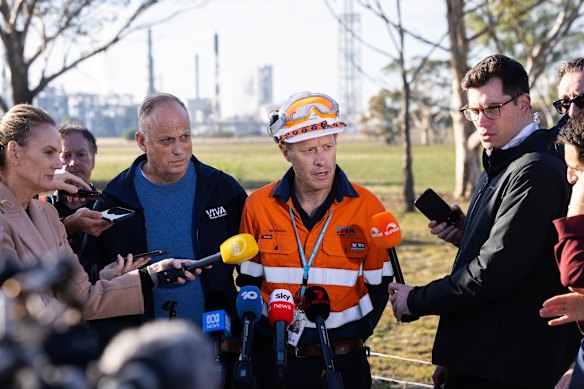
Tony Hynds, an organiser with the Australian Manufacturing Workers Union, joined dozens of others on the scene outside Viva on Thursday morning.
“We’ve been told there were about 30 people on the site, most of them operators,” he said.
“When the first explosion happened, they had to take off and get out of there pretty quickly. I’ve been told there was a small explosion and then two large ones, and then a large fireball.”
Australian Workers Union secretary Ronnie Hayden, who was on the scene on Thursday morning, described the scene as like a “war zone”.
“Some [workers] were pretty close to it, but they managed to run to get away from it,” he said. “They said it was like ‘a big bloody fireball coming straight for us’.”
Viva Energy’s plant in Geelong has been underwritten by significant government support to secure Australia’s two remaining refineries.
The federal government in March boosted its Fuel Security Services Payment, which kicks in during loss-making periods.
Viva has said the scheme, introduced in 2021, allowed it to spend $500 million upgrading the Geelong refinery.
Bowen said the facility would “take some time to repair”, and production had been reduced as a precaution.
“This is not a positive development, but obviously, there’s a long way to go in terms of working out just what the impact is. Our advice remains to people: buy as much fuel as you need, no more, no less,” he said.
At a midday press conference, Victorian Premier Jacinta Allan similarly said it was too soon to assess the damage.
“There’s no doubt that this comes at a really challenging time for fuel supplies around the nation and around the world as a result of Donald Trump’s war in Iran,” she said.
Motorists who re-fuelled at two service stations near Viva’s plant on Thursday morning weren’t looking forward to the prospect of higher fuel prices.
“I can’t really think about it,” carpenter Alan Spierings said. “I might have to buy a horse and cart!”
State Energy Minister Lily D’Ambrosio told ABC Radio there was no immediate impact on fuel supply due to Viva’s increased fuel orders.
She would not be drawn when asked if the fire would have any long-term effect on fuel supplies.
McGuinness, FRV’s assistant chief fire officer, said some flames were up to 60 metres in height.
“The fire went from a small fire through several explosions to being quite a large, intense fire,” he said.
One resident near the Viva plant in Corio – who didn’t want to be identified – woke up to their house rattling and an ominous red glow on the horizon around 1am.
“I was in bed, and I was wondering why everything was rattling and shaking,” they said. “The whole backyard was lit up red.”
A warning was issued for dozens of suburbs just after 2am, when a wind change blew smoke from the blaze towards Geelong.
Thousands of residents were told to close their doors and windows, and turn off their heating and cooling systems.
The warning area was downgraded shortly before 5.30am and contained to the suburbs of Corio, Norlane and North Shore, which directly surround the fire.
McGuiness said the elevated warning was precautionary.
“Our specialist hazmat technicians were able to determine there were no contaminants whatsoever – not only in the firefighting water, but also in the smoke that was being emitted,” he said.
On Monday, Bowen said Australia’s fuel reserves stood at 38 days of petrol, 28 days of jet fuel and 31 days of diesel.
With Reuters
Read more on the refinery fire:
 Nick Toscano is a business reporter for The Age and Sydney Morning Herald.Connect via X or email.
 Patrick Hatch is transport reporter at The Age and a former business reporter.Connect via X or email.
 Melissa Cunningham is a health reporter for The Age. She has previously covered crime and justice.Connect via X or email.
From our partners
Disclaimer : This story is auto aggregated by a computer programme and has not been created or edited by DOWNTHENEWS. Publisher: www.smh.com.au