
Having lived in Mumbai all my life, it’s natural that my best memories are closely linked to my travels on the city’s local trains. That mad haste to secure a seat in a Churchgate (Fast) at 6:30 pm; the crazy guesswork of wondering whether the Andheri (Slow) 7 am will show up at its designated platform or have a last-minute shift; and the familiar anxiety of staring down the tracks, trying to decode from the distant headlights whether the approaching train is yours — or the one right after it.
But most of the 8 million commuters who use the Mumbai locals daily do not enjoy the luxury of time. Every second counts. And to navigate this maze of travel, a sister duo — Reeva Sakaria and Lakhi Sakaria Chowdhary — created the Yatri app, a live train tracking application for daily commuters.
By Mumbaikars, for Mumbaikars
“If you’ve lived in Mumbai long enough, you’ve known there should be something like this,” Reeva shares at the outset. “While there are apps that display train information, there wasn’t one official digital information centre for railways. That’s what we wanted to build with Yatri,” she says.
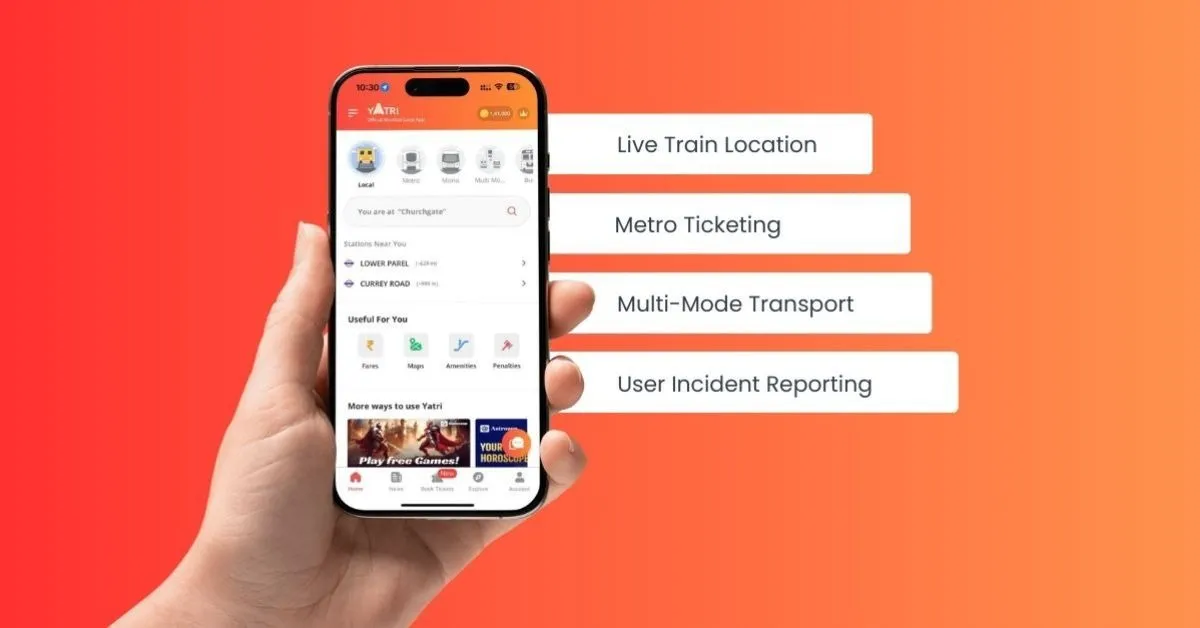
As the official partner of the Indian Railways, working with both the Central and Western Railway divisions, Yatri enables commuters to check the train’s live location.
You can find the nearest station on the map, type the source station, and track the local train of your choice. It lets you gauge how close or far you are from the train. App users can also mark their favourite trains and routes to receive custom notifications.
The geo-location of commuters guides them to the nearest station. The app’s built-in voice recognition lets commuters speak the source and destination station names aloud, and the app fetches the train’s live location.
But building something of this nature, particularly a bootstrapped initiative, wasn’t easy. It took the duo 15 months — the process began in April 2021, and the app was officially launched in July 2022.
Lakhi, who has a BTech in information technology and is an IIM Ahmedabad alumnus, says it was time-consuming because of the versatility of Mumbai locals. “When we studied the system closely, we realised that Mumbai locals include both older and newer trains. Some are AC locals with newer manufacturing, while others are much older. So the device we built had to be compatible across all kinds of trains. That meant going through multiple prototypes,” she explains.
While the app has amassed a lot of love — its current downloads stand at 2.1 million — the founder duo shares that cracking the code to accurate GPS (global positioning system) was half the battle won.
“One of the biggest challenges we took on was something no one had really managed to do successfully before: installing a GPS device in Mumbai’s local trains. Over 3,000 trains are running every day, so the scale itself is massive. That’s what made the technology complicated, but also exciting and challenging for us to work on,” Lakhi shares.
/filters:format(webp)/english-betterindia/media/media_files/2026/04/01/yatri-1-2026-04-01-18-34-18.jpg)
Explaining the modus operandi, she says they created different devices, installed them in trains, and ran them for three to four weeks at a time. Based on the results, they kept refining the design. “That entire process of building and testing multiple prototypes helped us arrive at better solutions. Eventually, we had to assemble and create a customised GPS device. These are not off-the-shelf products. It’s a completely curated system we built to crack live GPS tracking for local trains,” she adds.
While initially, the duo experimented with a card-machine-type device, they soon realised this wasn’t feasible. As Lakhi explains, “Motormen already have a long list of responsibilities and strict operating procedures, so expecting them to manage another device simply wasn’t practical. So we went back to the drawing board and worked on different solutions.”
The next approach was to install Bluetooth sensors on tracks at certain stations and to develop GPS devices that run on DC (direct current) — the type of electricity Mumbai locals operate on.
Easing public transport
Once the app was ready to launch, it still had to pass multiple rounds of testing. Algorithms and machine learning could only help so much. The real test was with commuters.
Lakhi shares, “We deployed people who would be inside the trains throughout the day, while others tracked the data outside. We were constantly comparing the GPS location being sent by the device with the train’s actual movement. We couldn’t afford even a second’s delay.”
In cases of mega blocks (scheduled suspension of train traffic for track maintenance) or service disruptions, the information is relayed to them directly from the railway control rooms.
Spotlighting another challenge they encountered, Reeva says it was that of mapping trains accurately. “Each train is identified by a rake number, but trains constantly move between lines, car sheds, and routes. A rake might start the day on one route and appear somewhere completely different later. Our system had to account for all those edge cases, which meant extensive testing and a lot of AI and machine learning layered on top of the hardware,” she points out.
But even once all of that was perfected, there was still brainstorming to do.
/filters:format(webp)/english-betterindia/media/media_files/2026/04/01/yatri-2-2026-04-01-18-36-52.jpg)
As Reeva explains, “Mumbai’s transport ecosystem keeps evolving; new metro lines are opening, routes are changing, and infrastructure is constantly being upgraded. For commuters, it becomes difficult to figure out which combination of transport will actually get them to their destination efficiently.”
This is where the ‘multimode’ feature came into play. “You can enter your source and destination, and the app suggests multiple route options using different forms of public transport — local trains, metro, buses, and more. Most people in Mumbai don’t travel using just one mode; it’s usually a combination. We wanted to simplify that entire journey,” Reeva explains.
This also involved building relationships with multiple operators: metro control rooms, BEST buses, ferries, and others. “Managing and updating information across all these systems is complex, but it’s necessary if you want to simplify the commuter’s journey,” Reeva shares.
While convincing commuters of the accuracy of the app and why adopting it will save them time has been a challenge, the duo says the proof lies in user experience. They add that they are currently working on the ticketing feature.
“We’ve started with metro ticketing, and over the next year, we hope to expand that to buses and local trains as well. The idea is to eventually make the app a complete journey planning platform for public transport,” Reeva concludes.
All pictures courtesy Yatri team
Sources
Overview of the existing Mumbai Suburban Railway.
WR Launches Tracking of Local Trains on ‘Yatri App’ for Passengers Traveling Over Mumbai Suburban Section.
Disclaimer : This story is auto aggregated by a computer programme and has not been created or edited by DOWNTHENEWS. Publisher: thebetterindia.com



