Formula 1 CEO and president Stefano Domenicali believes the series as a whole should try and agree on a future power unit formula as early as this year, backing a push for a lighter and simpler engine.
Initiated by FIA president Mohammed Ben Sulayem’s public desire for F1 to move to simpler, cheaper power units in the future, F1 stakeholders held meetings 12 months ago on what a future engine formula could look like and whether the 2026 regulations cycle could be shortened as a result.
Last year it was agreed that discussions on a potential return to V8s or a similar formula would be postponed in order for manufacturers, teams and the series to focus their full attention on the challenging rollout of the 2026 rules. The sport also needed to fully commit to the current regulations, which had seen the likes of Audi and Honda commit to F1 in the first place with a significant investment.
But now the 2026 regulations have been introduced, and given the long lead times involved, F1 boss Stefano Domenicali says the sport as a whole must decide on its future power unit regulations this year. Discussions about the current ruleset started as early as 2021.
“We cannot lose too much time because time is passing so quickly. We need to be robust enough to allow us not to be in a corner, we need to decide as soon as possible,” Domenicali told Motorsport. “Of course, we’re going to be together with the FIA in discussing that. But that’s something that this year we need to decide what could be next.”
Responding to the idea to bring forward the new formula by one year to 2030, which would require a supermajority among the power unit manufacturers according to the current governance agreements, Domenicali said the series must first respect the significant investments made by the current crop of OEMs.
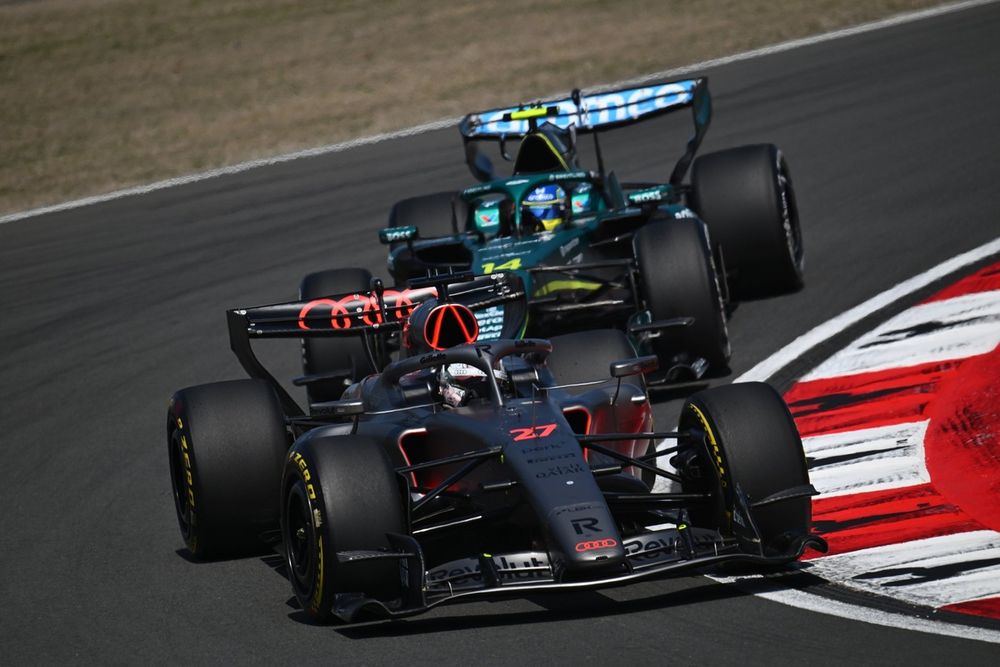
Nico Hulkenberg, Audi F1 Team, Fernando Alonso, Aston Martin Racing
Photo by: Guido De Bortoli / LAT Images via Getty Images
“In this moment, to have a manufacturer that invests in Formula 1 is something incredible, which deserves our total respect,” he said. “Because in this context, you don’t want to take that for granted. And let the FIA coordinate with their vision of what could be the right set of regulations that can be proposed to the manufacturer and to the teams.
“The regulations, in terms of governance, are expiring at the end of 2030. The agreement is part in that. After that, there is the possibility for the FIA to produce a set of regulations. We’re going to be together on that with the FIA, for sure. And after that, it is a matter of understanding if there is the possibility to eventually anticipate it or not. That’s something that will be part of the discussion we’re going to have now.”
There is a growing consensus in the F1 paddock that a return to a similar kind of engine formula to the pre-2014 era, with more cylinders and a simplified hybrid component, looks the most likely avenue for 2031 and beyond. A key factor is OEMs and governments, including the European Union, adjusting course from their aggressive pivot towards electric vehicles in recent years. That course correction is aided by the arrival of advanced sustainable fuel, which F1 has introduced this year.
Domenicali backs the FIA’s vision to make F1 cars much lighter and less complex, which should have a positive impact on both the racing spectacle, the drivers’ enjoyment and the costs involved for the manufacturers.
“I definitely see personally – but it’s up, of course, to the FIA to propose that – a sort of sustainable fuel for sure at the centre of the future, with a different balance of what could be the electrification with a strong internal combustion engine,” the Italian said.
“Because that’s motorsport. It will allow to save a lot of kilos, to have pure racing in that respect, in terms of a lighter car, smaller cars that you can really push as much as you can. So that’s going in the direction, I believe, that the purists should be happier.
“In terms of the racing itself, with some adjustment, it is great on the track. Don’t misunderstand me on that. But the car is still very heavy. The battery has [introduced] a lot of things that have to be considered when you design a car. So, these are the things that we need to process and to react to.”
We want your opinion!
What would you like to see on Motorsport.com?
– The Motorsport.com Team
Disclaimer : This story is auto aggregated by a computer programme and has not been created or edited by DOWNTHENEWS. Publisher: motorsport.com