What you need to know
Good morning and welcome to our rolling coverage of the conflict in the Middle East.
Here’s what you might have missed overnight.
- Iran has declared the Strait of Hormuz is fully reopened, at least for the duration of its current ceasefire with the US and Israel.
- US President Donald Trump confirmed the commercial re-opening, but says the US naval blockade of Iranian ports will continue until a peace deal is agreed.
- In response to the re-opening, oil prices fell more than 10 per cent on Friday (New York time), and share markets rallied.
- Speaking after a gathering of some 50 countries, including Australia, French President Emmanuel Macron and UK Prime Minister Keir Starmer said the strait must be reopened permanently, and they would keep planning a mission to restore maritime security.
- In a series of social media posts, Trump foreshadowed a deal with Iran to end the war, including the US taking Iran’s highly enriched uranium. Trump also said the US had “prohibited” Israel from further bombing of Lebanon.
- Lebanese have started returning to their homes in the country’s south as the 10-day ceasefire began, after an estimated 1.2 million people were displaced by Israel’s war with Hezbollah in the past 46 days.
- Israeli Prime Minister Benjamin Netanyahu said his military would occupy a “security zone” extending 10 kilometres into Lebanon’s territory, amid claims from the Lebanese army that the ceasefire had already been breached.
- On Friday, Prime Minister Anthony Albanese visited the Viva Energy plant in Geelong, a day after a fire erupted at the refinery, where he batted away several questions probing Trump’s latest criticism of his government.
- The Iranian soccer players who sought asylum following their Women’s Asian Cup campaign have confirmed they want to continue their sporting careers in Australia.
Oil tankers move toward Hormuz as cruise ship transits strait
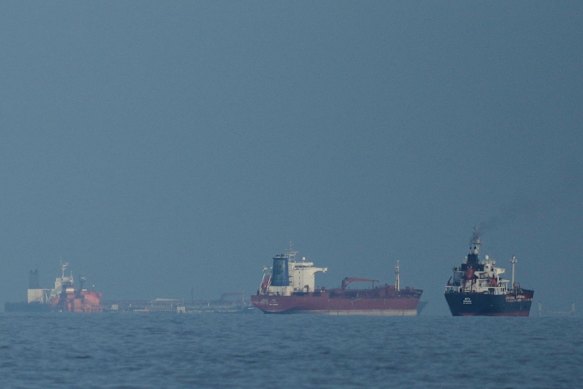
At least eight oil tankers raced toward the Strait of Hormuz in the hours after Iran’s foreign minister said the vital waterway was fully open to shipping.
Five of the carriers, which had been anchored north of Dubai, were moving into the waterway on Friday afternoon, soon after Iran’s foreign minister said it was completely open, vessel tracking data shows. Three more, which were waiting about 110km west, have also begun moving in the direction of the strait.
A Malta-flagged passenger vessel, reportedly sailing without passengers and bound for Oman, has departed Dubai after remaining docked for 47 days, according to vessel-tracker MarineTraffic.
It said the Celestial Discovery ship is expected to arrive in Oman on Saturday.
If the ships continue their voyages, their movements would be among the clearest signs yet that Hormuz might finally be opening up to shipping that isn’t connected to Iran since the war began on February 28.
Bloomberg, AP
Wall Street indexes rally at record levels
The benchmark S&P 500 and the tech-heavy Nasdaq traded at record highs on Friday, while the blue-chip Dow hit its highest level in over two months, as investors cheered Iran’s decision to open the Strait of Hormuz and were optimistic it could reach an agreement with the United States.
With traders increasingly confident that an end to the war is near, US crude oil prices tumbled more than 11 per cent, alleviating inflation concerns. The Strait of Hormuz is a vital waterway for global energy transportation.
“The concern about oil putting the world into a slowdown diminishes as it’s onward and upward for a possible final deal,” said Bob Doll, CEO of Crossmark, who noted that while there is still no signed US-Iran deal, “it looks like it’s heading in a direction that’s enough for the market to go up”.
Reuters
What you need to know
Good morning and welcome to our rolling coverage of the conflict in the Middle East.
Here’s what you might have missed overnight.
- Iran has declared the Strait of Hormuz is fully reopened, at least for the duration of its current ceasefire with the US and Israel.
- US President Donald Trump confirmed the commercial re-opening, but says the US naval blockade of Iranian ports will continue until a peace deal is agreed.
- In response to the re-opening, oil prices fell more than 10 per cent on Friday (New York time), and share markets rallied.
- Speaking after a gathering of some 50 countries, including Australia, French President Emmanuel Macron and UK Prime Minister Keir Starmer said the strait must be reopened permanently, and they would keep planning a mission to restore maritime security.
- In a series of social media posts, Trump foreshadowed a deal with Iran to end the war, including the US taking Iran’s highly enriched uranium. Trump also said the US had “prohibited” Israel from further bombing of Lebanon.
- Lebanese have started returning to their homes in the country’s south as the 10-day ceasefire began, after an estimated 1.2 million people were displaced by Israel’s war with Hezbollah in the past 46 days.
- Israeli Prime Minister Benjamin Netanyahu said his military would occupy a “security zone” extending 10 kilometres into Lebanon’s territory, amid claims from the Lebanese army that the ceasefire had already been breached.
- On Friday, Prime Minister Anthony Albanese visited the Viva Energy plant in Geelong, a day after a fire erupted at the refinery, where he batted away several questions probing Trump’s latest criticism of his government.
- The Iranian soccer players who sought asylum following their Women’s Asian Cup campaign have confirmed they want to continue their sporting careers in Australia.
Disclaimer : This story is auto aggregated by a computer programme and has not been created or edited by DOWNTHENEWS. Publisher: www.smh.com.au