Venezuela’s opposition leader, María Corina Machado, will seek to revive her push for political change with a rally in Madrid on Saturday, having found herself sidelined by Donald Trump after the abduction of the president Nicolás Maduro.
“Venezuela will be free,” the Nobel peace prize winner insisted in an interview on the eve of this weekend’s demonstration in the Puerta del Sol square, which is expected to draw tens of thousands of protesters.
Supporters had hoped Machado, whose movement is widely believed to have beaten Maduro in Venezuela’s 2024 presidential election, would take power after US troops captured her autocratic rival on 3 January. Instead, Trump backed Maduro’s vice-president, Delcy Rodríguez, in exchange for concessions involving Venezuela’s vast oil and mineral resources.
“We’re very happy with the president-elect that we have right now,” Trump said earlier this month, despite Rodríguez not having been elected.
Machado, who slipped out of Venezuela last December to receive her Nobel peace prize in Oslo, has been unable to return since Maduro’s capture, with Washington seemingly concerned her presence could cause social upheaval, and scupper Trump’s plans to exploit its oil reserves.
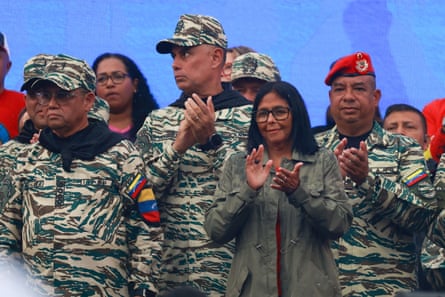
In Machado’s absence, Rodríguez has consolidated power, purging key Maduro allies from government and attempting to portray herself as a competent technocrat capable of reviving the moribund economy. The streets of Caracas feature campaign-style propaganda posters stamped with Rodríguez’s face and the slogan: “Onwards, Delcy, you have my trust.”
In a recent interview with the Spanish newspaper El País, Rodríguez’s brother, the powerful national assembly chief, Jorge Rodríguez, declined to say when fresh elections may be held. “The most important thing right now is the economy,” he said.
Members of Machado’s movement have grown increasingly frustrated at being frozen out of their country’s political future and the lack of a democratic transition after Maduro’s downfall.
Tom Shannon, a veteran US diplomat who has worked on Venezuela since the 1990s, said: “Every day that [Rodríguez] is there, is a day that the democratic opposition is not there … and it’s devastating for the opposition.”
Shannon, who was secretary of state John Kerry’s roving envoy in Latin America, said Trump’s decision to attack Iran had boosted Rodríguez’s hopes of retaining power.
“The pressure’s off now because all of our military attention is directed elsewhere and there just isn’t the bandwidth to keep the pressure on in Venezuela,” he said, noting how Washington was “rehabilitating” Rodríguez by lifting sanctions against her and issuing licences to stimulate US investment.
Speaking at a recent conference in Miami, the Machado ally Omar González complained that two crucial elements had been forgotten by those spearheading what the US secretary of state, Marco Rubio, had called Washington’s three-step plan for “stabilisation, recovery and transition”. One was the will of the Venezuelan people, who no longer wanted Rodríguez’s “gang of criminals in power”. The other was the country’s constitution, which requires elections to be held within seven months of a president’s absence.
González said he believed the way to “unlock” the situation was for Machado to return from exile, something he claimed she and other opposition activists would soon do. “To draw a perhaps slightly over-the-top analogy, [it will be] a sort of Normandy landing,” González said, predicting Venezuelan exiles would simultaneously return by land, air and sea to fight for democracy.
Quite when, or how, Machado will return remains a mystery, as does the reception she will receive from Rodríguez’s regime. In a recent interview, Delcy Rodríguez said the conservative politician would have to be “held accountable” if she did return.
Walter Molina, a Venezuelan political scientist who lives in Argentina, said he had no doubt life had improved in Venezuela since the end of Maduro’s “absolute tyranny”, albeit not enough, with more than 500 political prisoners still behind bars and Maduro’s allies still in power.
“If we were 50 floors below ground before, we are 35 floors below ground now … And if María Corina Machado returns I think we’ll be getting close to the ground floor,” he said.
“[Before] it was impossible to see a way out. Now you can see one. The question now is: how far away is this way out? And how far are we from the light at the end of the tunnel?”
Earlier this week, Machado met the French president, Emmanuel Macron, and the Dutch prime minister, Rob Jetten. But despite the high-profile nature of Saturday’s rally, Machado said there were no plans to meet Spain’s socialist prime minister, Pedro Sánchez, during her time in Madrid.
Sánchez, an outspoken critic of Donald Trump’s recent military interventions in Venezuela and Iran, questioned the legality of the US’s actions in the South American country after it seized Maduro.
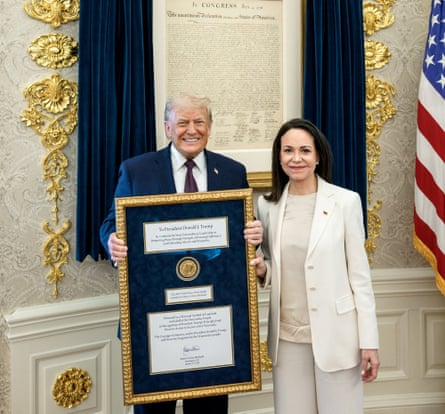
Machado, in contrast, has thanked Trump for intervening and presented him with her gold Nobel peace prize medal.
Speaking to Spain’s Cope radio station on Wednesday, Machado said that securing Venezuela’s return to freedom and democracy was “the most important objective”. She added: “There are times when holding certain meetings to that end are appropriate and there are times when they’re not appropriate, and that’s why there’s no meeting planned at this time.”
Sánchez will be attending a meeting of progressive leaders from around the world in Barcelona this weekend. However, on Friday Machado did meet Alberto Núñez Feijóo, the leader of Spain’s conservative People’s party, and Santiago Abascal, the leader of the far-right Vox party.
Disclaimer : This story is auto aggregated by a computer programme and has not been created or edited by DOWNTHENEWS. Publisher: theguardian.com