
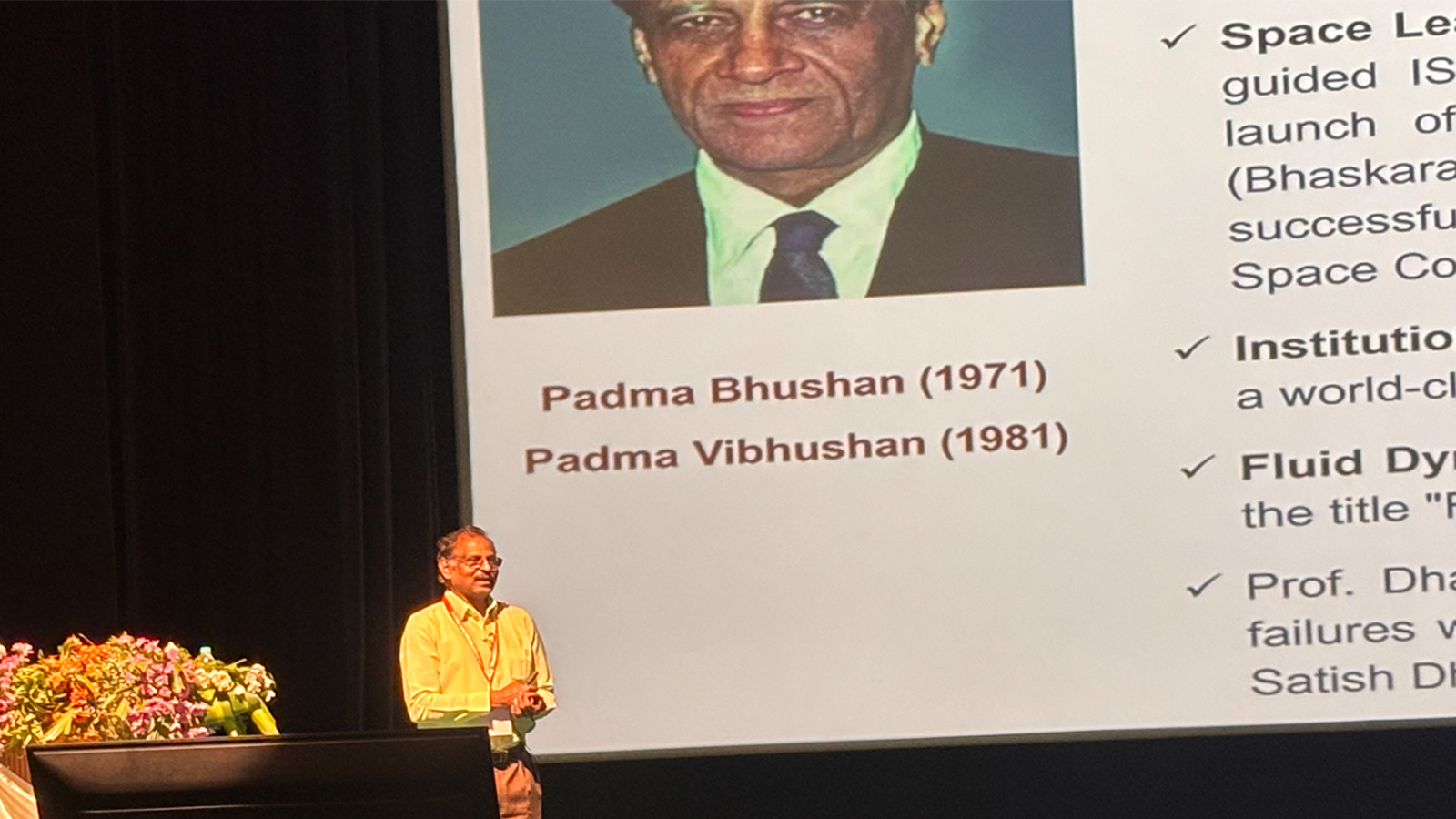
Hyderabad: “A robust certification system and trust in institutional goals are essential to motivate scientists to work harder towards national space programmes. In the recent instance, satellites played a crucial role in operation,” said V. Narayanan, Chairman of Indian Space Research Organisation (ISRO) and Secretary, Department of Space. He was addressing a conference on Prof Satish Dhawan, Memorial lecture on Indian Space Programme: Challenges and the Way Forward organised by the Aeronautical Society of India (AeSI) in Hyderabad on Saturday.
Highlighting the transformative role of space applications, Narayanan said communication and broadcasting have evolved dramatically over the decades. He noted that what once required long waiting hours at trunk call booths has now become instantaneous through mobile connectivity, reflecting the impact of satellite technology. He also pointed out that advancements in space-based applications have significantly reduced loss of life during disasters through improved forecasting and communication systems.
Speaking on national security, he said satellites play a crucial role in ensuring the safety and strategic preparedness of the country, adding that multiple satellites were effectively deployed during recent operations in Sindoor, performing communication and surveillance functions seamlessly.
Tracing the growth of India’s space infrastructure, Narayanan said the country, which initially depended on foreign support for equipment and technology, has now developed extensive facilities for launch vehicle assembly, solid and liquid propulsion systems, and deep-space communication.
He highlighted major achievements of ISRO, including over 400 launch missions and significant progress in space exploration. Referring to missions such as Chandrayaan-1 and Chandrayaan-3, he said India has made notable scientific discoveries, including the detection of water molecules on the Moon and successful soft-landing near the lunar south pole.
Narayanan also noted that India became the first country to successfully reach Mars orbit on its maiden attempt through the Mars Orbiter Mission. He added that India holds a world record for launching 104 satellites in a single mission, demonstrating its growing capabilities in space technology.
For future goals, he said India is working towards human spaceflight missions under the Gaganyaan programme, with multiple uncrewed and crewed missions planned. The country is also targeting the development of its own space station by 2035 and expanding satellite capacity significantly in the coming years.
Narayanan further stated that India is strengthening global collaborations, undertaking commercial launches, and developing advanced technologies such as reusable launch systems, electric propulsion, and deep-space exploration missions. Recalling the early days of the Indian space programme, he said the journey from transporting rocket components on bicycles to achieving global leadership in multiple domains reflects the country’s scientific resilience and innovation.
Disclaimer : This story is auto aggregated by a computer programme and has not been created or edited by DOWNTHENEWS. Publisher: deccanchronicle.com



