

Fuel prices are set to fall even further by next weekend after an Iranian leader announced a halt to the regime’s weeks-long blockade on shipping from the Middle East.
And Australia has thrown its support behind an international mission to keep the Strait of Hormuz open, with Prime Minister Anthony Albanese saying any move by Iran to charge vessels transiting through the strait would upend the global economy.
Oil prices, which surged following the joint US-Israeli attack on Iran on February 28, dropped 10 per cent on Saturday after Iranian Foreign Minister Abbas Araghchi declared that the strait would be “completely open for the remaining period of the ceasefire”. US President Donald Trump hailed it a “brilliant day for the world”.
Even before the hopeful news, Australia’s fuel prices were tumbling in line with global oil markets.
A high point was reached in late March, when the national average price for unleaded petrol was $2.58 per litre and diesel hit $3.27 per litre. Prices began to fall when the Albanese government delivered a 26¢ discount by halving the fuel excise on April 1.
Prices have fallen ever since. The cheapest unleaded petrol in Sydney on Saturday sold for $1.84 a litre, and the average across the city was $2.01. The city’s cheapest diesel was $2.69 and the average was $2.96.
Melbourne’s cheapest unleaded petrol was $1.82 a litre and the average was $2.06. The cheapest diesel was $2.83 and the average was $2.97.
Australian fuel prices shift in line with crude oil markets, typically with a lag of seven to 10 days. That means further discounts will soon reach Australian petrol stations if the downward trend continues.
Each $US10-a-barrel decline in oil prices could cut 10¢ a litre at the pump in Australia.
The fuel price cuts began on April 8 when a US-Iran ceasefire was announced. Crude oil is currently trading at $US92 a barrel, down from a high of $US128 in early April.
Despite the falls, experts warn it could take many months or longer for prices to stabilise, normal shipping schedules to resume, and damaged oil facilities to be repaired to full capacity. Oil was traded for $US73 a barrel before the war.
While Trump has foreshadowed a peace deal, confusion over Iran’s position persists ahead of the April 22 deadline for the ceasefire to end. An ongoing blockade of the strait would again be expected to drive oil prices higher, putting upward pressure on local fuel costs.
Trump insists that the US blockade of Iranian ports will remain, which Iranian leaders have said would prompt them to close the strait. Iran is also opposed to US demands for it to give up its stockpiles of enriched uranium.
However, the National Roads and Motorists Association said that barring the resumption of hostilities between the US and Iran, cheaper fuel should flow into the domestic market for at least another week.
“Our expectation is that, leading into the ANZAC Day long weekend, the falls will continue. But it’s the Middle East, and things can change by the hour,” said NRMA spokesman Peter Khoury.
On Friday night Albanese took part in the Strait of Hormuz summit with 49 national leaders, including from the UK, France, Canada, Germany and the United Arab Emirates. Its chief goal was to oppose a shipping toll, which would be used to generate significant revenue for Iran’s war-ravaged economy.
Albanese said such a move would be an existential threat to global trade and pledged that Australia would make an economic and diplomatic contribution to international efforts to ensure freedom of navigation.
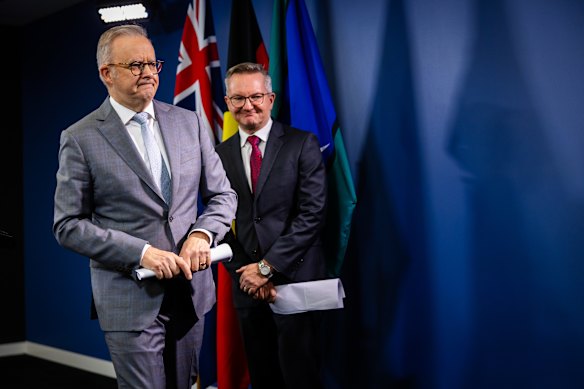
Requests for military contributions would be considered, he said at a press conference in Sydney on Saturday.
“We want to see the Strait of Hormuz opened and we want to see no privatisation and no tolls,” Albanese said.
The busy shipping channel carries more than a hundred cargoes a day of vital gas, fertiliser and chemicals, as well as one-fifth of global oil supply, via a bottleneck abutting Iran’s coastline in the Persian Gulf.
“Freedom of navigation is essential for global trade. It is how the world operates, not just in fuel but in other areas as well,” Albanese said.
“The precedent that would be created if a country was allowed to close a navigation strait to international traffic would change the very way that the global economy operates.”
Albanese said while there was no immediate need for motorists to cut their consumption, fuel-saving measures may be needed if oil exports from the Middle East remained shut for weeks into the future.
“There may be difficult times ahead,” he said. “That is why we want to see an end to this war.”
Australia’s commitment to the Strait of Hormuz summit is another example of its shared priorities with other middle-powers such as Canada and Japan, like free trade and a rules-based global order, according to Jon Berry, geopolitics lead at KPMG.
“Australia sees its interests are best met by banding together with other middle-power countries,” he said.
“The meeting overnight is an example of that and we’ve also seen other examples recently in Anthony Albanese’s outreach to Singapore and Malaysia and Brunei and Indonesia to reconfirm and solidify those trade and investment links.”
Energy Minister Chris Bowen on Saturday announced that the temporary lifting of sulphur limits on unleaded petrol would be extended from the initial deadline of the end of May until the end of September, so Australia could source fuel from a wider array of sources.
Bowen revealed a significant boost to Australia’s fuel stockpile. There are 46 days of unleaded petrol in storage, which is 10 days more than on February 28 when the Iran war began. There are 31 days’ worth of diesel in stockpile, which is the same as last week, and 30 days of jet fuel, up by two days on last week.
Start the day with a summary of the day’s most important and interesting stories, analysis and insights. Sign up for our Morning Edition newsletter.
 Mike Foley is the climate and energy correspondent for The Age and The Sydney Morning Herald.Connect via email.
From our partners
Disclaimer : This story is auto aggregated by a computer programme and has not been created or edited by DOWNTHENEWS. Publisher: www.smh.com.au


