Updated ,first published
MUSIC
Tim Rogers
Camelot Lounge, April 17
Reviewed by JAMES JENNINGS
★★★★
“Do you want chips with that?”
No, not something overheard from the bar staff tonight, but a question posed in new Tim Rogers song The Has-been.
It’s one of many lines this evening that elicit a laugh from the crowd, the track itself a self-deprecating examination of going from zero to hero in the music scene, its protagonist unceremoniously transitioning from rock god to bistro employee.
It’s been a few decades since Rogers’ band You Am I was part of the cultural zeitgeist in the ’90s, when it scored three consecutive Australian No.1 albums. In the years since, the singer-songwriter has bagged 10 ARIA awards and recorded a string of acclaimed LPs with and without You Am I, making The Has-been more humorous exaggeration than harrowing real-life tale.
Still, if the fickle nature of fame means Rogers can play a string of intimate solo shows in rooms with a capacity of about 160, we should be grateful.
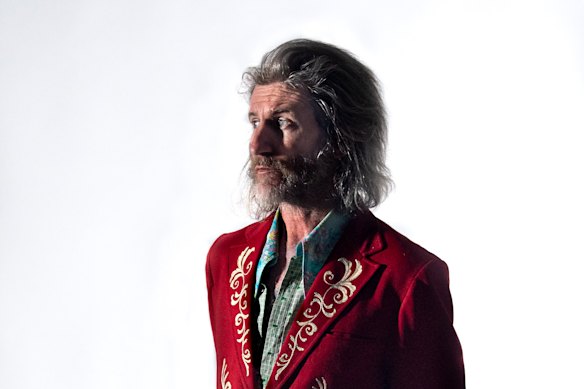
Resplendent in a striking red western-style suit embroidered with flowers, Rogers spins yarns about songs from across his discography, delightfully adding context to them.
Whether reminiscing about a beloved jukebox in a NYC East Village bar that’s no longer there (The Jukebox Has Left the Jones), admitting to singing Been So Good, Been So Far in French for drugs, or recounting the indignities of being a touring musician where you’re as “broke as a lawnmower’s choke” (an untitled new song), Rogers proves he’s a natural storyteller who instinctively knows how to balance humour with heart.
Age and the rock’n’roll lifestyle have given Rogers’ voice a weathered tone, which compliments tonight’s material perfectly. You Am I classics Berlin Chair, Purple Sneakers and Heavy Heart all carry more emotional weight thanks to the passing of time and the stripped-back presentation, with the addition of double bassist Ruben Shannon for most of the set elevating the material.
Before ending with a cover of UK singer-songwriter Jake Thackray’s hilariously bawdy The Lodger, Rogers apologises for not being available for post-show chats with the audience, explaining that one-on-one he’s a bit awkward, whereas on stage is where he is at his best. After tonight’s warm and generous performance, that’s hard to argue against.
MUSIC
Tchaikovsky’s Fifth Symphony
Sydney Symphony Orchestra with Donald Runnicles
Sydney Opera House, April 15
Reviewed by PETER McCALLUM
★★★★½
Greek violinist Leonidas Kavakos sustained the first movement, Nocturne, of Shostakovich’s Violin Concerto No. 1 in A minor, Opus 99 with drawn thoughtful phrases and a quiet mood of deep introspection before launching into the second, Scherzo, with spiky chipped bow strokes of demonic wildness.
The next two movements spanned comparable expressive opposites, moving from the portentous majesty of the third movement, Passacaglia, (which highlights Shostakovich’s unusual brass scoring of just horns and tuba), to frenetic energy and brilliance in the finale.
Here, the orchestral sounds were highlighted with dry spikes from the xylophone, as though someone had outlined leering shapes with a black pencil, while Kavakos dispatched increasingly dazzling virtuosic gestures without once causing a crack in his tone’s brilliant tensile polish.
It is as though Shostakovich has appropriated the archaic four-movement form of the Baroque Sonata da Chiesa and transformed it with the nightmarish extremes of 20th-century angst. Shostakovich unifies the work by thematic cross-references between the movements, often etching in his own musical signature DSCH (D E flat, C B) when the music is at its most sardonic.
Kovakos’ dark Mephistophelian stage persona seemed designed for such passages, but some of his most memorable playing came in the cadenza between the last two movements, which began in controlled quietness before moving to chords of increasingly radiant resonance.
Conductor Donald Runnicles introduced the work with a quotation from Shostakovich, “when a man is in despair, it means that he still believes in something”. With Tchaikovsky’s Symphony No. 5 in E minor, Opus 64, played in the second half, one might invert this and say that when a person is in rapture (as Tchaikovsky seems to be in the middle movements), he is still haunted by despair.
Clarinettist Olli Leppaniemi introduced that haunting thought, which returns in each of the subsequent movements, with a smooth yet distinct brooding tone, while Runnicles kept the tempo of the introduction intense and solemn without overdramatising its portentousness.
The high point of rapture came in Samuel Jacobs’ longing horn melody in the second movement and oboist Shefali Pryor’s serenely animated reply. The sound from the strings under concertmaster Andrew Haveron was impressive in the climactic moment, for its lilt in the third movement, Valse, and for the way it cut through the most blazing textures of the finale, which can sometimes appear inflated despite every effort at good taste. Runnicles has good taste in abundance, which allowed listeners to be swept up in the tumult without being concussed by triumphalism.
THEATRE
CLUEDO
Theatre Royal, April 16. Until May 10.
Reviewed by KATE PRENDERGAST
★
What a cacophony of flat-brained foolishness is Cluedo, the unnecessary play. Adapted from the 1985 film (“a movie that makes a scene of the crime”), this Hasbro-licensed farce is a trademark-milking overkill of its board-game universe, an aggressively witless whodunit that affronts the senses and shrinks the mind in its whirlwind of murders, shouting, door slams and bulging, brassy sound.
We’re at Boddy Manor. Six guests, all strangers to each other, all given colour-coded pseudonyms, have been summoned one stormy night. After dinner, during which Mrs Peacock slurps grotesquely at a bowl of soup, it’s revealed what they have in common: they are all being blackmailed by the owner of the house, a mysterious Mr Boddy. Cue: thunderclap!
The various indiscretions that provoked this blackmail are hardly level: Mrs White probably murdered several husbands, Colonel Mustard hired an escort (OK?), Miss Scarlett is the obvious aforementioned she. Reverend Green is a “bad conservative”, Professor Plum is an enjoyer of underage girls (gross), Mrs Peacock greases paws for her politician husband.
Yet Mr Boddy, purely for his Machiavellian love of the game, will allow all of them to leave scot-free if they get rid of the one witness beyond himself who knows of their crimes: the butler Wadsworth (Grant Piro). Thus ensues a spree of killings: in the study, the library, with a wrench, a revolver, etc. The working class “help” are very disposable here, among them faux French maid Yvette (in a derriere-led performance by Lib Campbell).
The posh set is moderately well-constructed, with parts of the manor’s interior popping in and out like a doll’s house to imply the six rooms behind the six (ever-slamming, please not again) doors. Nonetheless, a sense of place was better evoked on a piece of fold-out cardboard – I can still remember what the Billiard Room felt like, for instance, two decades or so after I last played the table-top game. I have no firm notion of it or other “crime scene” rooms in this production.
The dialogue is perhaps the most wince-worthy: a clamour of wearisome puns, dated double entendres and wordplay that will make you groan, titter feebly or scowl from your impenetrable tundra of icy rage. Then there’s the chorusing of plummy English accents and the synchronised movement of silver spoon-fed suspects. Repetition as a humour device becomes tiresome when the game has an operating mechanism of six.
Some sympathy must go towards the actors, whipped into a frenzy of obstreperous excess for this mystery thriller. Laurence Boxhall (Reverend Green) has a knack for leaving a memorable impression in big-budget franchised mediocrities – he was an excellent Gollum in the offensively dreadful Lord of the Rings musical and he shows off some final-hour goofing par excellence during Cluedo’s plot-twisty denouement. Adam Murphy’s Colonel Mustard, in British Empire hunter’s khaki, stands out as the odd man out. An extended death scene is, at least, genuinely amusing in over-the-top physical comedy.
Silliness can be wonderful – a hiccuping tonic, a rejuvenation from saturnine spirits. But in the wrong measure it’s like having buckets of lukewarm water thrown in your face. In Cluedo I did not care whodunit, I just wanted it to stop.
MUSIC
MGK
Qudos Bank Arena, April 14
Reviewed by JAMES JENNINGS
★★½
“Funny thing about legends, they don’t set out to be legends. They just burn so bright the rest of us can’t look away.”
So goes the self-aggrandising narration that opens MGK’s first Sydney show in eight years, and while there’s plenty of evoking music legends of yore – sample lyrics on this night include “I’m bad to the bone”, “I was born to walk the line” and “I’m a rolling stone” (from a song called Cliche, which gives the false hope some self-awareness is at play) – the truth is MGK has about as much depth and originality as a blank sheet of paper. Legend material he ain’t.
Still, it’s easy to see why the man known to the tax department as Colson Baker has drawn a sold-out crowd – he’s a tall, good-looking rooster who can rap, sing and write pop-punk songs that keep the algorithm happy. But for someone who fancies himself as a mythical rock star, MGK’s scant influences seem mostly to be relegated to profane but toothless pop-punks Blink-182, with some numbskull nu metal from Limp Bizkit thrown in for bad measure.
There’s also a stab at trying to sound like Iggy and the Stooges that comes off more like an energy drink commercial (Don’t Wait Run Fast), plus a couple of clumsy interpolations: Starman manages to make the chorus of Third Eye Blind’s upbeat-sounding 1997 hit Semi-Charmed Life sound sullen and lifeless, and Lonely Road’s spin on John Denver’s Take Me Home, Country Roads is nothing more than a cynical play for the country charts.
We thought we’d already hit peak cringe but then MGK puts on a baseball cap backwards to rap on Wild Boy. It’s hard to top his antiquated – quaint, even – idea of what rock’n’roll rebellion looks like in 2026: riding fast motorcycles, giving the finger and smoking durries.
It’s hard to imagine why Bob Dylan, one of music’s greatest wordsmiths, is a fan of MGK, considering his godawful lyrics. Still, you can’t fault MGK for having fun and living out his juvenile, weirdly conceptualised rock’n’roll fantasy throughout this energetic show, even if it all feels as calculated as a mid-career pop-punk pivot.
MUSIC
JON ROSE AT 75
People’s Republic of Australasia, April 12
Reviewed by JOHN SHAND
★★★★½
I first wrote about Jon Rose 43 years ago. While I have the misfortune to be 43 years older, his art is not. It is still just as fresh, funny, surprising, beautiful, subversive, inventive and defiant. The defiance is intrinsic. Rose has devoted his life to making music that shuns idiom, most often, as here, via free improvisation.
At 75, he is an internationally celebrated figure, which no doubt warms his heart, but changes nothing when he picks up his violin; when the aural canvas is initially just as blank as it ever was, and every performance is an adventure into the unknown.
Given he has lived in Alice Springs for some years, this was a rare Sydney appearance at the quirky venue of publisher Nick Shimmin’s loungeroom, which he opens to experimental artists and an email list-only audience.
For it, he chose a decades-long collaborator in saxophonist Jim Denley and a more recent one in double bassist Clayton Thomas. Like Rose, both have a virtuosity that climbs beyond mere facility and into the outer reaches of what is possible on each instrument.
To sit only a metre or two from them is to be swept into an intoxicating theatre of sound, since watching them make the music is as enthralling as the music itself. Process and outcome are one and the same. You could variously watch Thomas playing his bass with two bows, sometimes both in one hand, sometimes one in each, above and below the bridge; or Denley using a pot lid on the bell of his alto, making a scraping or vibrating sound while also semi-muting the horn; or Rose using his violin as a percussion instrument of boundless potential.
While all three naturally sought ways to enhance what was happening, Rose, in particular, used his slippery, spidery violin to subvert anything in danger of entering a cul-de-sac of predictability.
It could be music you bathed in, or clung to as it took you for a tumultuous ride, and always it was music of contrasts: of extremes of pitch; of unfamiliar textures; of fragmentary rhythms and elusive tonal centres.
Then would come a moment of blinding beauty, as of a melody heard in a distant, unattainable past. Each player intuitively dropped out here and there to leave intricate duets, and one of these, between Rose and Denley, was so texturally startling it was like music from another dimension.
The interaction was routinely uncanny. Partly, of course, it’s a matter of intense listening to each other, but also of freakish convergences. In one memorable section of the second set, the violin and alto cried plaintively over massive, granite-like pillars of bass sound.
Another section had Denley growling into his saxophone, Rose sounding like a creaky house in a gale, and Thomas a forewarning of the apocalypse, before all three suddenly retreated to the merest wisps of sounds, and then to just the ghosts of those wisps.
MUSIC
Bic Runga
City Recital Hall, April 12
Reviewed by AMBER CUNNEEN
★★★★
It took being far from home for Bic Runga to find the freedom to write her new album. Temporarily relocating from New Zealand to Paris, she reconnected with her muse to create Red Sunset, her first collection of original material since 2011.
This tour is a homecoming to audiences in Aotearoa and Australia, and to herself.
Runga takes to the stage inconspicuously, without introduction, to play drums for support act Silicon (the outlet of creative and romantic partner Kody Nielson). Shrouded in the same soft lighting and projected silhouettes, Runga is indistinguishable from the other performers, save for her red dress and famous face.
Shifting into her own set, she takes centre-stage, still seemingly coming to terms with a return to solo billing. Initially withdrawn at the microphone, she relaxes when handed an instrument (by the end of the night, she’ll skilfully cycle through four) and across the hour, she blooms: Bic Runga, the frontwoman, is back.
Red Sunset is more arthouse and experimental than albums past. Runga is self-aware, if not self-assured, about the shift. She says she hopes we’ll accept the material (and aren’t just waiting for Sway). The set list reflects this. Runga signposts each track as “old” or “new”, rotating between the decades every few minutes. It’s a clever approach. Runga’s vulnerability is endearing and the room is behind her.
Her older music is the better showcase of her talents. But even the songs that fall flat in the studio incarnation of Red Sunset take on a lustre when played live. She glides through the octaves with a distinct clarity on stage, her vocals able to break free of the album’s ambient instrumentation. Nielson is also dynamite on his turn at the drums, propelling the audience through each number.
Drive, performed alone on electric guitar, is magnetic. And for those who did come for Sway – and who could blame them? – the ’90s juggernaut holds up and the audience exults in it.
COMEDY
Glenn Moore: Please Sir, Glenn I Have Some Moore?
Comedy Store, April 9
Reviewed by DANIEL HERBORN
★★★★
Plenty of comedians have a few tried and tested jokes they keep in their back pocket, ready to use if their newer material doesn’t land. UK comedian Glenn Moore has a whole book of these failsafes – expertly-constructed one-liners he has apparently deployed to great effect on shows like Mock the Week and Have I Got News For You.
He’s also got a second book containing the worst joke he’s ever written, to be used if things are going too well. This may sound gimmicky, but Please Sir, Glenn I Have Some Moore? is anything but. It’s built around rock-solid, old-fashioned joke writing, with first-rate observational humour, puns and wordplay arriving at a relentless pace.
The narrative backbone is a road trip Moore took through Death Valley with his cousin Benji some 10 years ago. While Benji is an obnoxious type, Moore is so cowed by more confident people that he once agreed with a waiter that he had indeed given his name as “Greg Moore”.
When Benji ignores Moore’s directions and the pair become dangerously lost and low on petrol, he has to choose between an out-of-character confrontation or meekly accepting the blame. There’s slightly too much emphasis on this simple story when the real draw here is the comic digressions, ranging from why strippers only dress as the most important professions, why Julius Caesar was an overachiever and Moore’s ingenious way to sabotage a rival’s Google autocomplete.
With a bevy of running jokes and callbacks so good they could be used in a masterclass on extracting maximum hilarity through clever structure, this early Sydney Comedy Festival show has this year’s event off to a cracking start. Suffice to say that at one point Moore had to break out his “worst joke ever”, and even that got big laughs.
 John Shand has written about music and theatre since 1981 in more than 30 publications, including for Fairfax Media since 1993. He is also a playwright, author, poet, librettist, drummer and winner of the 2017 Walkley Arts Journalism AwardConnect via X.
From our partners
Disclaimer : This story is auto aggregated by a computer programme and has not been created or edited by DOWNTHENEWS. Publisher: www.smh.com.au