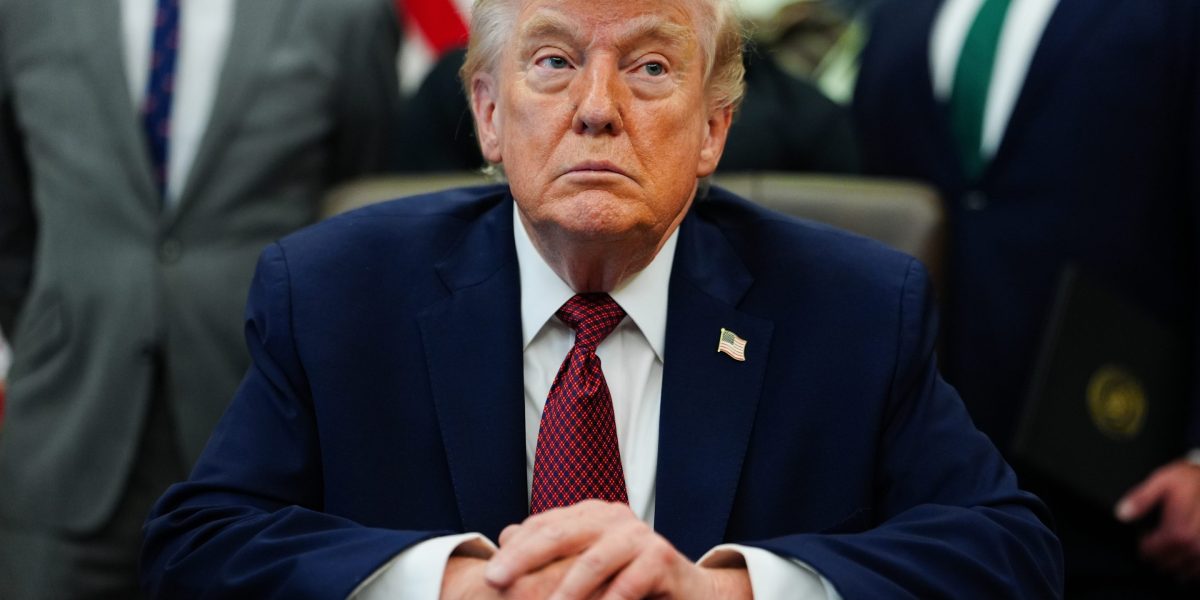
President Donald Trump said U.S. negotiators will head to Pakistan on Monday for another round of talks with Iran, raising hopes of extending a fragile ceasefire set to expire by Wednesday even as Washington and Tehran remain in a standoff over the Strait of Hormuz.
Iran did not immediately confirm the talks but its chief negotiator, parliament speaker Mohammed Bagher Qalibaf, said in an interview aired on state television late Saturday that “there will be no retreat in the field of diplomacy,” while acknowledging a wide gap remained between the sides.
The White House said Vice President JD Vance, who led the first round of historic face-to-face talks last weekend, would lead the delegation to Pakistan with envoys Steve Witkoff and Jared Kushner.
Pakistani authorities began tightening security in Islamabad. A regional official involved in the efforts said mediators were finalizing preparations and U.S. advance security teams were already on the ground. The official spoke on condition of anonymity because they weren’t authorized to discuss preparations with the media.
Iran on Saturday said it had received new proposals from the United States. It was unclear whether either side had shifted stances on issues that derailed the last round of negotiations, including Iran’s nuclear enrichment program, its regional proxies and control over the Strait of Hormuz.
Trump’s announcement repeated his threats against Iranian infrastructure that have drawn widespread criticism and warnings of war crimes. If Iran doesn’t agree to the U.S.-proposed deal, “the United States is going to knock out every single Power Plant, and every single Bridge, in Iran,” he wrote.
Iran says transits of the Strait of Hormuz are ‘impossible’
Ships remained unable to transit the critical waterway amid threats from Iran and a U.S. blockade on ships heading to and from Iranian ports. Roughly one-fifth of the world’s oil trade normally passes through the strait, and the global energy crisis threatened to deepen as the war is now in its eighth week.
Iranian officials earlier on Sunday held firm that ships wouldn’t pass while the U.S. blockade remained in effect. “It is impossible for others to pass through the Strait of Hormuz while we cannot,” Qalibaf said.
In his post about talks, Trump accused Iran of violating the ceasefire by firing at ships transiting the strait. Iran has called the U.S. blockade a violation, and foreign ministry spokesperson Esmaeil Baqaei on Sunday called it an “act of aggression.”
Iran had announced the strait’s reopening after a 10-day truce between Israel and the Iranian-backed Hezbollah militant group in Lebanon took hold on Friday. But Iran said it would continue enforcing its restrictions there after Trump said the U.S. blockade “will remain in full force” until Tehran reaches a deal with the United States.
After a brief uptick in transit attempts on Saturday, Iran fired on two India-flagged merchant ships that were forced to turn around, leading India to summon Iran’s ambassador over the “serious incident.” India noted that Iran earlier let several India-bound ships through.
For the Islamic Republic, the strait’s closure — imposed after the U.S. and Israel launched the Iran war on Feb. 28 during talks over Tehran’s nuclear program — is perhaps its most powerful weapon, inflicting political pain on Trump. For the United States, the blockade squeezes Iran’s already weakened economy by denying it long-term cash flow.
The war has killed at least 3,000 people in Iran, more than 2,290 in Lebanon, 23 in Israel and more than a dozen in Gulf Arab states. Fifteen Israeli soldiers in Lebanon and 13 U.S. service members throughout the region have been killed.
Since most supplies to U.S. military bases in the Gulf region come through the strait, “Iran is determined to maintain oversight and control over traffic through the strait until the war fully ends,” Iran’s Supreme National Security Council said late Saturday. That means Iran-designated routes, payment of fees and issuance of transit certificates.
The council has recently acted as Iran’s de facto top decision-making body.
Pakistan presses on diplomacy and Iran issues a warning
Pakistani Foreign Minister Ishaq Dar, who spoke by phone with Iran’s Foreign Minister Abbas Araghchi on Sunday, has said his country was working to “bridge” differences between the U.S. and Iran.
Iranian Deputy Foreign Minister Saeed Khatibzadeh on Saturday told The Associated Press that the U.S. is “risking the whole ceasefire package” with its blockade.
Khatibzadeh said Iran won’t hand over its stock of 970 pounds (440 kilograms) of enriched uranium to the United States, calling the idea “a nonstarter.” The deputy minister didn’t address other proposals for the enriched uranium, saying only that “we are ready to address any concerns.”
Disclaimer : This story is auto aggregated by a computer programme and has not been created or edited by DOWNTHENEWS. Publisher: fortune.com