
SHORT STORIES
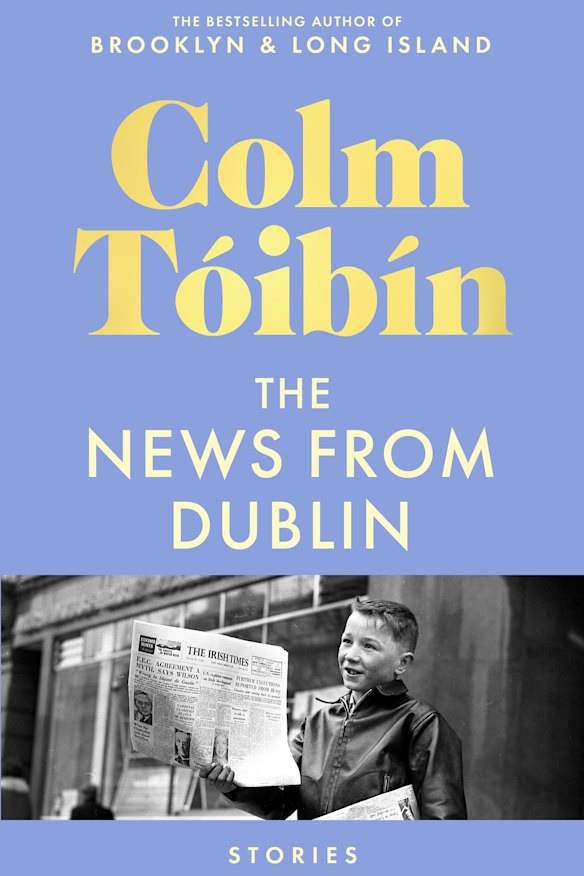
The News from Dublin
Colm Tóibín
Picador, $34.99
Despite its catchy title, the stories in Colm Tóibín’s collection The News from Dublin are not about newsy issues. Instead, they are about the only “issue” that ever really exists – our life in relationships. This news itself will not come as a surprise to readers already acquainted with Tóibín’s work because it continues the profoundly humanist approach to fiction he has undertaken for the past four decades.
By invoking humanism I mean not that Tóibín’s work is conservative or needlessly nostalgic but that it is continuous. Notwithstanding its often contemporary subject matter, it functions within an unusually intact aesthetic of character, community and place, steeped as Tóibín is in the work of masters such as Henry James, John McGahern and Marylinne Robinson. Like these writers, Tóibín remains neither above nor beyond but firmly inside the ordinary lives of social engagement; he allows the prose itself to disappear to portray eternal human predicaments and intractable emotional ambiguities. Ever so gradually, what could be described as Tóibín’s own artisanal variation on the ethics of ambiguity is infused into the readers, whether they like it or not.
The News from Dublin opens with a fictionalisation of Lady Augusta Gregory’s journey to Galway in 1918 to deliver the telegram reporting her son Robert’s death to his widow. Tóibín has fictionalised Lady Gregory before, in the 2010 collection The Empty Family, and has also written a slim but incisive book, Lady Gregory’s Toothbrush, about her role in both the Anglo-Irish ascendancy and the Celtic Revival. This opening story, then, resonates not only with the inherent ambiguities of the Irish literary past, of which Tóibín has become a key chronicler, but also with his own body of work, which continues to gather myriad cross-currents and recurring emblems around itself.
Readers of Tóibín, for instance, will know that his fiction is more than likely to be set either in his home county of Wexford in southern Ireland, in the Irish diaspora of the US, or among solitary Irish residents in Spain, which was itself a formative place for him as a younger writer. The News from Dublin takes us again to exactly these landscapes – they are by now established as recurring geographical motifs in Tóibín’s fiction – as he continues his rendition of how Ireland has extended from its own very particular and imaginative insularity to become an adjunct psychogeography of the fictionalised page. The collection also takes us, in the final, novella-length story The Catalan Girls, to Argentina, the setting for his third novel, The Story of the Night.
An ongoing quality of Tóibín’s fiction is its cumulative effect. The body of work, as well as each piece within it, wears its dramas lightly at first, until before you know it you are immersed in a difficult and even intransigent world of immense personal difficulties. This is again the case in these new stories, which portray the private worlds of those not only in exile from their birthplace but also from society’s approval. In A Sum of Money the consequences of rural poverty for Dan, a boarder at a secondary college in Wexford, are dramatised in such a way that we are made to feel, among other things, empathy for the perpetrator of a devious crime. Likewise, in the chilling A Free Man we find ourselves transfixed by the portrait of a convicted Irish paedophile teacher exiled in Barcelona, a man whose lack of remorse is captivating precisely because Tóibín’s subtle art renders it so believable.
These, then, are character-driven stories that transcend polemics. The point is not to make a point but rather to do the work that fiction does best, portraying the way the backstage of our minds plays out in the context of social situations. In this, Tóibín’s work is incomparably clear-eyed, and also well schooled. He is both an exponent and a scholar of the possibilities and powers of the late tradition in which he works, the modern novel and short story.
In the title piece, a story with indissoluble links to perhaps his two greatest novels, The Heather Blazing and Nora Webster, a family with connections to the ruling Fianna Fáil government in Dublin try to obtain a new cure for tuberculosis for a dying family member before it is released to the public. Tóibín’s stories can sometimes read like sculpted narrative arcs, at other times like shards of life polished at the edges. This piece feels almost like a conflation of the two. Its narrative traction does not so much peak as taper off, as if to say that despite the sun’s glory, life is full of false dawns, the truth being that there will be no news that will ever come to exempt us from our lives.
That life is intractable is indeed the news from Dublin, from Wexford, from Spain, the US and Argentina, in the hands of Tóibín. When we read his work we experience a doubling-up of our existence. Through his characters we understand afresh what it is like to be an individual in a family, in a community, even as we are swept away in his narrative inventions. That is why, as Tóibín has written before, life can be too thin an experience without fiction. Such is the human truth inherent in his style.
Gregory Day is a novelist, poet and musician. His most recent book is Southsightedness.
The Booklist is a weekly newsletter for book lovers from Jason Steger. Get it delivered every Friday.
 Gregory Day is a former coach of the Moriac Apricots. He is also an award-winning novelist, poet, essayist and musician based in Victoria, Australia.
From our partners
Disclaimer : This story is auto aggregated by a computer programme and has not been created or edited by DOWNTHENEWS. Publisher: www.smh.com.au