
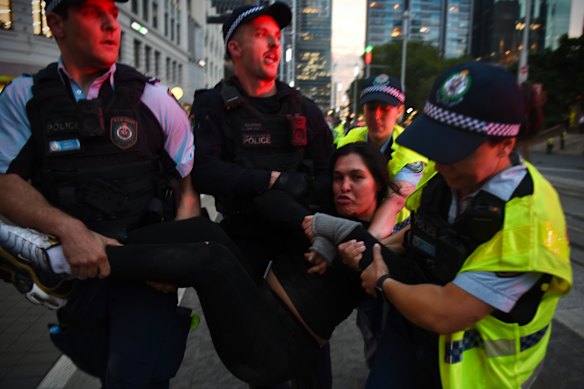

NSW Police are reviewing charges laid against protesters after the state’s highest court ruled the state government’s law restricting protests was unconstitutional.
But Premier Chris Minns insists protesters should “take responsibility” for their actions on February 9, when at least 25 people were charged after a protest against the visit of Israeli President Isaac Herzog. The protest became violent, with police using laws passed after the Bondi terror attack to stop activists marching on Sydney’s streets.
Two pieces of legislation gave police extraordinary powers on the night of the protest – both the Public Assembly Restriction Declaration (PARD) and the Major Events Act, giving police the power to close entire parts of the city.
Police will now review whether the court’s finding that the PARD burdens the implied freedom of political communication – and is therefore struck out – will impact any prosecutions, with more arrests still expected.
“The judgment was handed down last week. While disappointing, as an organisation we will review all prosecutions,” NSW Police Commissioner Mal Lanyon said.
Lanyon said he understands charges were laid both under the Major Events Act and the Crimes Act. This masthead revealed last week that the now struck-out PARD was cited in court documents to justify some police actions on the night.
“We will review each of those charges. If it’s necessary to do so, we will take action,” Lanyon said.
As well as finding the law was unconstitutional, the court also found that it is not appropriate for governments to crack down on all protests in a certain area to protect the community from social disharmony, and that social cohesion concerns were not a valid reason to restrict people’s right to participate in public debate.
The premier disagreed.
“I think it’s easy for lawyers and the courts to say it’s not the government’s responsibility, but when things go wrong and you have major violent disruption on the streets of Sydney, I can guarantee you, most people are desperate for the NSW Police to be out there to keep us safe,” Minns said.
Minns also accused the protesters of screaming “violent rhetoric and hateful phrases” for the past two years.
The state government is pursuing a ban on the phrase “globalise the Intifada” but is yet to introduce any legislation.
“This idea that the only reason there were violent scenes on the night is because the protest declaration was in place, and it somehow spurred them into a violent confrontation. I mean, if you believe that, I’ll sell the clock on top of the Town Hall – what a load of utter garbage,” Minns said.
The actions of police on the night of the protest are subject to a Law Enforcement Conduct Commission investigation, which will hold public hearings later in the year.
Start the day with a summary of the day’s most important and interesting stories, analysis and insights. Sign up for our Morning Edition newsletter.
 Jessica McSweeney is a reporter at The Sydney Morning Herald covering state politics and urban affairs.Connect via email.
From our partners
Disclaimer : This story is auto aggregated by a computer programme and has not been created or edited by DOWNTHENEWS. Publisher: www.smh.com.au


