
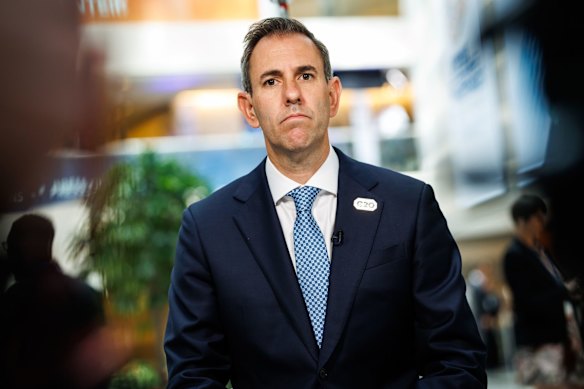

Treasurer Jim Chalmers has admitted the country is facing higher inflation, lower economic growth and a likely increase in unemployment, with next month’s budget and the broader economy held hostage to how quickly the war against Iran is resolved.
Speaking to reporters on Monday morning after returning from International Monetary Fund meetings in Washington, Chalmers said there were “obvious” risks to inflation and growth affecting the shape of the budget to be delivered on May 12.
He said extraordinary economic volatility made it difficult to give precise forecasts, noting that the price of oil had moved from less than $US90 a barrel to about $US95 a barrel in the past day.
Whatever the final impact, there was likely to be a hit to the nation’s key economic indicators.
“We do expect inflation to be higher, we do expect growth to be slower and slower growth typically, not always, particularly means higher unemployment, so that’s what we’re dealing with,” he said.
“The key factors which will determine whether we get a bit more inflation or a lot more inflation, a bit less growth or a lot less growth, will be how long the war continues, how long it takes to reopen the [Strait of Hormuz] … and how long it takes for the global economy to get back to something that looks a little bit more like normal.”
Earlier this year, Chalmers had made clear the budget would contain separate tax reform, savings and productivity packages.
The treasurer said the savings package had changed, largely because of the uncertainty created by the war against Iran.
“Every budget is carefully calibrated to the economic conditions, and now there’s more than the usual amount of volatility, and so it would be really strange if the budget that we hand down in May was identical to how we were sketching it out in January or February, but especially when there’s a major conflict,” he said.
“The savings package won’t be exactly the same as we might have been thinking a few months ago.”
The budget is likely to contain Treasury analysis of separate economic scenarios. Last week, the IMF released three sets of forecasts, including one that showed a global recession if the war is not resolved quickly.
Chalmers said the world needed a ceasefire that held, an end to the war and genuine freedom of navigation in the strait.
“Once we get those three things we can begin what will unfortunately probably be a longish process of getting the global economy show back on the road,” he said.
Some private sector analysts have said that the budget could receive a financial boost from the war, as higher inflation and better prices for key commodities would mean a lift in tax collections.
But Chalmers said lower growth and higher inflation would come at a cost to revenue and push up expenses, leaving the budget in a worse position under certain conditions.
Despite the turmoil, Chalmers said the government would push forward on reform, especially in the tax system.
Earlier on Monday, this masthead revealed that the treasurer is leaning towards a return to the pre-1999 capital gains tax system that would reduce some of the incentives for property investors to buy existing homes.
Chalmers said the government was continuing to look at options for making the housing and tax system fairer for young people.
“We have been really up-front for some time now in saying that we do think that there is intergenerational unfairness in the tax system and in the housing market,” he said.
“I think the housing market is where some of those intergenerational issues are most obvious, and so we are working through a range of options to see if we can deal with them or address them in a responsible way.”
Any changes to tax arrangements affecting the housing sector are likely to be highly contested.
The Finance Brokers Association of Australia on Monday said any change that reduced the number of rental properties on the market would only result in increased rents.
“While I commend the government for wanting to open up more housing, these changes will disadvantage the very people it seeks to help – younger Australians, as well as many other people on lower incomes,” association interim chief executive Peter White said.
“The theory that this will drive down the cost of housing to the extent where someone who can’t currently afford to service a mortgage and enter the property market, will suddenly be able to, is overly simplistic and ignores the many other factors in loan approval.”
Cut through the noise of federal politics with news, views and expert analysis. Subscribers can sign up to our weekly Inside Politics newsletter.
 Shane Wright is a senior economics correspondent for The Age and The Sydney Morning Herald.Connect via X or email.
From our partners
Disclaimer : This story is auto aggregated by a computer programme and has not been created or edited by DOWNTHENEWS. Publisher: www.smh.com.au






