
What you need to know
Thank you for joining our continuing live coverage of the war in the Middle East.
Here’s a recap of the latest developments:
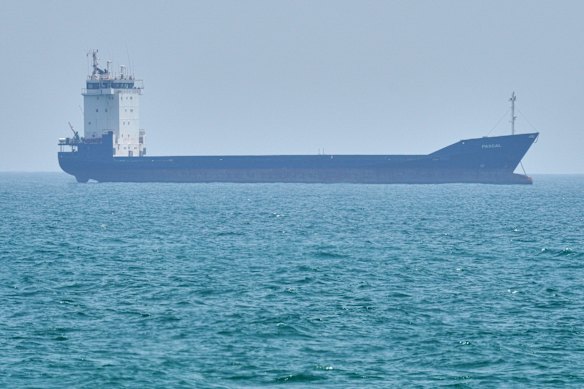
- The US has seized control of an Iranian container ship, Donald Trump says, after it tried to evade the American naval blockade of the Strait of Hormuz. Trump said the Navy ship “stopped them right in their tracks by blowing a hole in the engine room”.
- The US president also announced on social media earlier today that a delegation, including Vice President JD Vance, will travel to Pakistan on Monday (Washington time) for a second round of negotiations with Iran.
- However, Iran has not confirmed that it will participate in the talks, as state media reported that no agreement had been reached to attend the meeting.
- Trump also threatened strikes on Iranian power plants and bridges if a deal was not reached this week.
- Shipping remains at a standstill in the crucial Strait of Hormuz as Iran continues to enforce its blockade. Two tankers were forced by Iranian military forces to turn back on Sunday.
- Meanwhile, thousands of displaced Lebanese families are continuing to return home after a 10-day ceasefire that came into effect last Friday.
Oil, gas prices leap higher
Oil and natural gas prices soared after the US Navy seized an Iranian ship during a chaotic weekend that saw Tehran firing at vessels and reimposing controls in the Strait of Hormuz.
Brent jumped as much as 7.9 per cent, erasing most of its declines on Friday after a reopening of the key waterway was announced, while US oil jumped 7.2 per cent. European gas increased as much as 11 per cent. Tehran on Sunday (AEST) again closed the choke point, after it said a US blockade of Iran-linked ships violated a ceasefire agreement that ends this week.
President Donald Trump said the US Navy fired upon and seized the ship in the Gulf of Oman after it failed to heed warnings to stop as it left Hormuz, the first major encounter in the week-old blockade. The incident came hours after a back-and-forth over potential peace talks in Islamabad, with Trump saying he saw a chance for a deal and Iranians saying there was no “clear prospect” of an agreement.
“The market’s still carrying a risk premium into the deadline but just not fully committing to it,” said Haris Khurshid, chief investment officer at Karobaar Capital LP in Chicago. “If things just continue as they are, you probably see a gradual push higher to around $US105 [$147] to $US115, but with a lot of back and forth on headlines.”
The standoff over Hormuz – through which about a fifth of the world’s oil and liquefied natural gas flowed before the US-Israeli war on Iran began at the end of February – threatens to deepen the global energy crisis and is undermining Trump’s weekend prediction of a quick end to the conflict. The waterway is just one of the unresolved issues, which also include Iran’s nuclear capabilities and Israel’s ongoing invasion of Lebanon.
Bloomberg
Minister says peace talks welcome as Iran yet to confirm attendance
Transport Minister Catherine King says she welcomes the prospect of another round of peace talks between the US and Iran, after Trump announced a US delegation would visit Pakistan for negotiations.
“It’s good that the US is sending Vice President JD Vance for further talks, but this is really where the best diplomatic efforts are really going to be needed to resolve this [conflict].
“It’s volatile. It’s changing daily,” she told ABC’s News Breakfast this morning.
Iran has not confirmed whether it will participate in the talks, however, Iranian state media have reported.
Report: UAE discusses wartime ‘financial lifeline’ with US
The United Arab Emirates has begun talks with the US about a financial backstop in case the Iran war plunges the country into further crisis, The Wall Street Journal reported, citing US officials it did not identify.
UAE Central Bank Governor Khaled Mohamed Balama raised the idea of a currency swap line with Federal Reserve and US Treasury officials, including Treasury Secretary Scott Bessent, during meetings in Washington last week, according to the report.
The Emirati leaders said they have avoided the worst economic effects of the conflict but might still need a financial lifeline, the officials told the Journal.
The discussions underscore the UAE’s growing anxiety that the war could harm its economy and position as an international financial centre, draining foreign currency reserves and triggering capital flight, according to the WSJ. Emirati officials haven’t formally requested a swap line, the Journal said.
The war has inflicted damage on the UAE’s energy infrastructure and blocked oil shipments through the Strait of Hormuz, cutting off a critical stream of dollar income.
Bloomberg
In pictures: Tight security in preparation for US-Iran talks
Despite Iran not confirming it will attend a second round of talks with the US, the military in Pakistan were making preparations.
Here’s the scene in Islamabad as US officials including JD Vance prepare to fly to Pakistan.
Inflation, unemployment to worsen: Chalmers
Chalmers says he expects inflation, economic growth and unemployment to worsen.
“We do expect inflation to be higher, we do expect growth to be slower, and slower growth typically, not always but typically, means higher unemployment,” he said. “That’s what we’re dealing with to be upfront with you.”
However, he said Australia’s labour market, which has remained relatively resilient with unemployment at 4.3 per cent, would put the economy in good stead as the oil shock continues to play out.
“As we work through these consequences which are already serious and could become severe, we also have some very substantial advantages,” he said. “Our labour market is a source of considerable strength which is a good foundation from which to face all of this uncertainty.”
Chalmers keeps door open to extending fuel excise cut
Chalmers says the fuel excise cut will cost the federal budget about $2.5 billion, and has kept the door open to extending it, but says the government remains committed to finding savings.
“[The fuel excise cut] will be one of the bigger new spending items in the budget,” he said. [The budget] won’t be identical to what we were considering earlier in the year, but it will be ambitious. The savings package won’t be exactly the same as we might have been thinking a few months ago, but it will still be substantial.”
Chalmers said the fuel excise tax would be “temporary in one way or another”, but said all policies would remain under review.
Chalmers ducks questions on CGT discount
Treasurer Jim Chalmers will not confirm reports in this masthead that the government is actively considering changes to the capital gains tax discount.
“We haven’t taken any decisions on those policies,” he said in response to a question about what he could guarantee for people who own investment properties. “There’s more work to do on our options for tax reform in this budget.”
However, Chalmers said the government was assessing its options ahead of the budget.
“We have been really up front for some time now in saying that we do think that there is intergenerational unfairness in the tax system and in the housing market,” he said. “I think the housing market is where some of those intergenerational issues are most obvious, and so we are working through a range of options to see if we can deal with them or address them in a responsible way.”
Legislation being drafted for $1000 instant tax deduction
Chalmers has also announced the release draft legislation for a $1000 instant tax deduction for workers and “updated thinking” on the superannuation performance test.
“[The tax deduction] will cut back on paperwork, it’ll save time and money, it’ll provide a bit of tax relief as well,” he said. “It will benefit 6.2 million workers when they lodge a tax return next year. The benefit is up to $470 in the tax return, and it’s about $205 on average.”
The treasurer also said that while he had “absolutely no interest” in watering down or ditching the superannuation performance test, he would release details about the options available.
“There is no consensus here on the best way forward in the discussions that we’ve been having with the sector for some time. We would prefer a consensus, if one is possible, but at the very least, the paper that I’ll be releasing with Daniel Mulino soonish will give you an updated sense of our thinking here.”
Substantial savings to be delivered in NDIS: Chalmers
One of the most significant savings in the upcoming federal budget will be in the National Disability Insurance Scheme, Treasurer Jim Chalmers says.
Ahead of a speech by Health Minister Mark Butler at the National Press Club on Wednesday, Chalmers signalled the NDIS, which is estimated to cost about $49 billion this year, would be a centrepiece of his budget next month.
“[Butler] will provide more than the usual amount of detail in advance of the budget,” he said. “We need to make sure that [the NDIS] is sustainable, and that’s what our efforts are all about. This has been a really big part of our pre-budget deliberations. It is easily the most important part of the savings package that we will present on budget night.”
Chalmers attempts to soften blow ahead of budget delivery
Treasurer Jim Chalmers has signalled the federal budget will not deliver the savings or revenue the government anticipated a few months ago.
Speaking at a press conference in Canberra, Chalmers looked to soften the blow ahead of the federal budget next month as he comes under criticism for growing government spending.
“[The budget] won’t be exactly what we planned over the summer,” he said. “It would be strange if it was given how much has happened, particularly when it comes to these global developments. The savings package won’t be exactly the same as what we would have been contemplating over the summer, but it will be a substantial savings package.”
However, he said there would be tax reform, a productivity push, and some savings. “Cutting compliance costs is a big focus of the government and a big focus of the budget as well.”
Disclaimer : This story is auto aggregated by a computer programme and has not been created or edited by DOWNTHENEWS. Publisher: www.smh.com.au






