
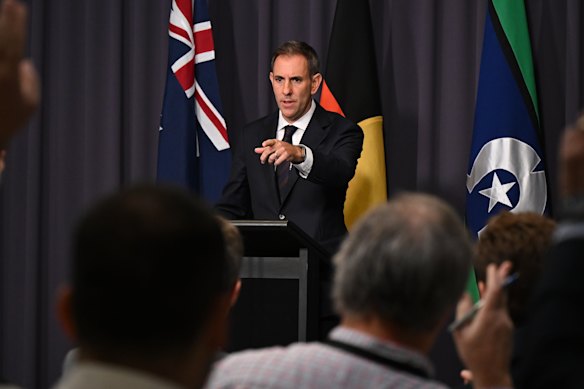
Treasurer Jim Chalmers has warned the National Disability Insurance Scheme is not affordable in its current form, laying the groundwork for major changes to the $50 billion program to become the central savings plank of next month’s budget.
Chalmers will try to keep backlash from the states at bay by holding an online meeting on Tuesday to brief treasurers about the NDIS overhaul that Health and Disability Minister Mark Butler will announce at the National Press Club in Canberra on Wednesday.
The states have regularly pushed back against the federal government’s request that they provide more disability services to ease pressure on the NDIS, fearing their own cost blowouts, and Queensland has not yet signed up to fund children’s early intervention despite agreeing to step up in a national cabinet deal.
Butler is expected to unveil changes to NDIS eligibility and plan budgets in the biggest reforms since the scheme was first launched 13 years ago. The NDIS has since become the federal budget’s third most-expensive item as it has expanded beyond forecasts to service 760,000 people, putting significant pressure on Labor to curtail spending amid broader economic pressures.
“The NDIS is growing too fast for Australians to afford. It’s about $49 billion this year. By the end of the forward estimates – not that far away – it’s about $62 billion,” Chalmers said at a Monday morning press conference.
“We are huge believers in the NDIS and massive supporters of the care that it provides Australians who need it … but in order to make sure that it is sustainable into the future, we have to deal with some of these escalating costs.”
This masthead first revealed the NDIS had firmed as the centrepiece of Labor’s budget savings earlier this month, as the war in the Middle East threw out the government’s plans. Chalmers on Monday confirmed the savings package had changed since summer because of the global uncertainty.
He said extraordinary economic volatility was also making it difficult to give precise forecasts and would hit the nation’s key economic indicators.
“We do expect inflation to be higher, we do expect growth to be slower, and slower growth typically… means higher unemployment,” he said.
“The key factors which will determine whether we get a bit more inflation or a lot more inflation, a bit less growth or a lot less growth, will be how long the war continues, how long it takes to reopen the [Strait of Hormuz] … and how long it takes for the global economy to get back to something that looks a little bit more like normal.”
But the NDIS has remained a central focus. Chalmers said hours of deliberations between ministers had preceded decisions, which will seek to bring the scheme’s annual growth rate to 6 per cent or lower after having ballooned by as much as 22 per cent a year when Labor came into government.
“It is easily the most important part of the savings package that we will present on budget night,” he said.
Butler earlier this month said the government was deliberating over restricting the number of people eligible for the scheme, constraining people’s plans, or doing both.
He has promised to consult Australians with disabilities, but many NDIS participants have since expressed fears about the government’s commitment to consultation and keeping the scheme’s foundational principles of choice and control.
Stakeholders are preparing for eligibility changes that would divert many children with mild or moderate support needs, as well as people with disabilities caused by mental illness, from the scheme over the four-year forward estimates.
The federal and state governments have already agreed to spend $10 billion establishing new “foundational supports” outside the NDIS for those groups of people when they signed a national cabinet agreement in December 2023. The new Thriving Kids program for children should be operating by 2028, although the government has not yet announced plans for people with mental illnesses.
By formally announcing eligibility changes, which would come into effect when the foundational supports are up and running, the government would in next month’s budget be able to revise down the long-term costs of supporting thousands of participants.
Butler has also flagged changes to how people use their NDIS plans. He has not ruled out limiting how many therapy appointments people can make each year. This would invite backlash from many participants and allied health professionals, but the minister has previously expressed scepticism about the way individual therapies are delivered through the scheme.
He could also curtail the way people access social and community participation, a service that covers a range of supports, from helping people build social skills to support workers taking them to the movies. It costs $12 billion overall and grew about 30 per cent in the last two years.
The government is expected to include a mandatory provider registration regime — just 6.5 per cent of the scheme’s 277,000 operators are currently registered – that would adjust requirements according to risk. Several disability organisations have also been pushing for a tiered pricing system.
George Taleporos, the independent chair of the Every Australian Counts group that first campaigned for the NDIS, said he wanted Butler to be honest about his plans and demonstrate he was willing to listen to disabled Australians before decisions were made.
“Our community is deeply worried about funding cuts, more red tape, and changes that make it harder for us to get the essential support that we need. We fear being pushed off the NDIS towards mainstream services that do not exist,” he said.
“We are worried that the government will force us to use inflexible registered providers that can’t meet our needs. And people with the highest support needs are terrified of being pushed into group homes that are unsafe and would put our lives at risk.”
Chalmers said he understood these conversations around the NDIS were difficult.
“They’re not just difficult because there’s a lot of dollars attached to them. They’re difficult because we all come at this with a lot of goodwill. You know, we all want to do the right thing here. I’m a huge believer in the NDIS,” he said.
“The primary motivation in our efforts is continuing to provide that high standard that people need and deserve.”
 Natassia Chrysanthos is Federal Political Correspondent. She has previously reported on immigration, health, social issues and the NDIS from Parliament House in Canberra.Connect via X or email.
 Shane Wright is a senior economics correspondent for The Age and The Sydney Morning Herald.Connect via X or email.
From our partners
Disclaimer : This story is auto aggregated by a computer programme and has not been created or edited by DOWNTHENEWS. Publisher: www.smh.com.au




