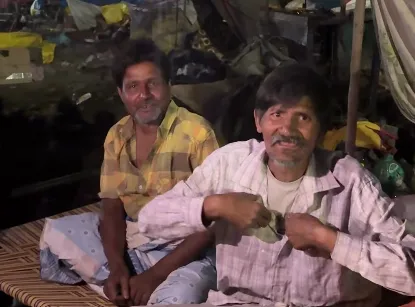
On the afternoon of April 15, a fire broke out in Lucknow’s Vikas Nagar, a densely populated settlement where migrant and daily wage workers have built their lives over the years. What began as a sudden blaze quickly spread through the narrow lanes, jumping from one makeshift home to another, leaving little time for residents to gather their belongings.
By the time the flames were brought under control hours later, nearly 300 homes had been gutted. Residents also reported hearing a series of explosions as LPG cylinders caught fire, intensifying the blaze and making it harder to control.
For many, the fire took away shelter and erased years of effort, savings, and stability in a single day. Amid the chaos, families ran in different directions, trying to escape the thick smoke and rising heat. Some attempted to salvage documents or small valuables, while others barely managed to get out with their lives. Thick smoke billowed across the area as multiple fire tenders were deployed, with teams working for hours to bring the situation under control.
When Reshma called her employers that day, her voice was trembling.
A domestic helper working in nearby homes, she had been part of the Vikas Nagar community for years. Like many others, she had slowly built a life for herself, saving what she could, keeping aside essentials, and holding on to important documents that defined her identity and security.
But in a matter of hours, all of it was gone.
“She lost everything. Her savings, jewellery, documents, even basic household items,” says Abdul Saboor, founder of the Madad Karona Foundation. “And her story is not unique. Almost every family here is going through the same loss.”
based in Lucknow, stepped in to provide immediate relief.
Reshma is one among nearly 1,000 residents who have been displaced by the fire. The settlement, home to migrant workers and daily wage earners, was a close-knit community where people supported one another through everyday struggles. Today, that sense of community is being tested in ways no one could have anticipated.
While fire officials worked tirelessly to contain the blaze, the immediate priority for authorities was to prevent it from spreading further. But once the flames were extinguished, another challenge emerged: helping hundreds of families navigate the aftermath. The exact cause of the fire is still under investigation.
The on-ground reality
Speaking with The Better India, Saboor shared, “When we reached the site, we saw people standing outside what used to be their homes, trying to understand what had just happened. There was shock, confusion, and a deep sense of loss.”
It was in these moments that local efforts began to take shape.
Madad Karona Foundation, a grassroots organisation based in Lucknow, stepped in to provide immediate relief. For Saboor and his team, the need of the hour was not just emergency response, but restoring a sense of stability for families who had lost everything.
“The fire may have been contained, but the crisis was far from over,” he says. “People had nothing left, not even food for the next day.”
In the days following the incident, volunteers began organising essential supplies and focusing on items to help families through the immediate aftermath. Ration kits were among the first forms of support to reach households, each containing basic staples such as wheat flour, rice, dal, cooking oil, sugar, salt, and biscuits.
Each kit costs approximately Rs 818 to assemble, and is designed to help a family access essential food supplies in the days following the disaster.
These kits may seem simple, but for families who have lost access to even the most basic necessities, they represent the ability to cook a meal, to feed children, to regain a small sense of routine amid uncertainty.
“Right now, the goal is to make sure no one has to sleep hungry,” Saboor explains. “When everything else is uncertain, food becomes the first step towards rebuilding a sense of normalcy.”
But food is only one part of the recovery.
As the days pass, new needs continue to emerge. Families require utensils to cook, bedding to sleep on, and basic hygiene products to maintain dignity. Children, many of whom lost their school supplies in the fire, need stationery to return to some semblance of normal life.
/filters:format(webp)/english-betterindia/media/media_files/2026/04/20/screenshot-2026-04-20-175240-2026-04-20-17-53-48.png)
as LPG cylinders caught fire, intensifying the blaze
and making it harder to control.
There are also less visible losses, such as the savings set aside for a wedding, money kept for medical emergencies, or small investments made over years of hard work. For daily wage earners, these were not just financial assets but lifelines for the future.
“Some families had been saving for years,” Saboor says. “That money was meant for important milestones, education, healthcare, and building a better life. Losing it overnight is devastating.”
In response, the foundation is gradually expanding its efforts beyond immediate food relief. Volunteers are working to collect and distribute essential household items, while also identifying families who may need more targeted support. These include utensils, bedding, electric fans, sanitary products, toiletries, and medicines.
At the same time, temporary shelters have been arranged in nearby schools, offering families a place to stay as they begin to piece their lives back together. But the emotional toll of the disaster remains significant.
And yet, amid the loss, there is also a powerful sense of solidarity. From neighbours helping one another sift through debris, to individuals stepping forward to contribute what they can, the response has been deeply community-driven. It is this collective effort that is helping families take their first steps toward recovery.
For Saboor, this is what keeps the work going.
“It’s the people who make this possible,” he says. “Every small contribution, every act of support, it all adds up.”
Today, the focus is not just on relief, but on rebuilding, helping families move from immediate survival to long-term recovery. It is a process that will take time, patience, and sustained support.
For those who wish to be part of this effort, the Madad Karona Foundation continues to coordinate relief efforts on the ground.
A contribution of Rs 818 can help provide a ration kit to a family, while additional support goes towards other essential supplies and targeted assistance for affected households.
Those who wish to contribute or support specific families can reach out to:
Saboor also shared that people can reach out directly if they wish to support individual families, especially those who have lost savings meant for important life events.
For Reshma and hundreds of others, the road ahead is uncertain. But in the midst of devastation, there is also reassurance, that even in moments of profound loss, they are not alone.
Because sometimes, rebuilding begins not with what is lost, but with who shows up.
Editor’s note: This report is based on information provided to The Better India by Abdul Saboor, founder of the Madad Karona Foundation, along with inputs from local volunteers at the site.
Disclaimer : This story is auto aggregated by a computer programme and has not been created or edited by DOWNTHENEWS. Publisher: thebetterindia.com