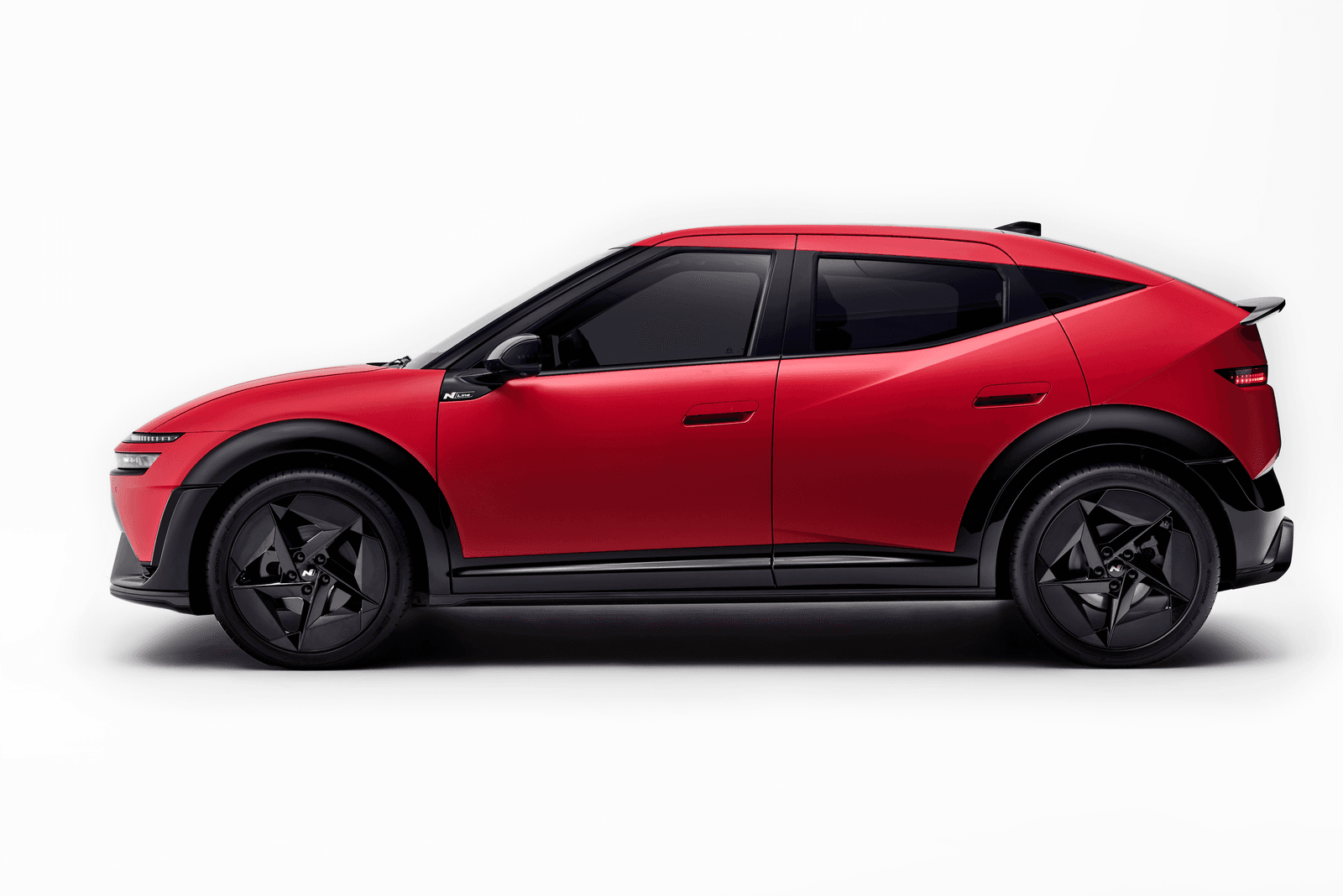
Hyundai has unveiled its Ioniq 3, a fully electric compact hatchback for urban driving designed to be as aerodynamically efficient as possible yet still offer up a surprisingly spacious interior—a trick the carmaker is loftily calling “Aero Hatch.” The 3 is intended to fill the gap between Hyundai’s Inster supermini and Ioniq 5 crossover.
In profile, the Ioniq 3 has a sleek front-end that transitions into a roofline that stays straight over both front and rear occupants before dropping to merge with the rear spoiler. It’s this roofline that maximizes interior headroom for the rear passengers, but it also offers a supposed class-leading drag coefficient of 0.263.
The car has the same underpinnings as its sibling brand, Kia’s EV2. Two battery options will deliver a projected WLTP distance of 344 km (around 214 miles) for the Standard Range Ioniq 3; the Long Range version is supposedly good for a competitive 308-mile range. Built on the group’s Electric-Global Modular Platform (E-GMP), the car has a 400-volt architecture to lower costs, rather than the 800-volt system of the Ioniq 5 N, 6, or 9 SUV. Still, this means that if you can find sufficiently fast DC charging, you can, in theory, top up from 10 to 80 percent in approximately 29 minutes (AC charging capability is up to 22 kW).
This is fine, but it is not a match for BYD’s new Blade 2.0 battery tech that WIRED tried, astonishingly allowing the Denza Z9 GT to charge its battery in just over 9 minutes from 10 percent. True, that battery tech was in a $100,000 “premium” EV, but it’s coming to BYD’s wider models, too. And if BYD makes good on its plans to deliver a charging network to rival Tesla’s Supercharger, then very soon buyers will be expecting comparable charge times, and 30 minutes will quickly feel awfully long.
I asked José Muñoz, Hyundai Motor Company President and CEO, whether this new battery technology from BYD concerns him, whether Hyundai—leading the EV pack with 800-volt architectures for so long—needs to match the Blade 2.0’s performance. “We welcome the challenge,” Muñoz tells me. “Every challenge is an opportunity to do better. And I can tell you that, lately, we have a lot of opportunities to do better.”
“We are also working on fast charging,” Muñoz says, adding that Hyundai’s success will be built on not merely one leading technology, but many. “There are not more elements that may be offered by the Chinese that we can offer. It’s only a matter of how you mix them. A lot of times, you get stuck into one indicator. I’m an engineer. And we always have the example of the airplanes: What is more important in an airplane, altitude or speed? There is only one answer. You need to achieve both.”
Speaking of speed, the front-wheel-drive Ioniq 3’s electric powertrains will give up to 107.8 kW (147 PS) and 250 Nm of torque, and a top speed of 106 mph. And while, sadly, there is no planned high-performance N version, you can spec the car with a similar N-Line aesthetic, pictured here.
Looking inside, the Ioniq 3, revealed at a brand-hosted event in Milan (WIRED paid for its own travel expenses), will be Hyundai’s first European model with its Pleos Connect infotainment system based on Android Automotive OS. You get a 12.9-inch screen for access to vehicle functions, navigation, and connectivity, but can upgrade this to an almost outsized 14.6-inch display. Hyundai has wisely kept physical switchgear for functions such as seat heating, air conditioning, and volume control.
The flat floor improves cabin space, and Hyundai claims three adults in the rear can sit comfortably side by side. There’s also a surprisingly generous luggage capacity of 441 liters, complemented by what Hyundai calls its “Megabox”—a concealed storage space beneath the trunk floor big enough to fit an entire suitcase.

Additional optional interior extras include relaxation seats, heated and ventilated seating, a Bose sound system, and ambient LED lighting. You also get digital key access from a smartphone or a wearable such as a smartwatch. As with all other modern Hyundais, the Ioniq 3 gets Vehicle-to-Load (V2L) capability, for powering household appliances and the like, with sockets for this on both the interior and exterior.
As for assisted driving systems, this EV gets the brand’s Highway Driving Assist 2, which is Level 2 autonomy helping manage speed, distance, lane centering, and automated lane changes on highways. Remote smart parking assist, memory reverse, blind-spot monitoring, and seven airbags come as standard.
This new urban Ioniq is available to buy in Europe from September, but there’s no word on pricing just yet. You can expect around £25,000 (about $33,800). It will be made in Türkiye for Europe, but sadly, it will not be coming to the US.
However, competing in a crowded European market with the likes of the Volkswagen ID 3, Kia’s EV2 and EV3, the Volvo EX30, and BYD’s Dolphin, plus a battery technology possibly very soon to be eclipsed by BYD’s latest kit, the Ioniq 3 will be trading heavily on Hyundai’s design smarts here, as well as the considerable brand value already gained from its much-admired 5 and 6 N models.
Disclaimer : This story is auto aggregated by a computer programme and has not been created or edited by DOWNTHENEWS. Publisher: wired.com