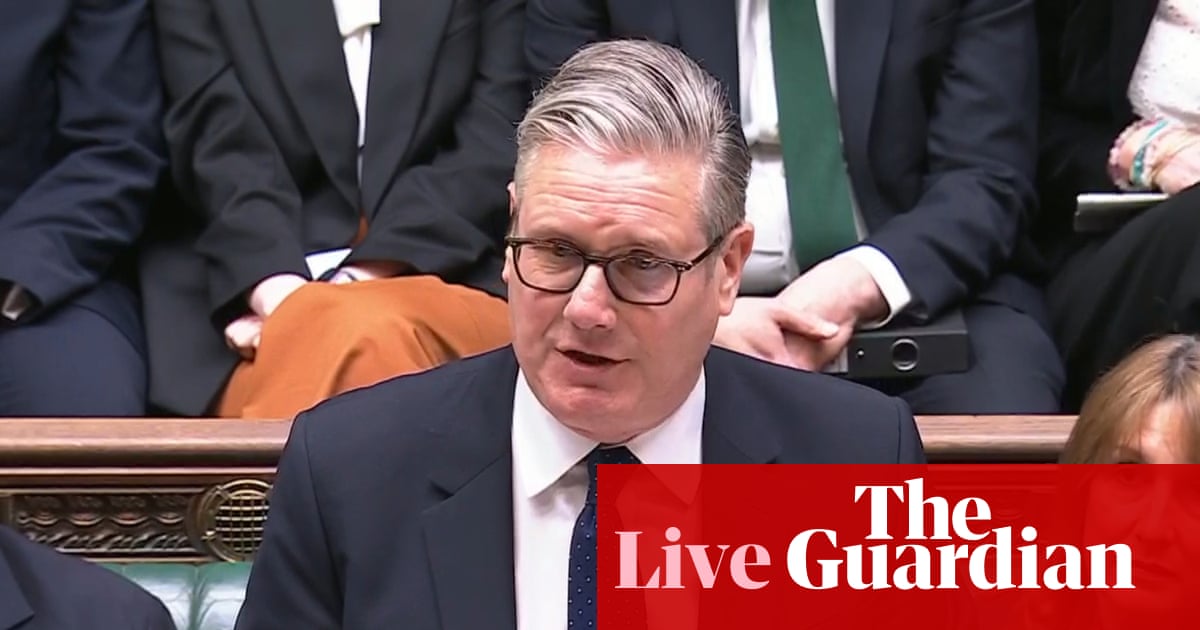
Starmer went on:
Many members across the House will find these facts to be incredible.
That generated lots of ironic jeering from opposition MPs.
Starmer went on:
I can only say they [the MPs jeering] right. It beggars belief that throughout the whole timeline of events, officials in the Foreign Office saw fit to withhold this information from the most senior ministers in our system, in government.
That is not how the vast majority of people in this country expect politics, government or accountability to work. And I do not think it’s how most public servants think it should work either.
I work with hundreds of civil servants, thousands all of whom act with the utmost integrity, dedication and pride to serve this country, including officials from the Foreign Office who, as we speak, are doing a phenomenal job representing our national interest in a dangerous world in Ukraine, in the Middle East and all around the world.
This is not about them, but yet it is surely beyond doubt that the recommendation from UKSV that Peter Mandelson should be denied development and clearance was information that could and should have been shared with me on repeated occasions, and therefore should have been available to this House and ultimately to the British people.
Mark Francois (Con) asks Starmer to confirm that he had asked if Mandelson failed his vetting, and who he asked.
Starmer said he was told that Mandelson was given vetting clearance.
Ellie Chowns (Green) said Starmer should resign.
What’s really staggering and unforgivable is that [Starmer] appointed Peter Mandelson … knowing about his friendship with the paedophile Jeffrey Epstein. What’s unforgivable is that the prime minister was more concerned with pandering to Donald Trump than with standing with the victims and survivors …
Will he take personal responsibility for his staggering and unforgivable errors of judgment and resign?
Starmer said it was unbelievable that he was not told.
Neil Duncan-Jordan (Lab) says Starmer covered process in his statement. He went on:
Surely, Prime Minister, the real issue is why, when Peter Mandelson’s reputation was already known, was he ever considered for such an important role?
Starmer says he accepts the appointment was wrong.
Lisa Smart (Lib Dem) asks Starmer again to explain why he ignored Simon Case’s advice. (See 4.51pm.)
Starmer said that he thought he had followed the advice, because Mandleson’s appointment was subject to vetting being approved. He said when Chris Wormald, the then cabinet secretary, looked at this process in September, he concluded that the process had been followed in line with what Case recommended.
(Starmer’s answer seems to miss the point, implicit in Case’s advice, which was that, once an appointment gets publicly announced, it becomes much harder for political reasons to accept a vetting decision saying the appointment should not go ahead.)
Andrew Mitchell, the former Tory cabinet minister, said Robbins was “a fine and experienced civil servant” who should not be made to take the blame.
Starmer said he lost confidence in Robbins because he did not share the vetting information. But, he went on:
That doesn’t mean [Robbins] hasn’t got a distinguished career. He does have a distinguished career.
Oliver Dowden, the former Tory deputy PM, asked Starmer what Olly Robbins told him when Starmer said he should have been told about the vetting decision. Dowden said that senior officials try to deliver on the wishes of ministers. He suggests that Robbins was trying to help Starmer because he knew Starmer wanted the appointment to go ahead.
Starmer said Robbins has had “a distinguished career”. He said that Robbins’ view was that he was not allowed to give this information to the PM.
But Starmer said he does not want to put words into Robbins’ mouth. Robbins will explain his position tomorrow, he said.
One of Kemi Badenoch’s six questions for Keir Starmer was about Mandelson remaning a director of a Russian defence firm after the invastion of Crimea. See 4.10pm.
She has now answered her own question – posting another extract from the documents released under the humble address mechanism showing that this issue was flagged up to Starmer as a result of the Cabinet Office vetting process (which was different from the UKSV vetting – the main focus of this hearing).
She said:
It’s quite clear from this document the Prime Minister was told this in November 2024.
He didn’t want to answer my question…because HE KNEW.
He was told.
Yet he appointed Mandelson anyway putting our national security at risk.
Julian Lewis, (Con), a former chair of the intelligence and security committee, asked Starmer if he asked Olly Robbins why he did not tell ministers about Mandelson failinng the vetting interview.
Starmer replied:
I did ask him and I didn’t accept his explanation. That’s why I sacked him.
Stephen Flynn, the SNP leader at Westminter, said Starmer was just blaming others. He went on:
The prime minister blames all of this, all of it, on the judgment of others. But I’m interested in his judgment. Does he believe himself to be gullible, incompetent or both?
Starmer said he did not accept that.
Karl Turner (Lab) told Starmer that “ex post facto vetting” for political appointments was pointless. He asked what Starmer was doing to regain the public’s trust.
Starmer said he did not accept Turner’s point about vetting. And, on public trust, he said:
It is important that we remain focused on the cost of living and on dealing with the war on two fronts that we face in this country.
David Davis, the former Tory cabinet minister, asked why Starmer did not follow Simon Case’s recommendation about ensuring security vetting took place before the appointment was confirmed. (See 12.34pm.)
Starmer said he thought Mandelson’s appointment was subject to security vetting being confirmed. He was told that was the standard process.
Lee Anderson, the Reform UK, told Starmer that no one believed him, not the public, nor opposition MPs, nor Labour MPs. “Does the prime minister agree with me he’s been lying?”
Lindsay Hoyle, the speaker, told Anderson he would have to withdraw that. Parliamentary rules do not allow MPs to call each other liars.
Anderson said he wouldn’t. He went on:
I will not withdraw. That man couldn’t lie straight in bed.
Hoyle told Anderson to leave, which he did.
Jeremy Wright (Con), a member the intelligence and security committee, asked for information relevant to vetting to be handed over it in the first tranche of information it was considering. (The ISC is scrutinising Mandelson material required to be published by the humble address on behalf of parliament, so that material that would pose a national security risk gets held back.) Wright says the ISC did not learn about Mandelson failing to the vetting interview until the story was published by the Guardian on Thursday last week. He asked why Starmer did not tell the committee as soon as he found out on Tuesday.
Starmer says he was going to tell the committee. He wanted to get all the facts first, he said.
John McDonnell (Lab) said he welcomed Starmer’s apology. He went on to claim that, when Keir Starmer wanted to become Labour leader, he became dependent on Morgan McSweeney and Peter Mandelson to organise and fund his election. He went on:
When he became prime minister, the reward for McSweeney was control of No 10 and, for Mandelson, the highest diplomatic office.
And the message, that unspoken message to civil servants, was what Mandelson wants. Mandelson gets.
He said Starmer should clear this “toxic culture” out from Labour. And he called for an inquiry into Labour Together, the thinktank that was founded by McSweeney and subsequently criticised for smearing journalists writing critically about it.
Simon Hoare (Con), chair of the public administration and constitutional affairs committee, said he did not understand why nobody asked what had happened in the light of David Maddox’s story in the Independent last September. (See 11.44am.)
Starmer said questions were asked.
The FCDO was repeatedly asked … The same answer came back because a clear decision have been taken that this information was not going to be disclosed and it wasn’t as close to me, let alone to anybody else.
The Labour MPs Diane Abbott said Peter Mandelson had a history of being sacked for scandals going back to the 1990s. She went on:
It’s one thing to say, as [Starmer] insists on saying nobody told me, nobody told me anything, nobody told me. The question is, why didn’t the prime minister ask?
Ed Davey, the Lib Dem leader, also linked Keir Starmer to Boris Johnson. He said that, when Johnson was PM, Starmer said the public wanted honesty and accountability. Davey went on:
I’m afraid the fact that [Starmer] even had to make the statement today shows how badly he has failed, how badly he’s let down the millions of people across our country who are so desperate for change.
UPDATE: Davey said:
The prime minister knew that appointing Mandelson was an enormous risk, he decided it was a risk worth taking – a catastrophic error of judgment, and now that it’s blown up in his face, the only decent thing to do is to take responsibility.
Back in 2022, the prime minister rightly accused Boris Johnson of expecting others to take the blame while he clung on. That was not acceptable then, and it’s not acceptable now …
After years of chaos under the Conservatives, we needed a government focused on the interests of the people – the cost of living crisis, the health and care crisis, our national security. We needed a government of honesty, integrity and accountability. So will the prime minister finally accept that the only way he can help to deliver that is to resign?
Disclaimer : This story is auto aggregated by a computer programme and has not been created or edited by DOWNTHENEWS. Publisher: theguardian.com