
Golf instruction is ever-evolving, but the best advice stands the test of time. In GOLF.com’s series, Timeless Tips, we’re highlighting some of the greatest advice teachers and players have dispensed in the pages of GOLF Magazine. Today, we look back at our December 1979 issue for a deep dive into how your body should move to initiate your downswing.
The backswing gets everything organized, but the downswing is where the magic happens. From the top of the backswing to impact, what the club is doing is incredibly important. If something gets out of whack in this section of the swing, there is little hope for squaring the club at impact.
The order in which you move each part of the body has a huge impact on how this happens. This sequencing helps with efficiency and consistency, which ultimately makes the game much easier.
But while there are some rules that need to be followed for maximum efficiency, that doesn’t mean every swing is exactly the same. Every golfer’s body moves in unique ways, which has an impact on how they can best swing the club.
One such impact area is the initial downswing move, which GOLF Magazine explored in a 1979 issue by then-instruction editor Ernie Vossler. Check it out below to learn more about how you should initiate your own downswing.
How to initiate the downswing
You’ve completed your backswing. You have paused for a fraction of a second to change directions. Now you’re going to make your first move down. What should that first move feel like? What should it actually be?
Put these questions to top Tour stars, teaching professionals or amateurs and you’re likely to get as many different keys, tips or feel descriptions as the number of golfers polled. What works for some golfers doesn’t work for others.
The fact is that the proper first move down depends entirely on the type of swing you have.
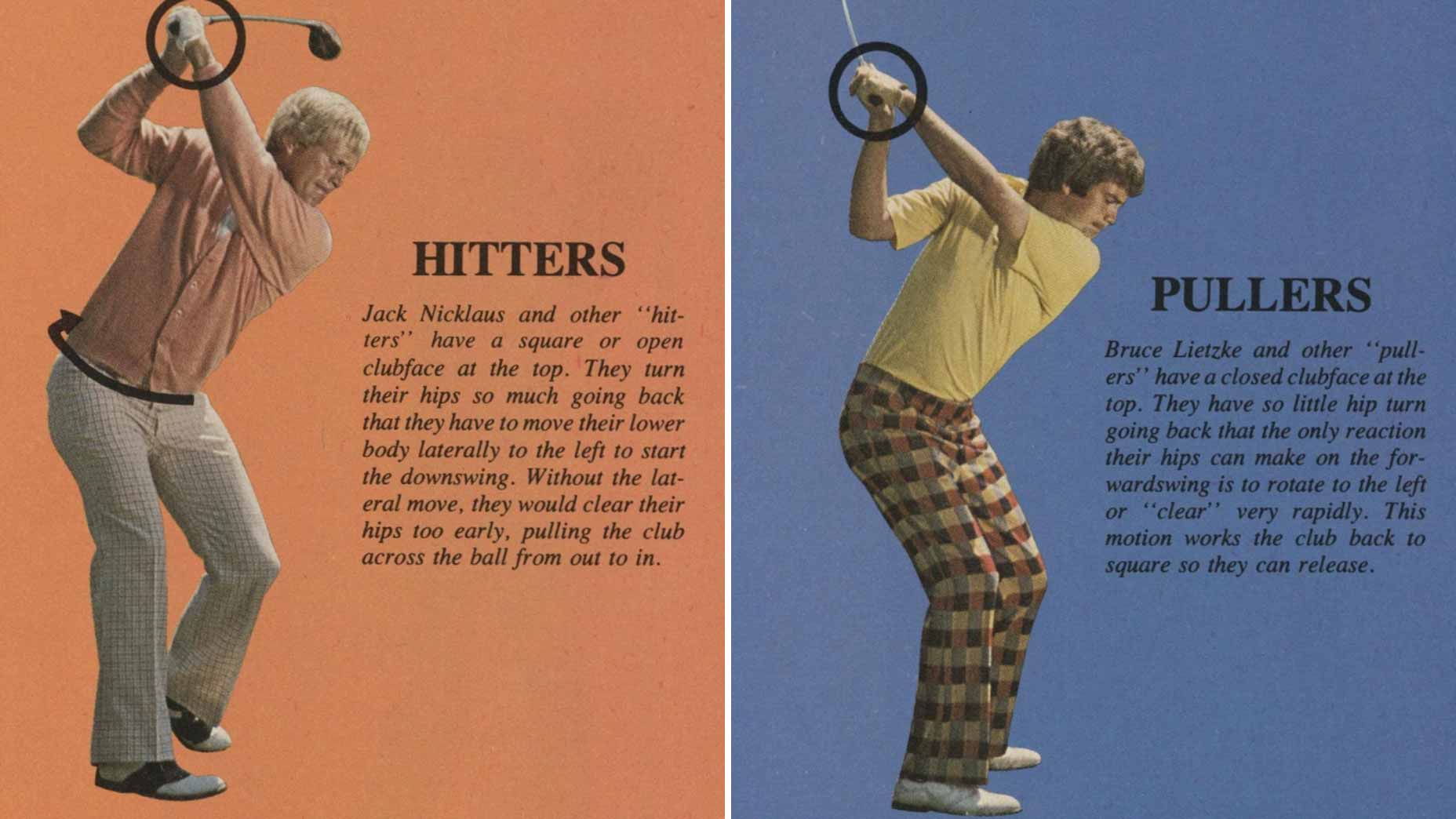
Broadly speaking, there are two categories of golfer. One type is the “hitter,” who has a square or open clubface at the top of the swing. On the forward swing, all he has to do is “hit” or release so that he works the club back from that open position to a square position at impact and then to a closed position in the follow-through. To be more precise, the “hitter’s” club will be in a “toe up” position halfway into the forward swing. From there he begins to roll his right forearm over his left so that waist-high in the follow-through the toe of the club again points straight up. That’s releasing.
The second type is the “puller.” At the top of the swing, this golfer has the clubface to some degree closed. On the forward swing, this golfer has to pull from the left side in order to work the clubface from a closed position back to square before he can release the club.
Now let’s examine these two swing types in more detail. Then we’ll discuss the first moves down for each.
GOLF Magazine
Hitters and pullers
Because the fine line between “hitters” and “pullers” depends on clubface position at the top, let me clarify the terms “open” and “closed.”
If you extend the fingers of your left hand so that the back of the left hand is in line with the left forearm, then make a fist, as though you were going to hold a club, you will notice a small angle between the back of the hand and the forearm. Your hand is now in the “square” position. Now, with your hand still in a fist, move the back of your hand toward the top of your forearm as far as you can; you have gone from square to a fully “open” position. Then, continuing to hold the fist, move the back of the left hand from square to where the left wrist is in line with the forearm. Although this straight line position is commonly accepted as square, it is actually slightly “closed.” The completely closed position finds the left wrist in as convex a position relative to the forearm as you can achieve.
If you’re square to open at the top of your swing, you’re a “hitter;” if closed to any degree, you’re a “puller.” You can determine which type of swing you have by checking yourself in a mirror or by asking a friend to check you at the top of your swing.
The “hitter” has a big shoulder turn going back. He has some or no forearm rotation to the right, depending on whether he’s to some degree open or perfectly square at the top. (In other words, the forearm rotation or lack of it is the direct cause of the clubface position at the top.) However, his most important backswing characteristic, in regard to the first move down, is his big hip turn. Study any of the “hitters” on Tour, including Jack Nicklaus, Tom Watson, Hale Irwin and Gil Morgan. You’ll see that the “hitter” turns his hips so far in the backswing that he must move the lower body laterally to the left to start the downswing. This allows him to hit from inside, to square at impact, and back to the inside. Without this initial, lateral move, the “hitter” would clear the hips too early in the forward swing. He would pull the club across the line from out to in and slice or pull.
The “puller” also has a big shoulder turn going back. He has a little forearm rotation to the left, if his left wrist is in line with his left forearm at the top, and has more of this type of rotation if his wrist position at the top is convex. (Again, the forearm rotation directly causes the ultimate top-of-the-swing position.) However, as with the “hitter,” the important point is hip action. The “puller” — Lee Trevino, Larry Nelson, Bruce Lietzke and David Graham are examples — has very little hip turn going back. He turns his shoulders, but holds his hips and closes the clubface. On the forward swing, the only reaction his hips can make is to rotate to the left or “clear” very rapidly.
This clearing motion is mandatory for the “puller.” Because he has closed the clubface going back, he has to reverse that position in the forward swing, and the only way to do that is to subordinate the right side and “pull” with the left side by a clearing motion of the hips. For the first two-thirds of the downswing, the “puller” reverses the clubface back to square, then goes ahead and releases normally. However, this late release does require much more strength and more precise timing than the action of the “hitter,” who can start releasing the moment he begins his forward swing.
Disclaimer : This story is auto aggregated by a computer programme and has not been created or edited by DOWNTHENEWS. Publisher: golf.com









