
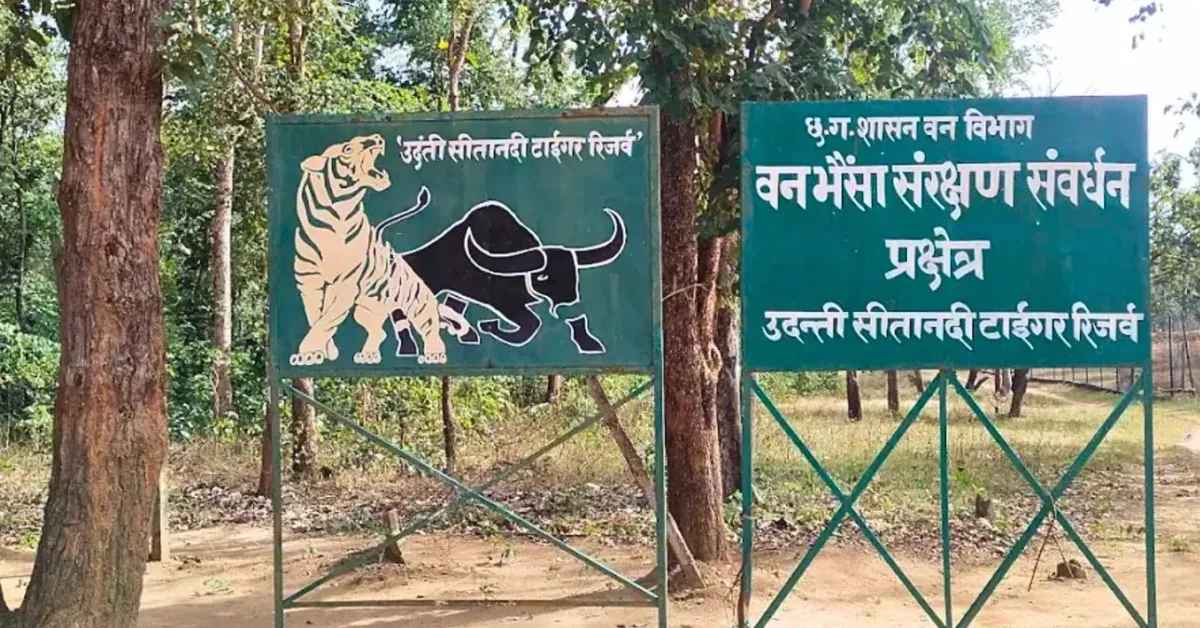
As the first rays of sunlight fall on the thick sal forests of Udanti-Sitanadi Tiger Reserve, the jungle slowly comes alive. Birds call out from treetops, leaves crunch softly under unseen movement, and fresh pugmarks on the forest floor hint that wildlife has already passed by.
It’s calm, alive, and full of quiet excitement — the kind that makes you pause and look a little closer. For years, these forests have held stories of elusive wildlife — but now, they’re also telling a new story: one where the people who live closest to nature are becoming its strongest protectors.
When communities become custodians
Conservation efforts often struggle when local communities are left out of the equation. But here, in the forests near Raipur, a shift is underway. The Udanti-Sitanadi Tiger Reserve (USTR) in Gariaband has launched a community-based eco-tourism initiative that puts villagers at the heart of conservation.
Under this initiative, residents have been appointed as ‘Goodwill Ambassadors’. These are not just titles — they come with real responsibilities.
From guiding tourists through forest trails to sharing knowledge about wildlife and local ecosystems, these ambassadors are becoming the bridge between visitors and the forest.
It’s a simple but powerful idea: when communities benefit from conservation, they are more likely to protect it.
Boosting sightings through shared responsibility
One of the most encouraging outcomes of this initiative has been a noticeable rise in wildlife sightings, including some rare and fascinating species.
In recent years, joint efforts by the forest department and local communities have led to more frequent sightings of the Indian skimmer, the Indian giant squirrel, the Indian pangolin, and the peregrine falcon — known as the world’s fastest flying bird.
/filters:format(webp)/english-betterindia/media/media_files/2026/04/21/udanti-sitanadi-tiger-reserve-2026-04-21-12-45-14.png)
These sightings are especially significant as they reflect a healthier, more secure habitat.
With villagers actively involved in protecting the forest, disturbances have reduced and awareness has increased. Their presence acts as a constant support system for conservation on the ground.
The result is clear: wildlife is returning, moving more freely, and even drawing visitors from far-off places, creating a positive cycle where conservation and eco-tourism strengthen each other.
Livelihoods rooted in conservation
Beyond conservation, the initiative is also opening up new avenues for income — something that is often a missing piece in wildlife protection efforts.
Eco-tourism, when done responsibly, can create sustainable livelihoods. Here, villagers are earning through guided tours, hospitality services, and other tourism-related activities. Instead of relying only on traditional or uncertain sources of income, they now have an opportunity that aligns with protecting their surroundings.
/filters:format(webp)/english-betterindia/media/media_files/2026/04/21/udanti-sitanadi-tiger-reserve-2026-04-21-12-33-15.png)
The programme is also designed to create structured employment pathways. Community members are being encouraged to train as nature and safari guides, with registrations being streamlined through the reserve’s official platform so that tourists can easily book guides and experiences online. This not only formalises their work but also ensures a steady flow of opportunities.
In fact, specific tourism sites are being developed to support this model. At Kulhadighat, the Indian Skimmer Tourism site will be led by a local community leader, with plans for activities like kayaking and other visitor facilities. Such efforts are expected to generate more local jobs and reduce the need for migration to other states in search of work.
This shift is important. It reduces pressure on forest resources while improving economic stability for families.
More importantly, it changes how the forest is seen — not as a restriction, but as a shared resource that supports both people and wildlife.
A model worth watching
What’s unfolding in Chhattisgarh is a reminder that conservation works best when people are part of it.
/filters:format(webp)/english-betterindia/media/media_files/2026/04/21/udanti-sitanadi-tiger-reserve-2026-04-21-12-37-47.png)
By involving locals as stakeholders, the Udanti-Sitanadi initiative is building a model that is inclusive and practical. It recognises that those who live closest to the forest understand it deeply and, when given the opportunity, can help protect it in meaningful ways.
There’s still a long road ahead, but the early signs — increased sightings, better livelihoods, and stronger community ownership — are promising.
Back in the forest, a villager-turned-guide walks a group of visitors along a quiet trail, pointing out bird calls and animal signs along the way. Somewhere nearby, unseen but present, the forest continues to thrive and this time, it’s not just surviving — it’s being cared for, together.
Sources:
‘Guardians of the green: USTR turns villagers into wildlife ambassadors’ by Partha Behera for The Times Of India, Published on 14 April 2026.
‘Udanti-Sitanadi tiger reserve: Villagers appointed as ‘Goodwill Ambassadors’ by CG Khabar, Published on 15 April 2026.
Disclaimer : This story is auto aggregated by a computer programme and has not been created or edited by DOWNTHENEWS. Publisher: thebetterindia.com



