Kallas sticks to the earlier line, as she says she expects “positive movement” on the loan in the next 24 hours.
She says:
“We must continue to give Ukraine what it needs to hold its own. And its own until Putin understands that this war leads nowhere.
Following Hungarian elections, there is a new momentum, and I expect the positive decision on the 90 billion loan in the next 24 hours.”
… and so on that note, it’s a wrap for today!
-
Ukraine’s president Volodymyr Zelenskyy told EU leaders that “Ukraine has delivered on what was requested by the European Union” to unblock the critical €90bn loan for Kyiv (17:24, 18:08).
-
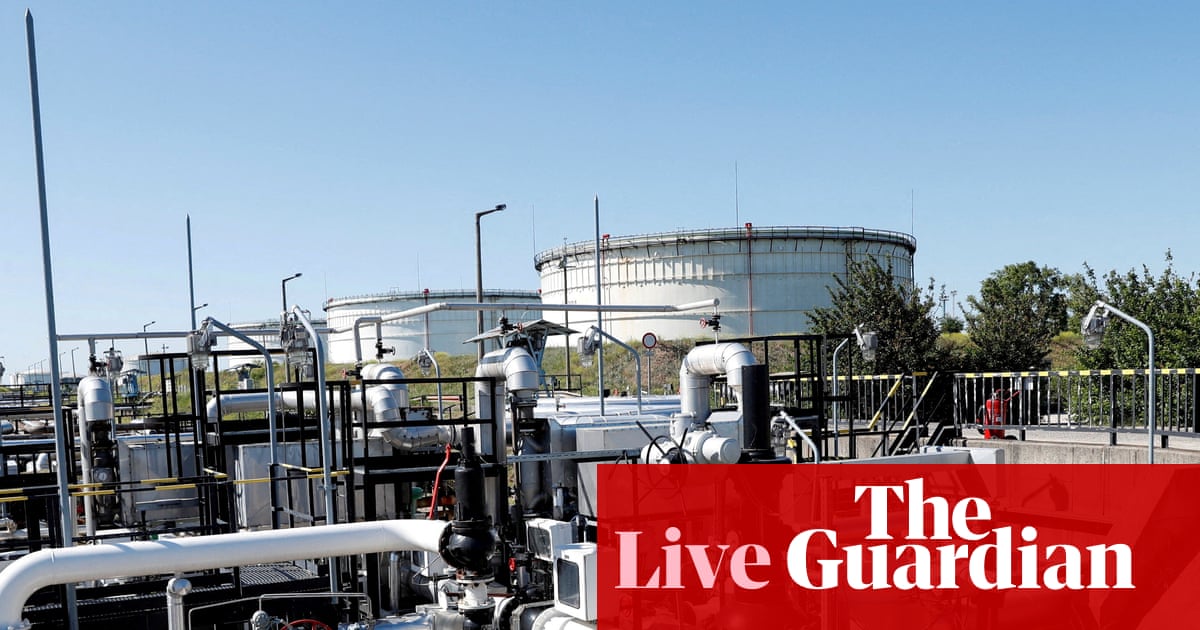
He confirmed the Druzhba pipeline transporting oil to Hungary and Slovakia was fixed and could become operational after months of disruption caused by a Russian airstrike earlier this year (16:32) – but stopped short of confirming that the oil was actually flowing.
-
The much-awaited news prompted the EU’s foreign policy chief, Kaja Kallas, to say “a positive decision” on the €90bn loan could be reached in the next 24 hours (17:26).
-
There has been no public comment from Hungary so far, the main country blocking the disbursement of the loan, but Kallas said that last week’s parliamentary election showed “a new momentum” to revisit “long-blocked decisions” (17:26, 17:28).
-
The issue is expected to come up during tomorrow’s meeting of EU ambassadors in Brussels, who could sign off the loan after months of delays, but there are some outstanding questions about the political sequence of the decision that is needed to progress the loan (12:39, 16:35).
In other news,
-
EU foreign ministers did not decide to accept Spain, Ireland and Slovenia’s request to suspend all of parts of the bloc’s association agreement with Israel, despite growing frustration with its actions in the Middle East (16:26).
Elsewhere,
-
The EU’s highest court has found Hungary’s anti-LGBTQ+ law to be discriminatory, stigmatising and in breach of basic democratic values, setting up an early test for the incoming prime minister Péter Magyar’s government when it takes power next month.
If you have any tips, comments or suggestions, email me at jakub.krupa@theguardian.com.
I am also on Bluesky at @jakubkrupa.bsky.social and on X at @jakubkrupa.
Looks like the finish line for this four-month saga on the €90bn loan could be in sight.
Let’s see how it all ends, as we will no doubt hear from the Hungarian and Slovak governments sooner rather than later if a deal is to be agreed tomorrow.
But things are clearly afoot as Zelenskyy has now posted a readout from his call with the European Commission’s president, Ursula von der Leyen, too.
In it, he repeated that “all necessary steps on Ukraine’s side have been taken,” as he said that the €90bn loan for Ukraine “will strengthen not only Ukraine but all of Europe, and it is important that we begin receiving [these funds] soon.”
He then added:
“We also addressed other European issues. It is entirely fair to open negotiation clusters on our EU membership – technically, Ukraine is already fully prepared. It is equally fair to continue maintaining sanctions pressure on Russia – Europe’s determination in adopting new sanctions steps is crucial, given the weakening of some existing restrictions. We agreed to examine these matters in detail and coordinate the next steps during our meeting.”
It looks like others journalists are trying, just as I am, to figure out who specifically we are waiting for to move right now.
And, erm, I don’t think there’s a clear answer.
When asked who holds the leverage in the process, Kallas gives a rather confusing answer, but ultimately says that the EU needs to get rid of Russian energy imports more broadly to not “give them this revenue, whether its via Druzhba or any other means.”
Guess we will have to wait how the process unfolds tomorrow, when the EU ambassadors meet again to discuss this issue.
The 24 hour clock starts now.
Asked about details of what she expects to happen on Ukraine, Kallas confirms that “we expect an agreement in 24 hours.”
“I don’t want to jinx it. I hope that everything goes well, because we have seen some [twists and] turns in this file, but this is the agreement that we had in December and resuming [the flows] is a promise that Ukraine made, so hopefully all the obstacles are removed.”
After a follow-up question she says she doesn’t know if the oil flows already or when it will flow, but says there was a clear promise from Ukraine to get it flowing – and given Zelenskyy has confirmed that everything else is ready, there’s a chance to break the deadlock now.
Kallas also talks about Israel, saying that some countries requested “a full or partial” suspension of the EU association agreement or restrictions on trade.
She says there was no unanimity needed to progress on this issue.
“The measures that we have already on the table that require qualified majority will require states shifting their position,” she added.
On the Middle East, Kallas calls for the next round of talks to happen at all cost, warning that “if the fighting resumes tonight, it will come at the very large cost for all.”
In particular, she says that Lebanon “is paying a heavy price for a war it did not choose.”
She says that it’s “non-negotiable” that the freedom of navigation should be restored, and “Europe will play its part in restoring the free flow of energy and trade once the conditions allow.”
She adds:
“We should also revisit long blocked decisions, including opening negotiation clusters with Ukraine, also the European peace facility weapons fund. Also, we should revisit sanctions that have been on the table and not agreed before. But also, we should move on with the new sanctions package.”
Kallas sticks to the earlier line, as she says she expects “positive movement” on the loan in the next 24 hours.
She says:
“We must continue to give Ukraine what it needs to hold its own. And its own until Putin understands that this war leads nowhere.
Following Hungarian elections, there is a new momentum, and I expect the positive decision on the 90 billion loan in the next 24 hours.”
OK, the EU’s Kallas is now here.
Let’s see what he says.
In the meantime, Ukraine’s Zelenskyy posted another update after his phone call with the president of the European Council, António Costa.
He said the pair discussed the unblocking of the loan, and “Ukraine has delivered on what was requested by the European Union.”
Let’s stand by for a confirmation from the EU – or Hungary/Slovakia – that the oil is flowing, then.
Zelenskyy also then added:
“António also noted our security agreements with countries in the Middle East and the Gulf region. The Ukrainian system for protecting lives, which we are offering to partners in the Drone Deal format, is truly unique. We have already begun this cooperation with several European countries as well.
We agreed to continue discussing this topic during an in-person meeting in the near future. It is important that Europe remains united and protected.”
The EU’s foreign policy chief Kaja Kallas is about to speak to the media after today’s meeting of the bloc’s foreign ministers, so let’s see if she can help us understand the process a bit more.
I will bring you her words as soon as she arrives.
It remains to be seen what Zelenskyy actually means when he says there is a “connection” between the pipeline and the loan.
If he simply means that there’s a link between the two things, sure. That’s obvious.
But if it’s about the exact sequence of ending the current standoff that he would like to see, it could make things a bit awkward. After all, he says the pipeline “can” resume operation – and not that it has resumed.
Hungary’s outgoing and incoming prime ministers suggested that Ukraine should stop political games, and just get on with the restart. “If on the Ukrainian side the Druzhba pipeline is ready for oil shipments, then they should kindly reopen it as they had promised,” Péter Magyar told reporters yesterday.
Both he and Viktor Orbán suggested that the pipeline needs to resume its operations first for them to drop Budapest’s veto on the €90bn loan package for Ukraine. Slovak prime minister Robert Fico also suggested that’s the only right sequence of events.
But Zelenskyy’s comments drawing a “connection” between the two issues could be interpreted as a way of saying he wants the loan to progress first.
With EU ambassadors expected to meet to discuss the issue again tomorrow, let’s see what will come first: the resumption of oil flows, or the lifting of the veto.
It feels like a tiny, technical details that surely should easily get resolved given the stakes, but considering how little trust is there between the partners, it’s one to watch.
Meanwhile, Ukraine’s president Volodymyr Zelenskyy said that Ukraine “has completed repair work” on the Druzhba oil pipeline, which can now “resume operation,” potentially paving the way for the crucial €90bn EU loan for Ukraine to be finally released.
“Although no one can currently guarantee that Russia will not repeat attacks on the pipeline infrastructure, our specialists have ensured the basic conditions for restoring the operation of the pipeline system and equipment,” he said.
But he added:
“We connect this with the unblocking of the European support package for Ukraine, which had already been approved by the European Council. We also hope our partners will take the necessary steps regarding the EU [accession] negotiation clusters for Ukraine – we have already fulfilled our part of the work on the first clusters.”
Zelenskyy also added:
“In addition, we must continue systematic sanctions pressure on Russia over this war and work on further diversifying energy supplies to Europe. Europe must be independent from those who seek to destroy or weaken it.”
Speaking of Italians, Antonio Tajani is one of the first to leave the EU foreign ministers’ meeting in Luxembourg.
On the Middle East, he says the ministers discussed the need to restore freedom of navigation in the strait of Hormuz, and to push for an end to the conflict.
But he added that the suggestion to suspend the trade part of the EU’s association agreement with Israel was “put aside.”
“Italy is against stopping the agreement. We need to put pressure [on Israel], but [this] is not the solution. We need to study other solutions,” he added in English, pointing to the Italian government’s decision to suspend its defence deal with Israel.
On Ukraine, he asked for a comment from his junior minister Maria Tripodi, and she said there was a “commitment” to unblock the €90bn loan for Ukraine.
“I don’t know how long it will take, but I believe we are moving towards continuing our support for Ukraine,” Tajani said.
Meanwhile, Italian prime minister Giorgia Meloni said her government was prepared to make changes to a contested plan offering financial rewards to lawyers who help with migrants’ repatriations, even as she stood by the broader idea.
Under draft legislation set to be approved by parliament this week, lawyers assisting migrants with voluntary repatriation would receive state money, but only if the procedure is successfully completed, Reuters reported.
The measure has been denounced as unconstitutional by lawyers and judges’ associations, and has raised concerns from the country’s president Sergio Mattarella, who can refuse to sign legislation on constitutional grounds.
Meloni, who has headed a right-wing coalition in power since 2022, acknowledged that her government had received “technical observations” on the bill from the presidency and lawyers, which would be taken into account in a separate piece of legislation.
But Reuters noted that the measure is part of a so-called Security Decree which must receive final approval by the lower house of parliament by April 25, or else lapse. If it were amended, the upper Senate would also have to vote on it.
“There are no time margins … to correct the decree,” Meloni said, without elaborating on future amendments. “We are going ahead with rules that we consider to be of absolute common sense.“
Associate editor, film
Martin Scorsese’s documentary about Pope Francis is to have its world premiere in the Vatican today as one of a set of events commemorating the first anniversary of Francis’s death.
The screening of the film, titled Aldeas, The Final Dream of Pope Francis, is being staged by Scholas Occurrentes, an international organisation aiming to “to encourage social integration and the culture of encounter through sports, arts and technology”, which was set up in Argentina by Francis in 2001 while he was Archbishop of Buenos Aires, and made into a foundation when he became pope in 2013.
Scorsese announced the film, which he has co-directed with Johnny Shipley and Clare Tavernor, shortly after Francis’s death in April 2025, saying it would contain the pope’s last in-depth on-camera interview.
Originally titled Aldeas – A New Story, the film will outline Scholas Occurrentes’ Aldeas “community cinema movement” which Francis described before his death as “go[ing] to the roots of what human life is, human sociability, human conflicts … the essence of a life’s journey”.
At the time Scorsese said: “Now, more than ever, we need to talk to each other, listen to one another cross-culturally … It was important to Pope Francis for people across the globe to exchange ideas with respect while also preserving their cultural identity, and cinema is the best medium to do that.”
The screening comes at a time of increasing tension between the US government and the papacy, after Pope Leo appeared to criticise the US and Israel’s attack on Iran. President Donald Trump attacked Leo in a social media post, and posted an image of himself as a Jesus-like figure, which was later deleted, while vice-president JD Vance said “the pope [needed] to be careful when he talks about matters of theology”.
Scorsese and Francis met a number of times, with Scorsese initiating an increasing number of religious-themed projects in recent years, including Silence, his 2016 adaptation of Shūsaku Endō’s novel about Jesuit missionaries in Japan, and his 2024 TV series The Saints.
Disclaimer : This story is auto aggregated by a computer programme and has not been created or edited by DOWNTHENEWS. Publisher: theguardian.com