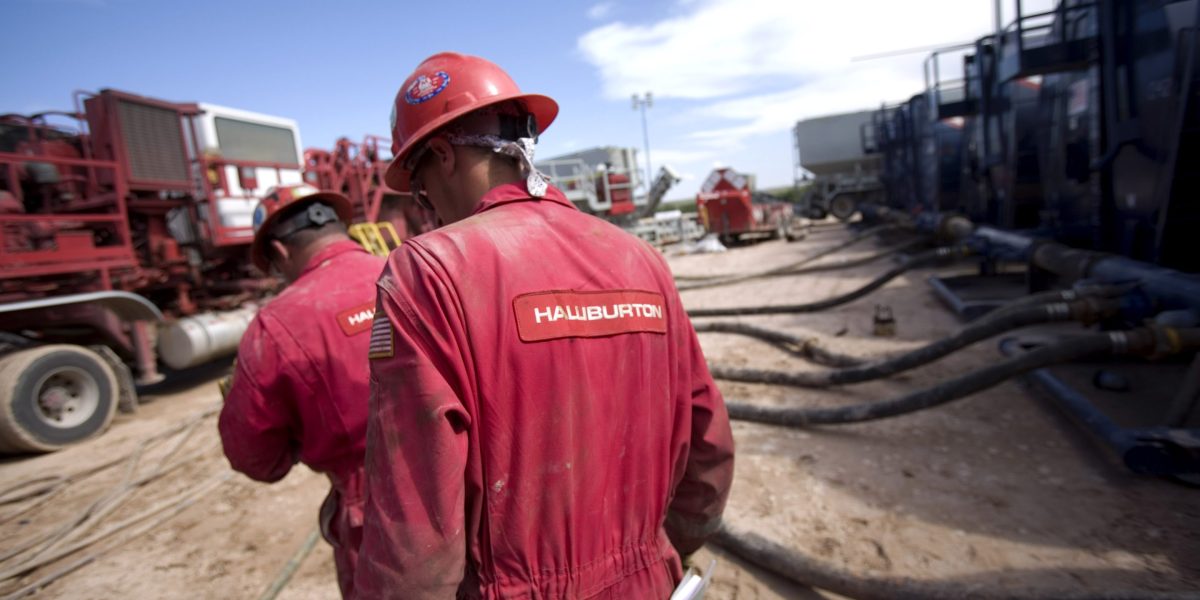
The U.S. oil sector has entered the “early innings” of a rebound with more growth to come, Halliburton chairman and CEO Jeff Miller said Tuesday, explaining that the Iran war is forcing countries to prioritize energy security by capturing more barrels both domestically and from other regions outside the Middle East.
Amid the pain of higher prices at the pump and in supply chains, there are bright spots for oilfield services companies like Halliburton, which conducts drilling and fracking work (hydraulic fracturing), as oil production ramps up around the world to make up for disruptions caused by the war and the standoff over the pivotal Strait of Hormuz, through which some 20% of global energy supplies flow.
Miller kicked off the first earnings season for the industry since the war began by arguing that the sector has fundamentally shifted—at least for a “few solid years”—with elevated prices and a push to rely less on the Middle East. This is the case even if a deal is reached soon to reopen the Strait of Hormuz choke point, Miller said.
“In North America, we already see the early signs of recovery. Outside of the Middle East, we expect our international business to grow,” Miller said, specifically citing growth in South America and Africa. “Equally important is the view that energy security is no longer [just] a talking point. That’s going to drive activity, and I think that change is not temporal.”
Indications that a ramp-up of U.S. oil supply is ahead
U.S. oil production hit a record high of more than 13.8 million barrels last year, but the volumes plateaued and even decreased slightly amid a global glut of crude oil before the Iran war.
Commodity prices are expected to remain higher—even if they come down from their current levels—into 2027 and perhaps beyond because of supply-chain shocks, logistical problems, heightened geopolitical and insurance risks, and the prolonged timelines for Middle Eastern nations to repair infrastructure and restart their oil and gas supplies.
While drilling activity and production volumes have not yet ramped up in the U.S., there’s an early indicator that they will: Smaller oil producers—the typical first movers—already are hiring more fracking fleets and keeping drilling rigs contracted for longer.
“We’re in the early innings, and big public companies typically would come later in that cycle,” Miller said. “The early movers are the smaller companies, but that’s an important move because that early move by small operators is what takes [fleet] capacity out of the market and creates [equipment] tightness.”
As the world entered 2026 expecting an oversupply of oil, more companies were expected to cut back on their contracted drilling rigs and fracking fleets. Instead, they have largely held steady. And Halliburton, which feared less work—more “white space” on the calendar—is now virtually booked in full through the second quarter, and the back half of the year is quickly filling up, said Halliburton chief operating officer Shannon Slocum.
“I am excited about North America. We see a recovery in progress,” Slocum said. “There are just really constructive conversations about getting back to work and grabbing the value that’s out there, not only now but for the future.”
The global impact of the Iran war
Since the beginning of the war, the world has cumulatively lost more than 600 million barrels of oil and is “trending towards 1 billion,” Miller said.
“This represents several years of meaningful, incremental demand to replace strategic reserves on top of what I believe will be continued structural demand growth,” Miller argued.
Halliburton specifically highlighted major growth prospects in South America—in Argentina, Brazil, Suriname, and Guyana—as well as in Africa, including Namibia and Nigeria. Miller expressed bullishness on a rebound in Venezuela as well, which is in the process of opening back up to more international investment again after the U.S. arrest of former leader Nicolás Maduro.
“We’re making progress in Venezuela. I spent some time there,” Miller said. “We’re having great discussions with customers. We’re talking about commercial terms. Our facilities there are in better shape than I expected. Clearly, that is an opportunity. There’s work to do without question. I think some of that work comes faster than others, but we’re really, really pleased to be back in Venezuela and have Venezuela back in business.”
Halliburton reported first-quarter net income of $461 million, up from $204 million year over year. The company touted that its growth outpaced losses from Middle East disruptions in March.
Halliburton’s operations were hit hardest in Iraq and Qatar, although operations also were impacted in Saudi Arabia, Kuwait, and the United Arab Emirates, Slocum said.
“Halliburton’s operational footprint is intact. Most of our business is working today,” Slocum said of the Middle East. “We’re in constant contact with our customers and there to support them when they’re ready and able to go back to work.
“The thing you’ll start seeing first moving is probably just turning back on wells,” Slocum said. “That would be a well-by-well situation of how they produce and how they flow. The longer they get shut in, the more complex that gets. But we’re ready, and it will just take time to figure that out.”
Disclaimer : This story is auto aggregated by a computer programme and has not been created or edited by DOWNTHENEWS. Publisher: fortune.com